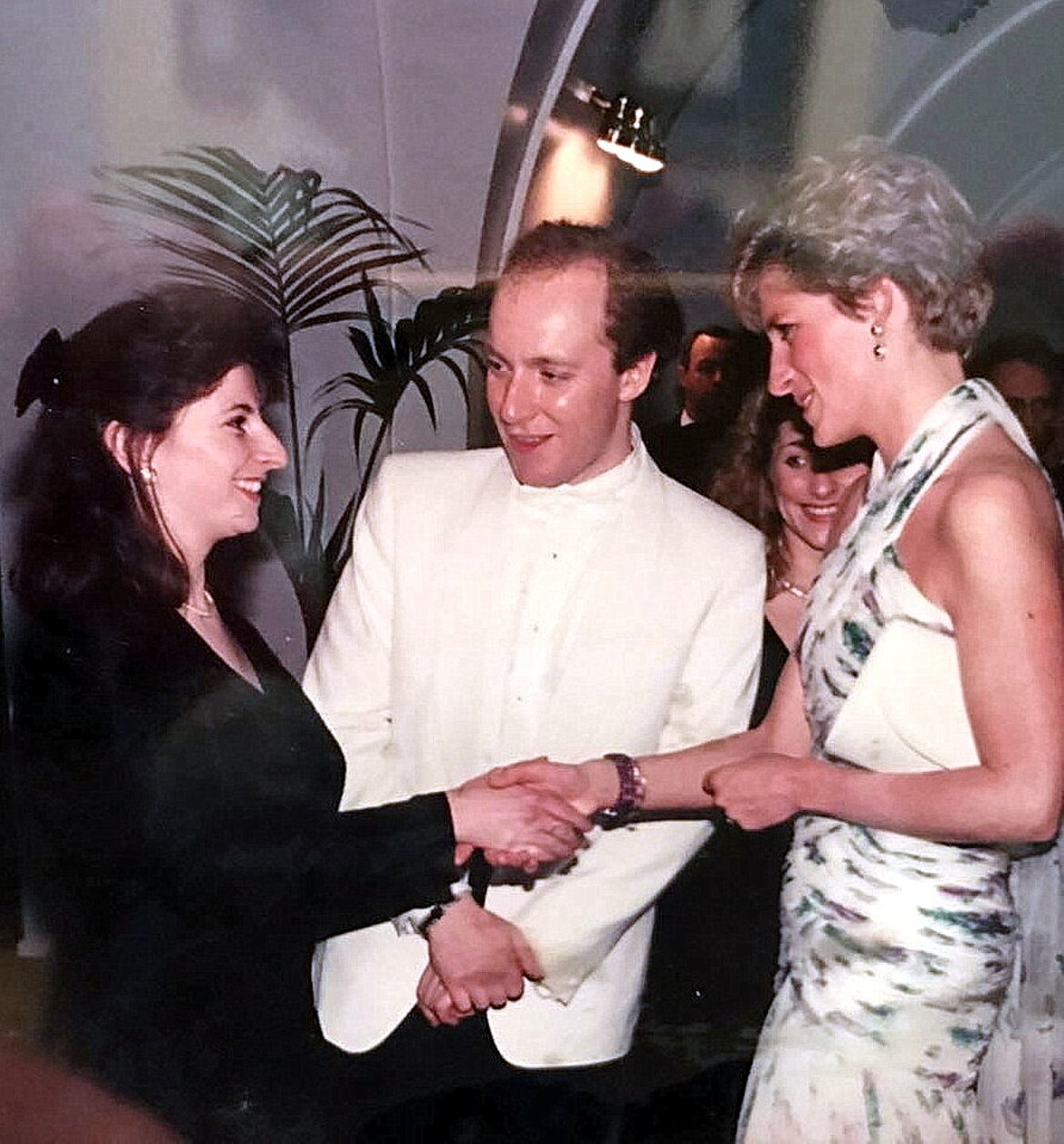
Beverly Wescott, second violinist with the BBC National Orchestra & Chorus of Wales, greets Princess Diana after a concert.
Wescott: "My violin, which is 41 years old, was made for me by Wanna Zambelli, a teacher at the International School of Violin Making in Cremona and the leading Italian violin maker." Photo: © Beverly Wescott Archive
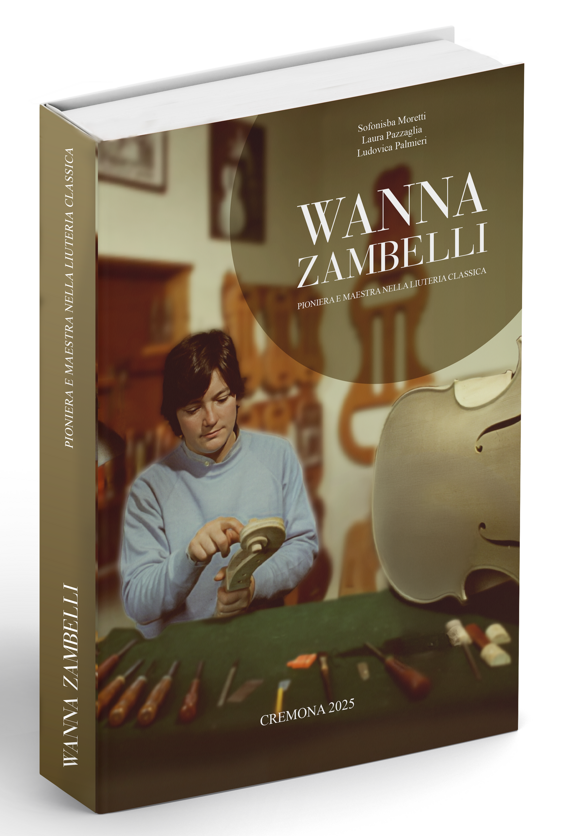
Wanna Zambelli
Pioneer and master in classical violin making
by Sofonisba Moretti
Milan, 2025
"Working with love?... / Work is love revealed. / If you cannot work with love, but it repels you, / leave it, it is better to sit at the door of the temple / to receive alms from those who work with joy".
Gibran Kahlil Gibran, Lebanese poet and painter
Extract from the book «Wanna Zambelli. Pioneer and master in classical violin making» by Sofonisba Moretti, Laura Pazzaglia and Ludovica Palmieri. Milan, 2025
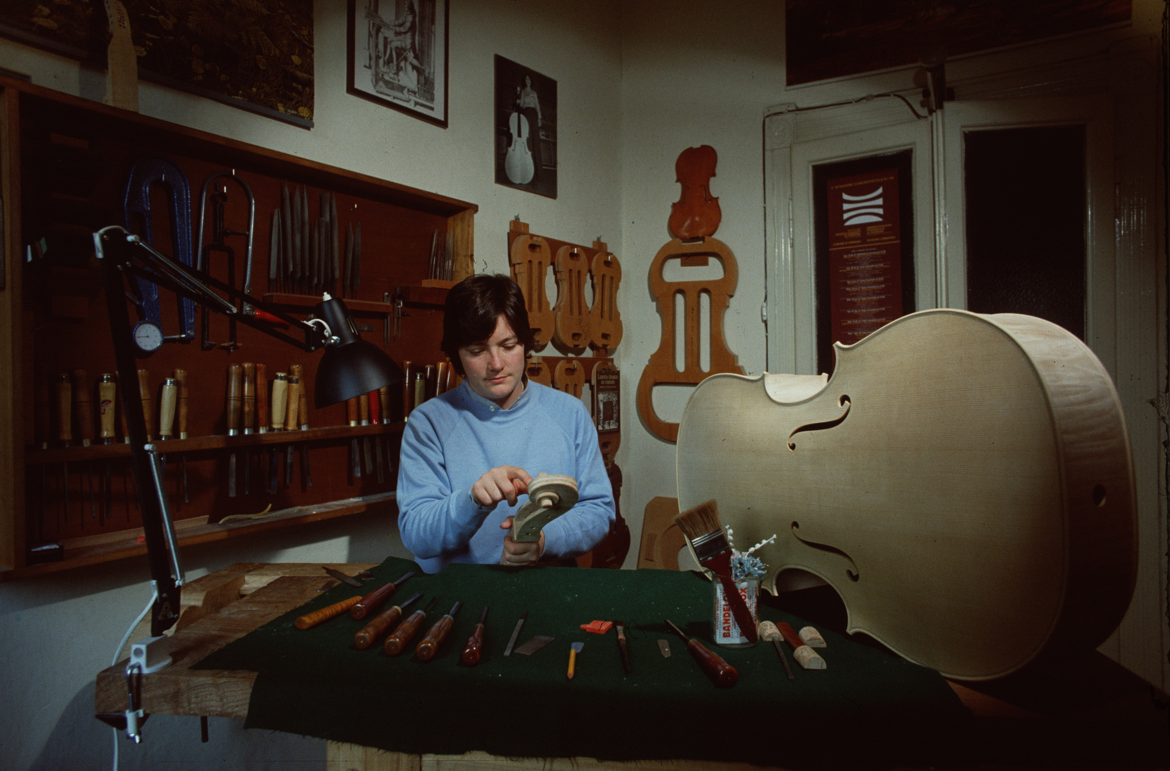
Wanna Zambelli at her workbench in her workshop. Cremona, January 1983. Photo: © 1983 David Lees, «Zambelli's Studio», gettyimages
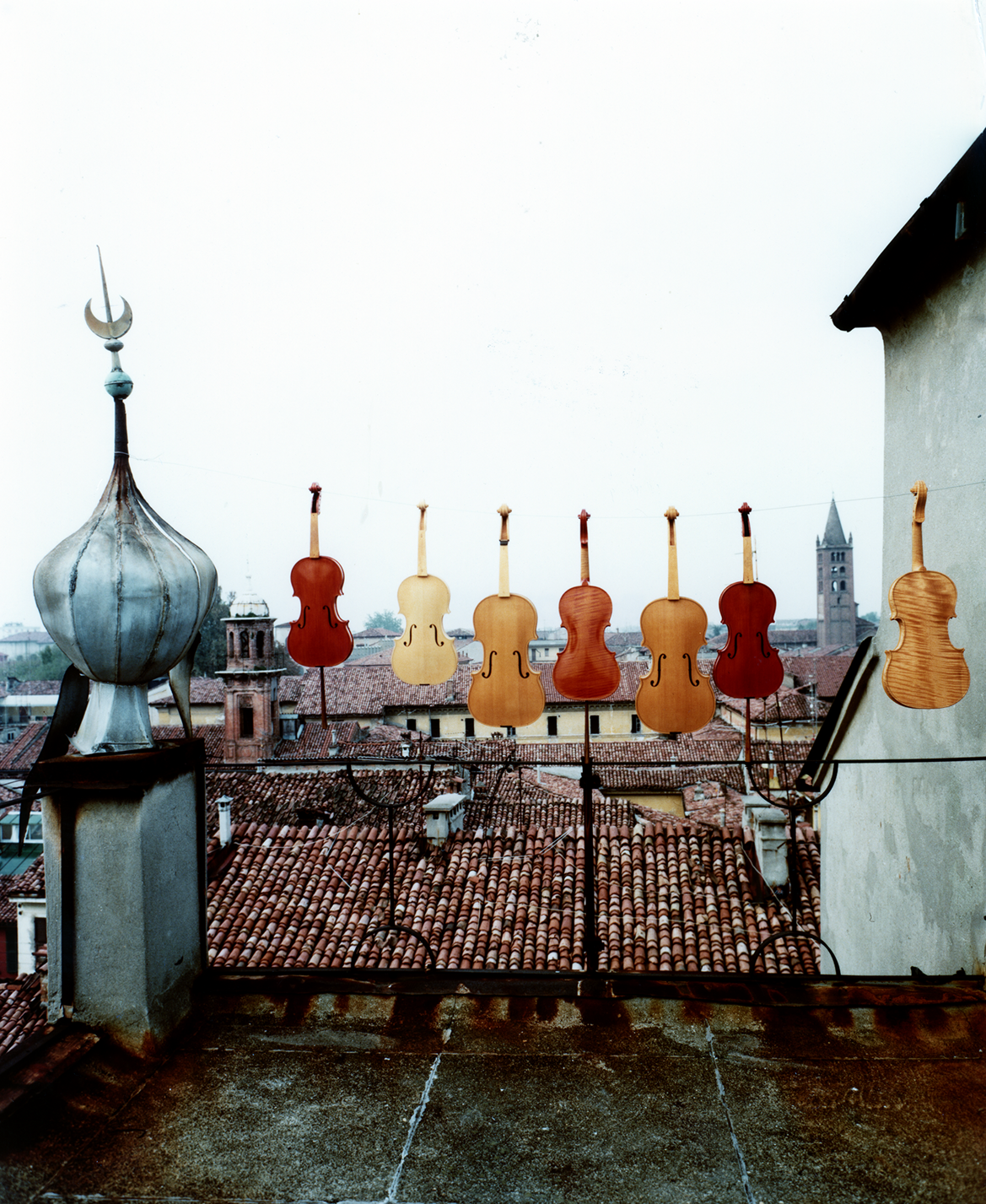
Violins hanging on the roof terrace of master violin maker Francesco Bissolotti in Cremona, in whose workshop Wanna Zambelli perfected her post-diploma training from 1972 to 1975. Photo: © Ezio Quiresi,Cremona (Zambelli Archive)
Early years and training: the birth of a luthier
Cremona, a city steeped in history and melody, is universally recognised as the cradle of violin making, a centuries-old art that has immortalised legendary figures such as Antonio Stradivari and Giuseppe Guarneri del Gesù. In this context of artisanal excellence, Wanna Zambelli emerges as a prominent figure in the contemporary Cremonese violin-making scene. Her story is marked by a significant first: she was the first Italian woman (third in the world, after the Swiss Linda Hediger and the French Claudie Biteur) to graduate from the prestigious International School of Violin Making in Cremona, an achievement that not only testifies to her passion and dedication, but also marks a crucial moment in the evolution of a traditionally male-dominated profession.
This pioneering event in 1972 is not simply an individual success, but suggests a gradual change in gender dynamics within the world of Cremonese violin-making, paving the way for future generations of women eager to take up this noble art. The fact that an Italian woman had to wait until 1972 to obtain this recognition highlights how, for a long time, the construction of musical instruments in Cremona was a predominantly male activity. Zambelli's diploma, therefore, was not only a personal achievement, but a potential turning point that helped make violin-making a more inclusive field.
Born in 1953 in Volongo (Cremona), the town of Carla Fracci's youth, Wanna Zambelli, a shy and reserved girl, embarked on her journey into the world of violin making by enrolling at the Violin Making School in the city of Stradivari.
Her decision to devote herself to this art came at a time when, as she herself recalls, the Cremonese violin-making scene was composed of a limited number of artisan workshops, with prominent figures such as the maestros Gio Batta Morassi, Francesco Bissolotti and Giorgio Cè among the few who had opened their own businesses. Initially, there wasn't even a music conservatory in Cremona, indicating a musical and lutherie scene that was less formally structured than it would later become. Zambelli's choice to enter this environment in the late 1960s indicates a strong personal interest in violin-making and a certain boldness in pursuing a career in a field with a still limited female presence. The exponential growth of the Violin Making School in the following years, from a dozen students to an ever-increasing number, suggests that the success of figures such as Zambelli may have contributed to increasing the institution's reputation and attracting more and more aspiring violin makers, both men and women.
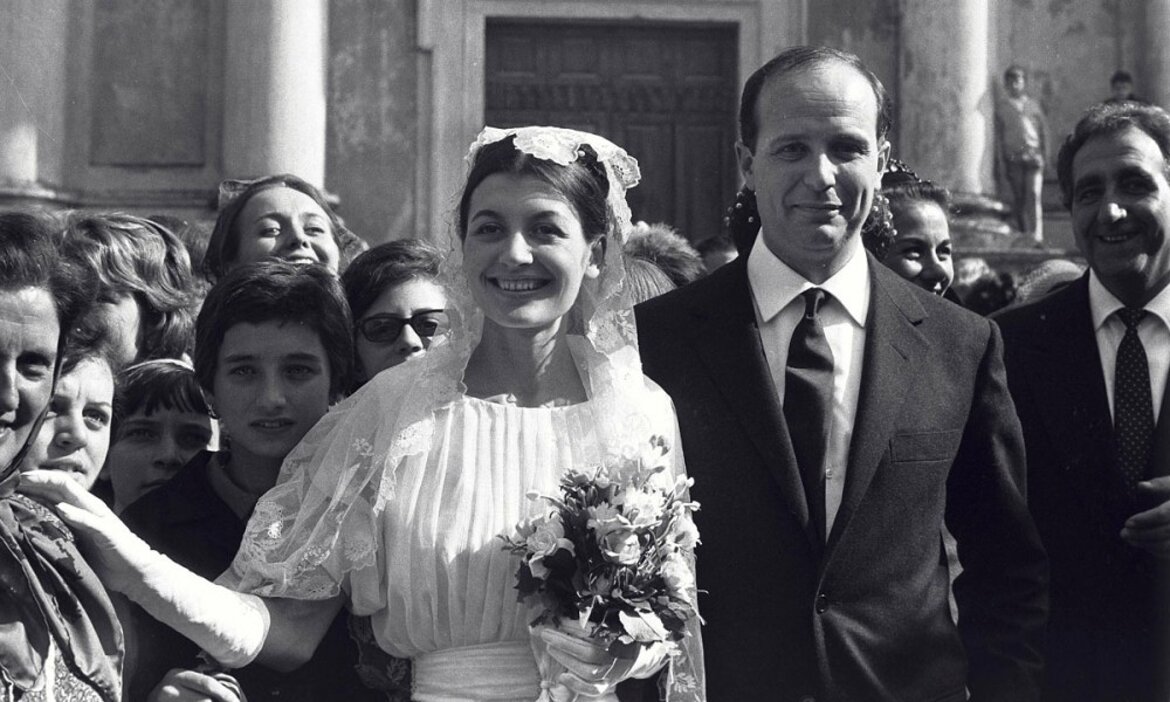
Carla Fracci and Beppe Menegatti, newlyweds, leaving the parish church of Volongo (Cremona) on October 7, 1964. The wedding took place in the hometown of Santina Rocca Fracci, Carla's mother, and where Carla spent the happy years of her youth. Photo: Zambelli Archive
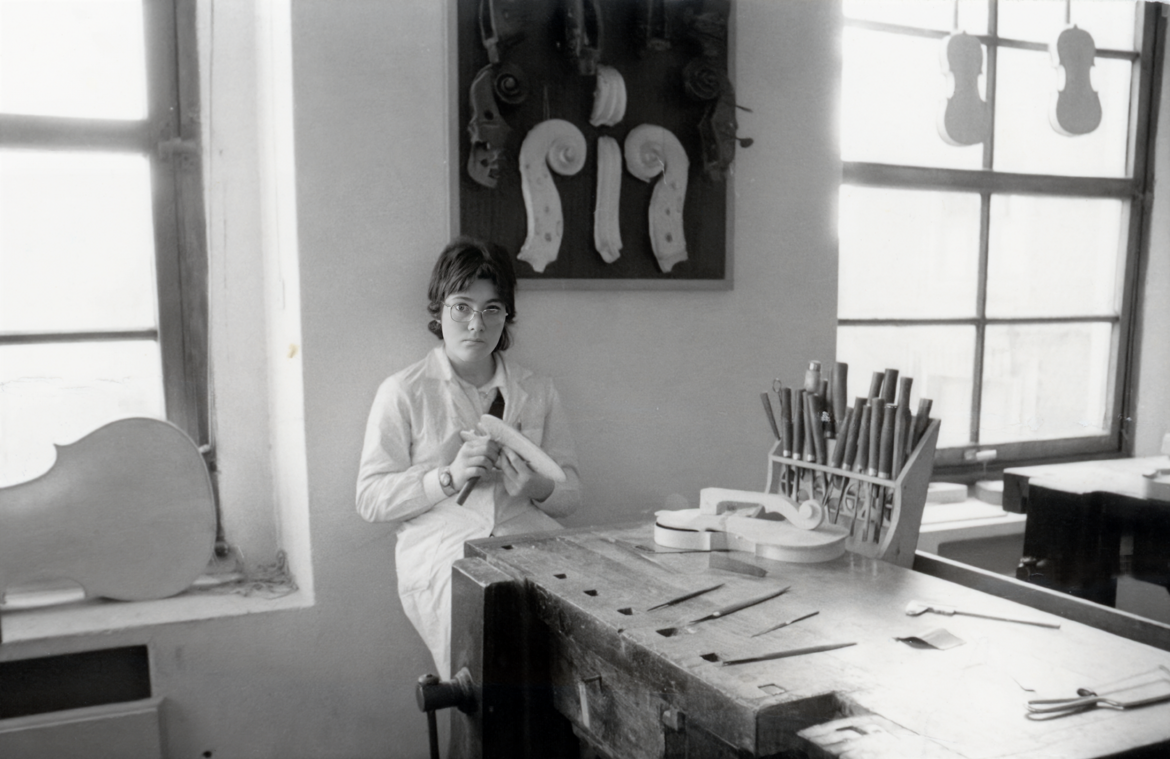
Wanna Zambelli at the beginning of her long journey among violins. Cremona, International School of Violin Making, 1968. Photo: © 1968 Ezio Scarpini
Masters and influences: the maturation of a style
During her formative years, Zambelli had the opportunity to study under the master luthier Pietro Sgarabotto, a "traditional master" as she herself described him. Being a pupil of a respected master like Sgarabotto placed her directly in the line of succession of the Cremonese violin-making tradition and provided her with a solid base of technical knowledge, connecting her permanently to the city's artisanal heritage.
After graduating in 1972, Wanna Zambelli's professional career continued with an exciting experience in the workshop of master luthier Francesco Bissolotti. Working alongside Bissolotti was a crucial phase in further refining her practical skills and deepening her understanding of the classic Cremonese method. This post-graduate collaboration highlights the importance of practical experience and mentoring in the refinement of the art of violin making, an aspect that goes beyond the formal education received at school.
Zambelli's apprenticeship was certainly a demanding one, but one with fascinating implications, which led her to fall in love with violin-making and to express herself at the highest level in her work. Using the classic Cremonese method (based mainly on the use of the "internal mould" and closed-box threading), she has built violins, violas and cellos inspired by the models of the great masters: Antonio Stradivari, Giuseppe Guarneri del Gesù, Gasparo da Salò, Carlo Testore and Camillo Camilli. The internal mould used in constructing the instrument and the execution of closed purfling are techniques rooted in the centuries-old Cremonese violin-making tradition. Zambelli's choice to follow this method reflects a deep respect for the artisanal heritage of her city and a commitment to making high-quality instruments. In addition to following the classic models, Zambelli has also explored the creation of customised models. This openness to innovation, while respecting tradition, demonstrates a search for a balance between emulating the great masters of the past and expressing her own artistic voice.
During her time in Bissolotti's workshop, Zambelli had the privilege of meeting and learning from one of the greatest modern luthiers and restorers: the Italian-American Maestro Simone Fernando Sacconi. Although Sacconi was not a direct teacher at the school, his influence proved decisive. Her interactions with Sacconi, in particular his deep knowledge of Stradivari's construction secrets, had a significant impact on Zambelli's approach to the classic Cremonese method. This encounter with a figure of such stature demonstrates how, within the Cremonese violin-making community, informal knowledge sharing and learning from established masters can be just as important as formal education. The opportunity to learn directly from Sacconi, who had dedicated his life to the study of Stradivari and the great classical masters, allowed Zambelli to acquire a unique perspective and to develop a full understanding of the art of violin making. This link with Sacconi, a leading figure in the 20th century, lends further authority to her career and subsequent activities. The teachings and advice of this craftsman-artist enabled her, in fact, not only to fully grasp the secrets of the artisanal construction method but also to make its expressive language her own.
Sacconi, author of the seminal work The "Secrets" of Stradivari (a sort of bible for luthiers), was in Cremona during the summer and autumn of 1972 to complete his book, offering Zambelli direct exposure to his profound insights into the master luthier's construction methods.
This interaction with Sacconi provided Wanna with an unparalleled understanding of the classic Cremonese techniques and was not a simple formal lesson; it represented an unmediated transmission of a heritage that, in 2012, would be recognised by UNESCO as an intangible cultural asset of humanity. Direct apprenticeship with masters who embody centuries of tradition, such as Sacconi, who studied the classics in depth, instils in the student authentic knowledge, techniques and philosophical approaches that cannot be fully acquired from written texts. This direct line of descent ensures the continuity and authenticity of the Cremonese method, making Zambelli not only a practitioner but a living guardian of this legacy. Her subsequent role as a teacher, as will be detailed, is a direct effect of this profound training experience, ensuring the perpetuation of the glorious Cremonese artisan tradition.
One of the most significant episodes recounted by Wanna Zambelli dates back to an early summer afternoon in 1972 in Francesco Bissolotti's workshop in Cremona, when they received the daily visit of Simone Fernando Sacconi, already elderly but still very lucid.
Sacconi, a legendary figure in the world of violin making, entered quietly and began to observe a nearly finished violin on Wanna's workbench. He lifted it carefully, turned it slowly in the natural light, and started pointing out little details:
‒ The curve of the soundboard's arching was "almost perfect", but it could gain a bit more visual tension.
‒ The f-holes were well cut, but he suggested "feeling" their vibration with the eye as well. By “feeling” he meant that the luthier’s eye must grasp the vibrational potential of those curves: it is not enough to verify their geometric architecture, but it is necessary to perceive (visually) the sound energy that that design will release.
‒ The purfling of the soundboard was precise, but Sacconi pointed out that "precision isn't enough – it also needs soul".
These were not criticisms, but advice "from a master to a budding master". Bissolotti, who knew Sacconi's character well, remained silent, leaving Wanna to speak. Excited but determined, she answered point by point, explaining her construction choices with clarity and passion. Sacconi smiled, nodded, and ended with a phrase that Wanna has carried with her ever since: "Remember: the hand must be precise, but the eye must be even more exacting." It was a moment of symbolic transition: Sacconi's unspoken acknowledgement that the young luthier was now fully stepping into the Cremonese tradition.
Years later, Wanna would recount that episode to her students at the Violin Making School, turning it into a lesson in method and humility. And in June 2023, on the fiftieth anniversary of Sacconi's death, Wanna, together with Fausto Cacciatori and Marco Vinicio Bissolotti, organised at the Violin Museum an exhibition, a study day, and the presentation of a new book on Sacconi – all to honour the master who had passed on to her not only technique, but also an ethical vision of work. Sacconi's legacy, in fact, is not only made up of instruments and restorations, but of a true "way of thinking" about violin making.
In October of the same year (2023), Zambelli attended the inauguration of the "Sacconi Room" at the Violin Museum, a testament to the enduring bond between master and pupil.
One afternoon in July 1972, while Zambelli was working on a fir board in the vice of his workbench, Sacconi approached silently and, without saying a word, changed the blade on her hacksaw. When Wanna noticed the different blade, he explained that the thinner blade would enhance the grain of the wood without splintering it, a little trick derived from his research on Stradivari. Even today, Wanna cites it as the perfect example of a lesson imparted more through gestures than words.
Among other tokens of esteem, which culminated in the invitation to go to New York to work with him at the famous Rembert Wurlitzer restoration workshop, one autumn day in 1972, Sacconi described Zambelli as a "luthier with golden little hands". In short, Zambelli and Sacconi are two central figures in the recent history of violin making, linked by a thread of mastery, memory and Cremonese tradition. For her, Sacconi left a legacy of patience, slowness, and sensitivity in her work, as well as the pursuit of the perfect balance between wood and varnish – values that she today upholds and passes on, seeing them as essential for resisting the pressures of mass production.
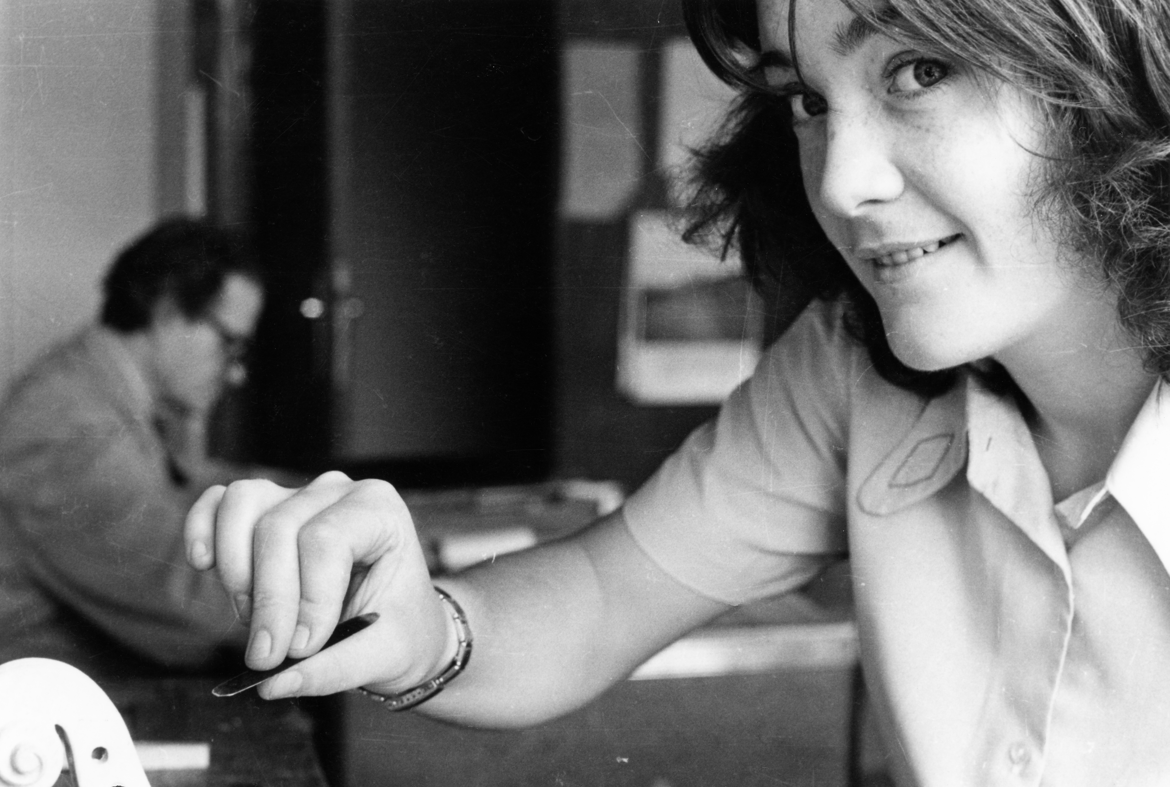
Wanna Zambelli at the Violin Making School. Cremona, 1971. In the background, her first teacher, Pietro Sgarabotto. Photo: © 1971 Zambelli Archive
The affirmation of a talent: the Sacconi Prize and other awards
Wanna Zambelli's talent and skill were recognised early on when, on 21 September 1973, she won the gold medal with a plaque at the 5th Italian Biennial Competition of String Instruments in Cremona. The special prize she received on that occasion bore the engraving «S. F. Sacconi» and was awarded to her as the best luthier under the age of 30 by an international jury chaired by the great London expert Charles Beare, who was called upon to replace Sacconi, who died in New York on 26 June of the same year. This prestigious award, obtained only one year after graduation, testifies to Wanna's exceptional skill and her rapid rise in the world of violin-making. Such an important award at the beginning of her career undoubtedly helped to consolidate her reputation within the violin-making community and opened up new professional opportunities for her. However, following the example of her "maestro" (Sacconi), she later decided to refrain from participating in any luthiery competition. This choice suggests a possible change in her professional philosophy, shifting the focus from competitive recognition to other aspects of her career, such as teaching and preserving the traditional method. It may also reflect a view that true craftsmanship is measured through dedication to work and the transmission of knowledge, rather than through competition.
A few years later, Wanna Zambelli received the coveted «National Craftsmanship Award» established by the National Union of Soroptimist Clubs of Italy and, in 1989, the «La Gentil Impresa» Award conferred by the CNA of Lombardy.
Although she mainly builds instruments commissioned by musicians, her craftsmanship is also recognised in the international market. A significant example is a modern Italian violin, labelled "Wanna Zambelli / Cremonese / made in Cremona 1983", which was sold at Christie's, one of the most prestigious auction houses. The detailed description of this instrument – a personal model (35.7 cm), entirely handcrafted according to the Cremonese classical method or internal mould, with a one-piece back, ribs and scroll in Balkan maple with attractive figuring, top in Italian spruce with straight grain, and originally finished in a red-orange varnish – highlights the distinctive aesthetic and material qualities of her work. The sale of a violin by Wanna Zambelli in such a renowned context validates her mastery. While Cremona is famous for its ancient masters such as Stradivari and Guarneri, the presence in 1983 of a "modern Italian violin" by Zambelli in a prestigious auction house shows that modern Cremonese violin making is not just an academic exercise, but produces instruments of recognised commercial and artistic value. This indicates a healthy and active market for new instruments made in the traditional style, suggesting that Cremona's legacy is not merely a matter of historical preservation, but a vibrant, living tradition. This implies a limited but continuous demand for instruments that embody the classical method, even if they are not centuries old. And this is beyond the counterfeits and forgeries that have also plagued the city of Stradivari for years.
Wanna Zambelli's influence as a teacher was also formally recognised in 2015, when the ANLAI (Italian National Association of Artistic Violin Making) awarded her the «A life dedicated to music and violin making» prize, specifically in recognition of her role as a "teacher and trainer of young violin makers". Her swift transition from student to teacher, and her subsequent dedication to educating numerous pupils, highlight a crucial role that extends beyond that of a mere craftsperson. She acts as a vital conduit for the transmission of the highly specialised knowledge of Cremonese violin-making. Her deep understanding, gained directly from masters such as Sgarabotto, Bissolotti, and Sacconi, allowed her to effectively pass on this complex, often tacit knowledge to new generations. Her role as a "trainer" has directly contributed to the perpetuation and global dissemination of Cremonese violin making.
In 2012, UNESCO's recognition of traditional Cremonese violin craftsmanship as an intangible cultural heritage of humanity provided a broader context for the significance of her work, as Zambelli is a living embodiment and active perpetuator of this heritage.
This demonstrates that the vitality of a cultural heritage depends not only on historical figures, but also on contemporary practitioners who dedicate themselves to its continuity, documentation, and transmission. Zambelli's life and work exemplify the dedication required to sustain and evolve a centuries-old craft in the modern era, reinforcing Cremona's status as a living centre of violin-making, not merely a historical museum.
In addition, Wanna has been involved in projects such as the Register of Intangible Heritage of Lombardy (R.E.I.L.), making an active contribution to the documentation and conservation of traditional Cremonese violin making. In this regard, here is the video interview with Wanna Zambelli by Fulvia Caruso, lecturer at the Department of Musicology and Cultural Heritage of Cremona at the University of Pavia: Liuteria cremonese. Maestri. Wanna Zambelli
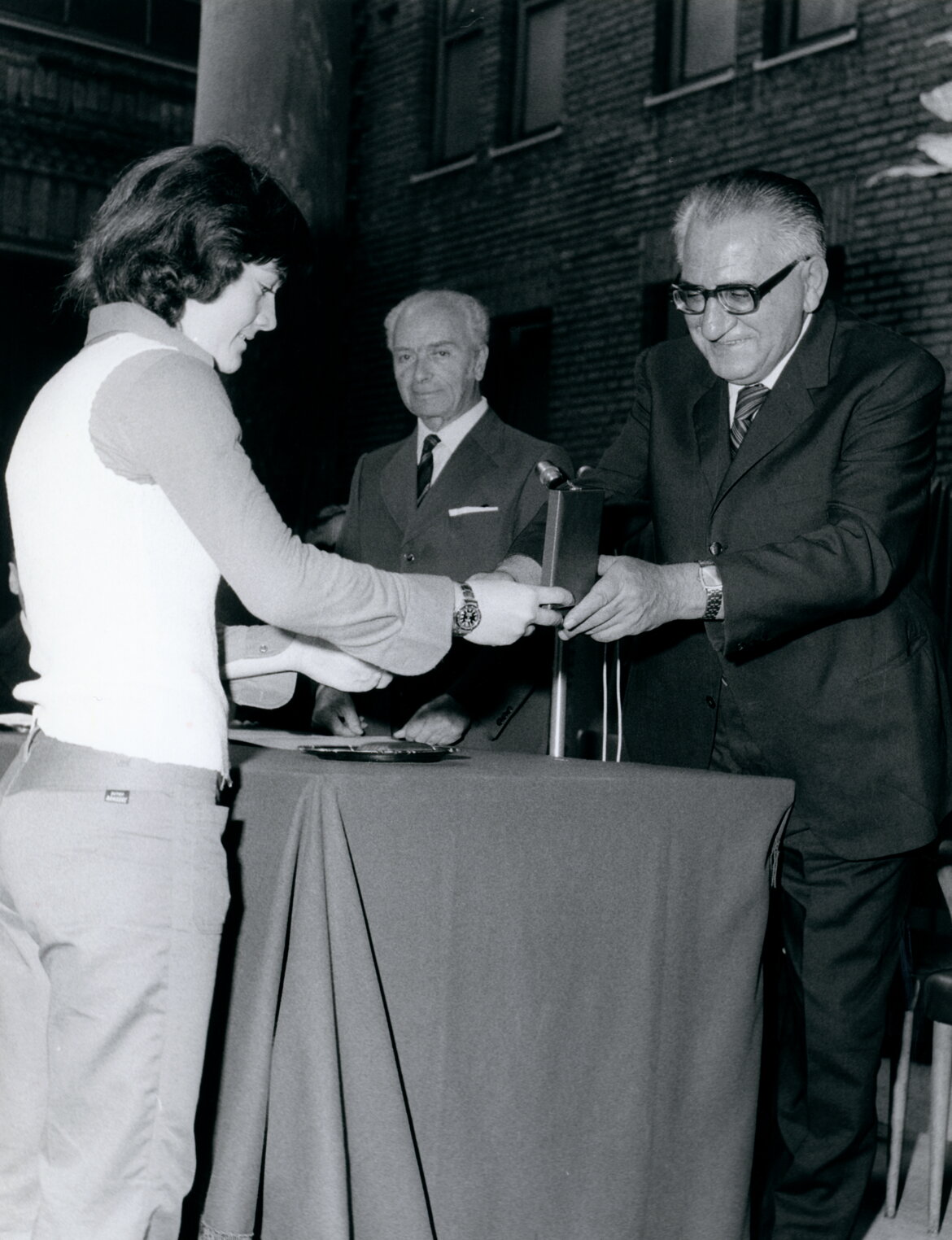
Violin maker Wanna Zambelli receives the gold medal and plaque of the «Simone Fernando Sacconi» Award from Cremona Mayor Sen. Emilio Zanoni at the 5th Italian Biennial Competition of String Instruments.
Cremona, September 21, 1973. Photo: © 1973 Zambelli Archive
Teaching: the Transmission of Knowledge
Beginning in 1974, Wanna Zambelli embarked on a long and significant career as a practical workshop teacher at the International School of Violin Making in Cremona. Her decades-long teaching (from November 1974 to June 2018) demonstrates a profound dedication to transmitting knowledge and skills in the Cremonese violin-making tradition. Her role as an educator has had a significant impact on the education of hundreds of students from around the world, who fondly remember her for her great humanity and constant presence. Her students, such as Bulgarian Martin Stoyanov, credit her with improving their style and construction techniques. This testimony underscores not only Wanna's technical expertise, but also her human qualities and her ability to inspire and guide her students. Her experience as a practicing violin maker has enriched her teaching approach, providing students with valuable insights into the real world of instrument making. Likewise, the act of teaching further consolidated her mastery of the art. The fact that students from around the world have benefited from her teaching highlights the global reach of Cremonese violin making's influence and the crucial role that teachers like Zambelli play in disseminating these unique skills internationally.
As mentioned, a key aspect of Wanna Zambelli's commitment is her dedication to preserving the classical Cremonese violin-making method. In 1980, she collaborated with Maestro Bissolotti and other luthiers from Aclap (Association of Cremonese Professional Violin Makers) to create the exhibition «Classical Violin Making: A Method. Stradivari and the Cremonese School.» This initiative demonstrates a collective commitment by a group of Cremonese luthiers to safeguard and promote their traditional techniques, underscoring the importance of preserving their artisanal heritage in the face of evolving practices and potentially damaging external influences.
The creation of Aclap and projects like this traveling exhibition (30 successful performances in Italy, Europe, and around the world from 1980 to 1989, starting at La Scala) reflect a conscious effort by the Cremonese violin-making community to maintain the integrity and authenticity of this ancient and renowned art. The exhibition "Classical Violin Making: A Method" has been an important educational tool for both aspiring violin makers and the general public, raising awareness and deepening appreciation for the complexity and sophistication of the classical Cremonese method. Zambelli's participation in this initiative underscores her total commitment to these traditional techniques. In her own instrument-making, our violin maker, in addition to rigorously following the classical Cremonese method, has always prioritized a personal and direct relationship with the musician.
In short, long before anyone had suspected it, Zambelli, along with Sacconi and Bissolotti, pioneered a new way of understanding and practicing violin making that fits perfectly into the virtuous path that, in 2012, would lead to Cremonese violin-making expertise being recognized by UNESCO as an intangible cultural heritage of humanity.
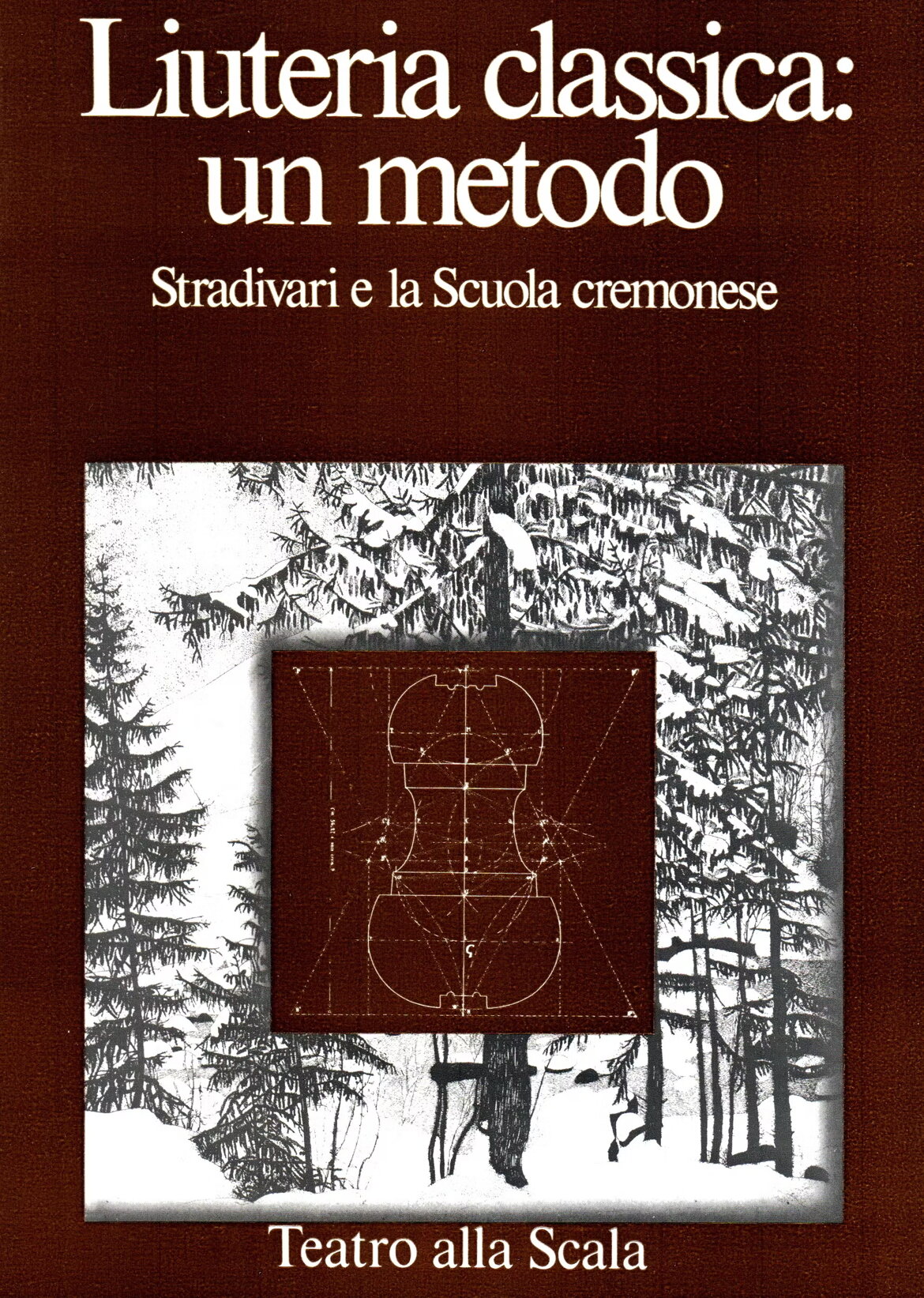
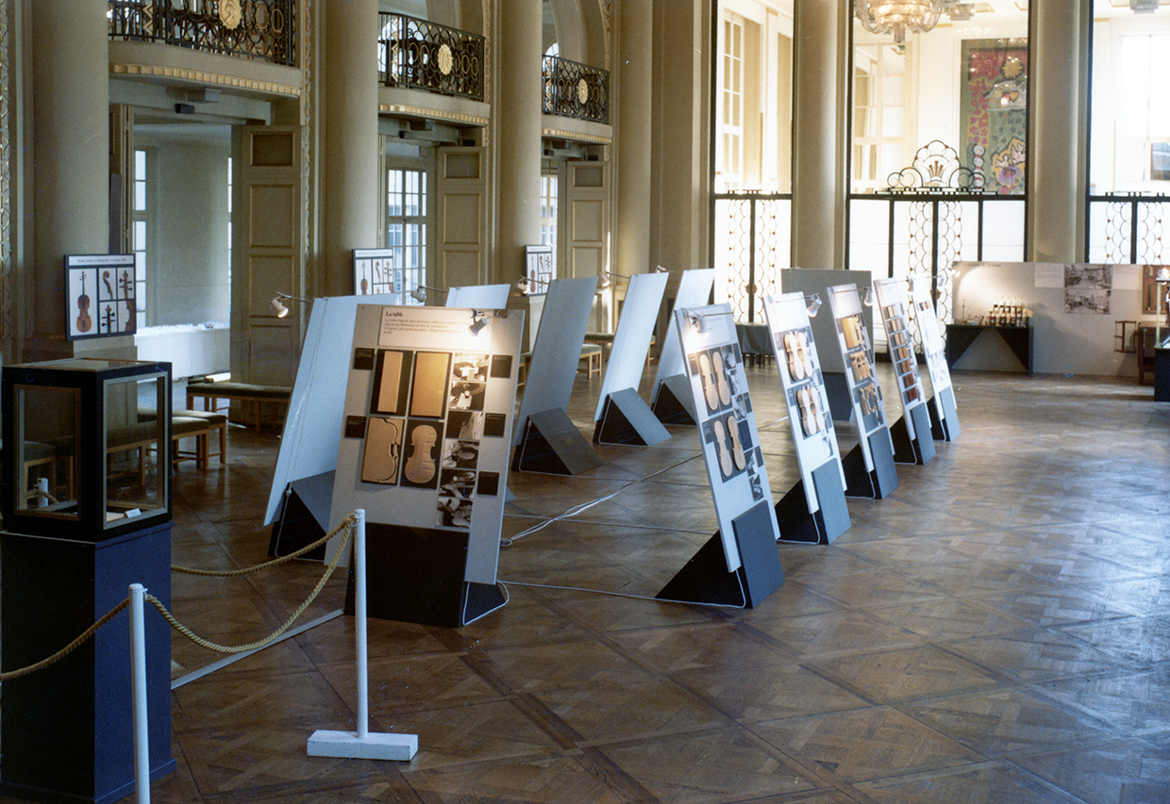
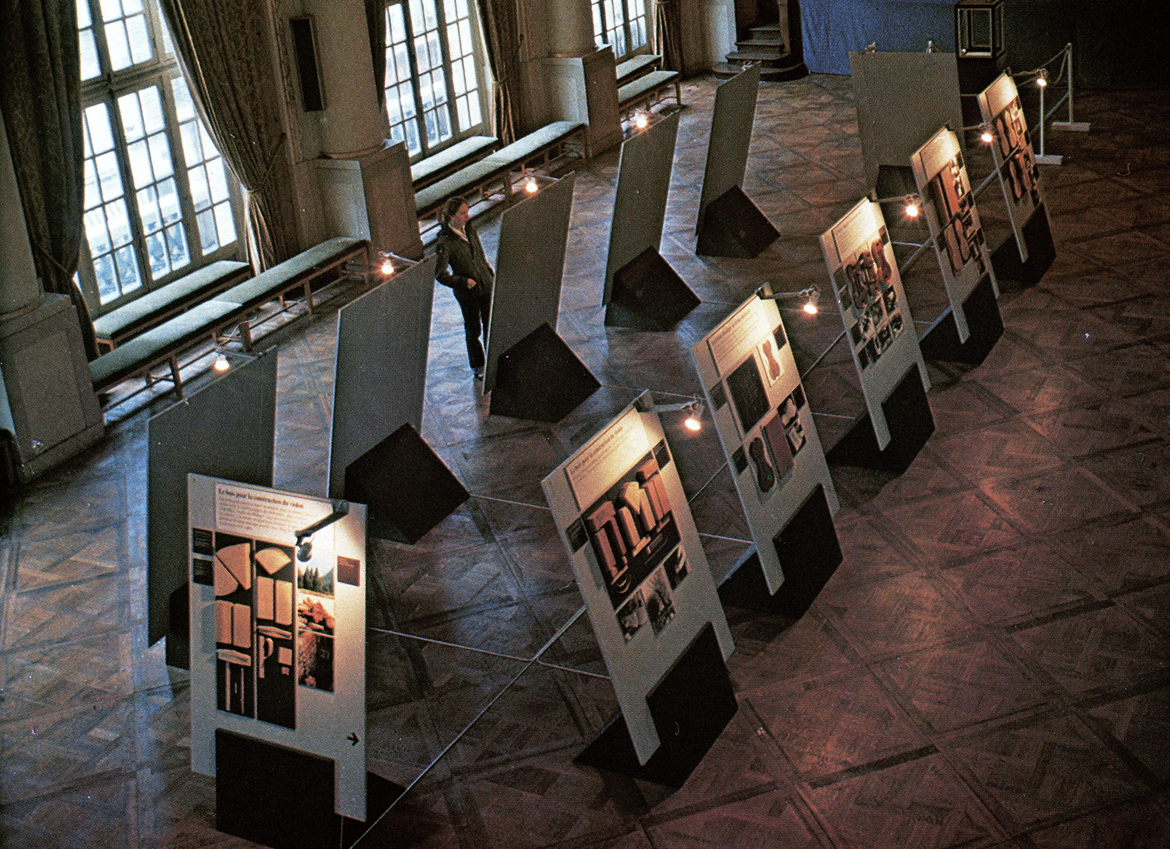
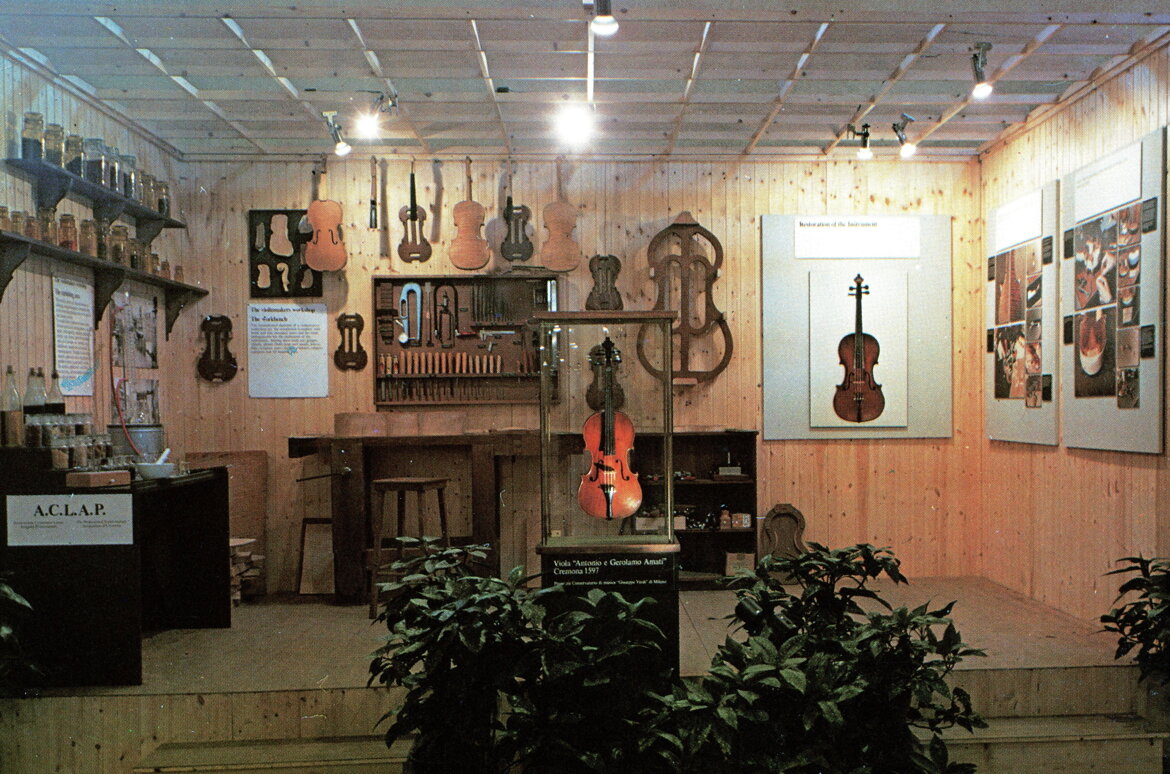
From top: Catalog of the Aclap exhibition «Liuteria classica: un metodo. Stradivari e la Scuola cremonese / Classical Violin Making: A Method. Stradivari and the Cremonese School,» curated by master violin maker Francesco Bissolotti, along with Wanna Zambelli and other Aclap luthiers. The first exhibition was held in the Ridotto dei Palchi of the Teatro alla Scala from May 7 to August 10, 1980, with the section: «Eight Masterpieces of Classical Cremonese Violin Making,» featuring antique instruments loaned by the Municipality of Cremona and major private collectors, including Enrico Costa of Genoa. The following photos: glimpses of the exhibition at the Municipality of Paris, one of 30 editions presented in Italy and Europe from 1980 to 1989.
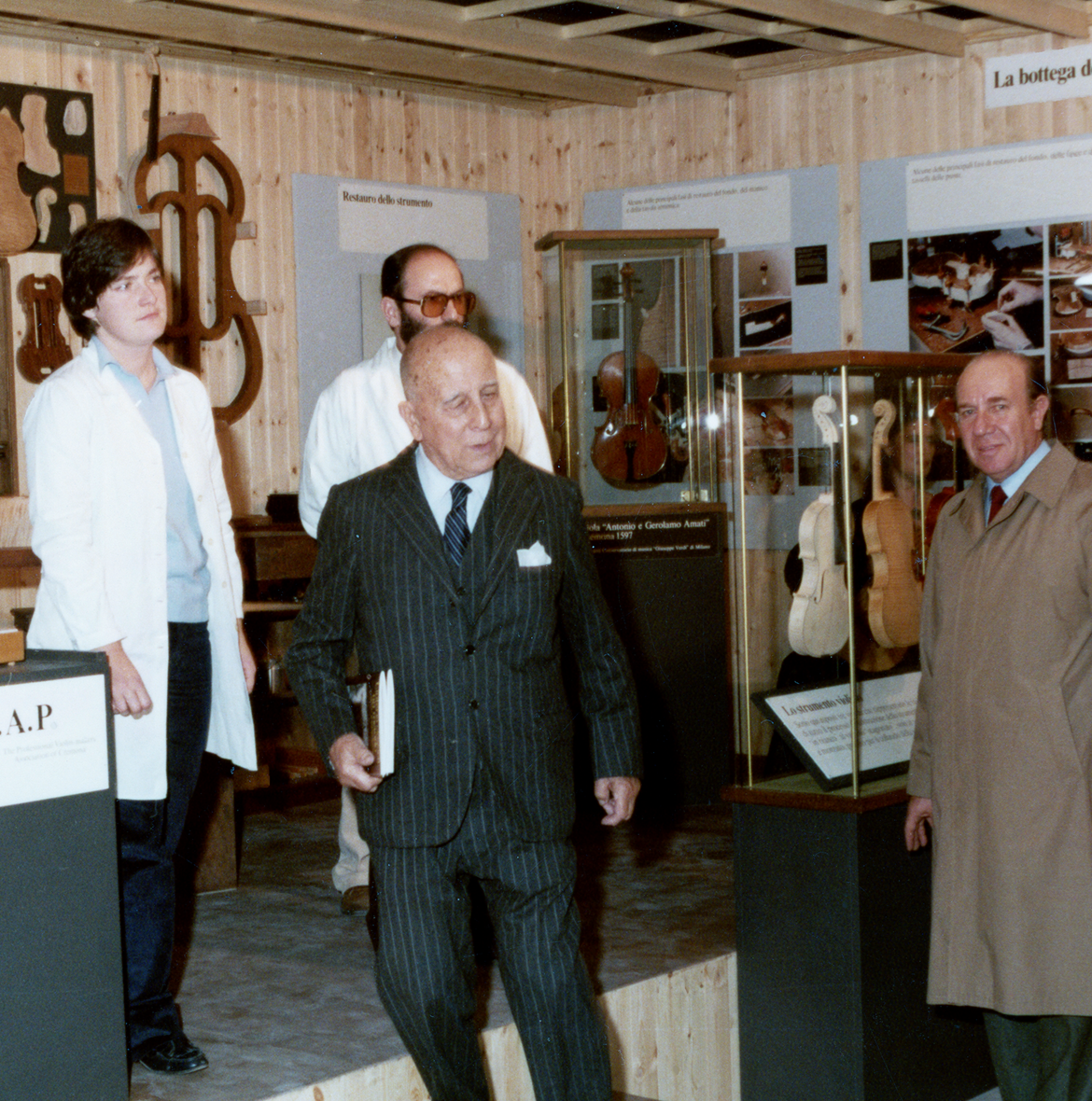
From left in the photo: Violin maker Wanna Zambelli, Genoese collector Enrico Costa (in a dark suit), master violin maker Francesco Bissolotti, and Archimede Cattaneo, Councilor for Culture of the Province of Cremona, in the "Luthier's Workshop" of the Aclap exhibition "Classical Violin Making: a Method. Stradivari and the Cremonese School," held in the halls of the "Sant'Agostino" Museum in Genoa as part of the celebrations for the Bicentenary of the Birth of Niccolò Paganini, inaugurated by the President of the Italian Republic, Sandro Pertini (Genoa, October 29, 1982). Photo: © 1982 Ezio Quiresi, Cremona
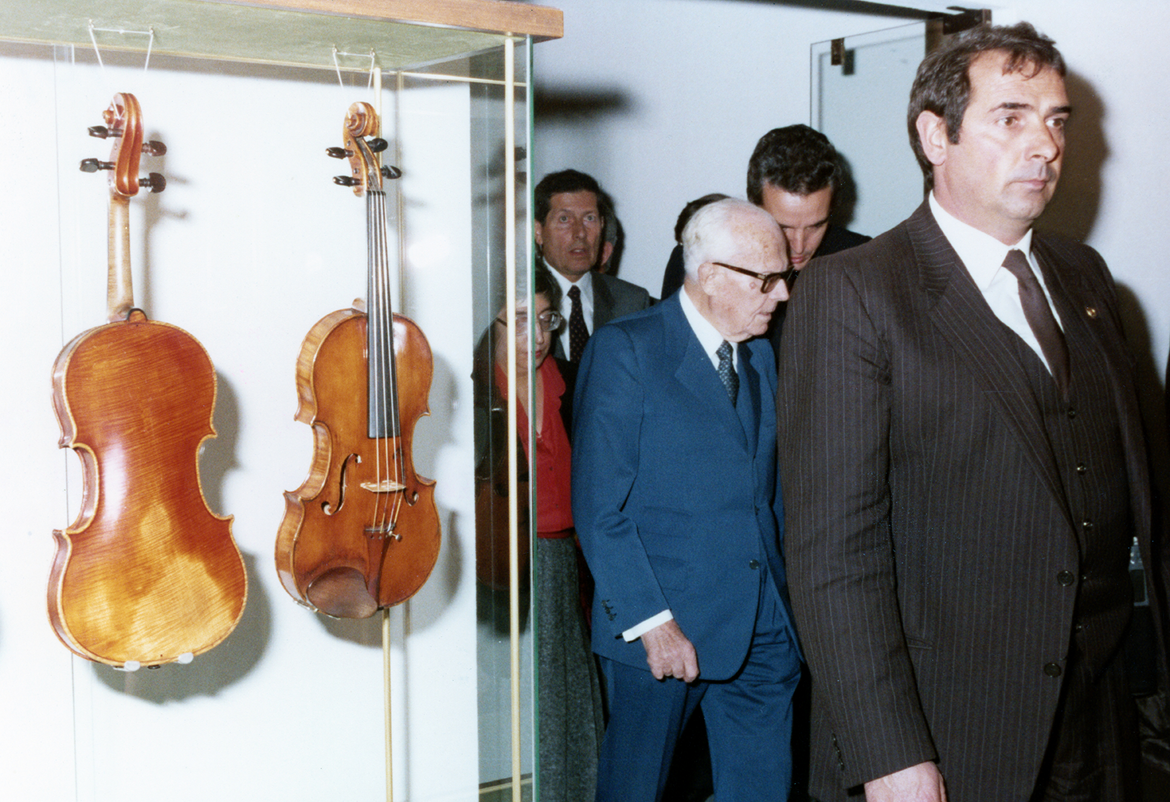
In the center of the photo: The President of the Italian Republic, Sandro Pertini, inaugurates the Aclap exhibition "Classical Violin Making: a Method. "Stradivari and the Cremonese School" in the halls of the "Sant'Agostino" Museum in Genoa as part of the celebrations for the bicentenary of the birth of Niccolò Paganini (Genoa, October 29, 1982). Photo: © 1982 Ezio Quiresi, Cremona
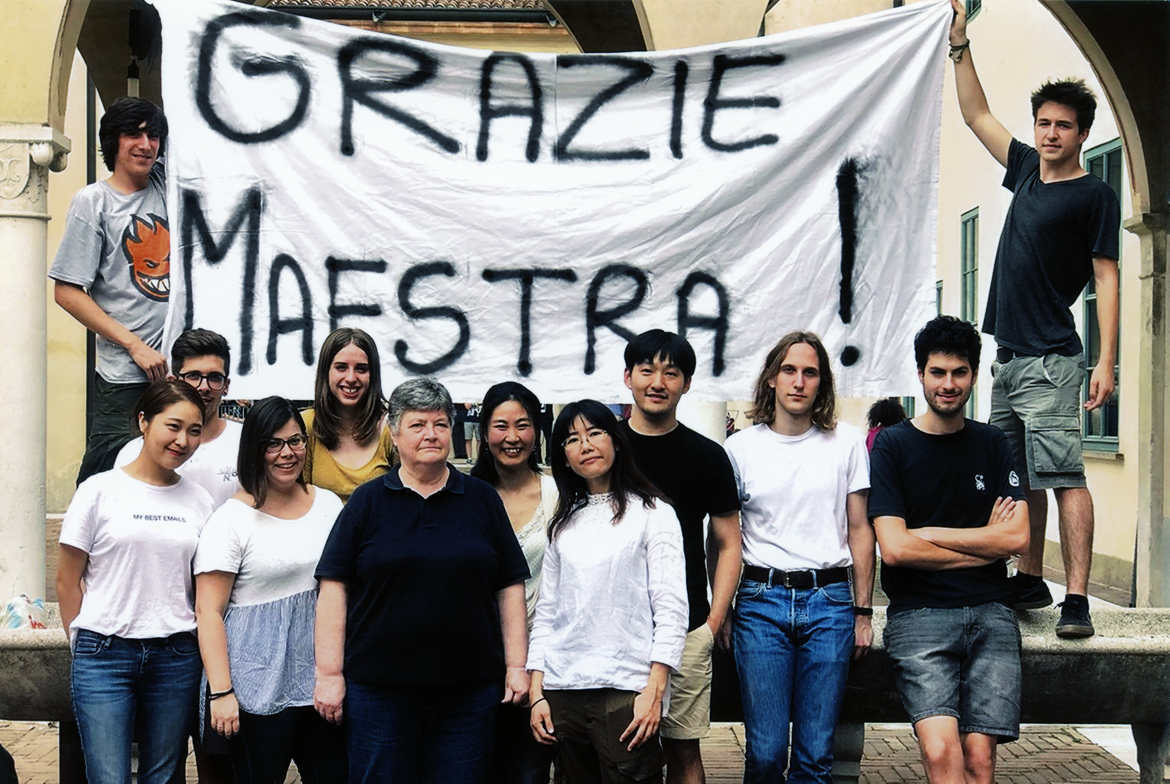
Wanna Zambelli (front row, wearing a dark t-shirt) with her students on her last day of teaching, after 44 years, at the Antonio Stradivari International School of Violin Making. Cremona, June 28, 2018. Photo: © 2018 The Strad, London, accompanying the feature «Female luthiers: And justice for all?» by Femke Colborne, November 2018.
Female luthiers: And justice for all?
by Femke Colborne
The Strad, London
First edition November 2018
Second edition March 2022
The Direct Luthier-Musician Relationship: A Path to Good Violins
The line of work, cultural research and contacts established and developed by Aclap in the 1970s and 1980s, centered on the direct luthier-musician relationship, has borne abundant fruit. These fruits extend to the entire city of Cremona, as the overall effect of the approach – which mitigates negotiation in favor of a direct relationship between luthier and musician – cannot help but be transformed into a gift of personal welcome for the illustrious guest, enriching us with his presence and talent.
A pivotal moment within this work perspective occurred in October 1983, when several great violinists met in the workshop of master luthier Francesco Bissolotti: Salvatore Accardo, Bruno Giuranna, and Rocco Filippini. In an atmosphere of friendship and sincere cordiality, the instruments of Bissolotti, his sons, and Wanna Zambelli were passed from hand to hand in rapid exchanges of opinions and brilliant testing.
This joyful moment of discussion about the aesthetic and acoustic quality of the instruments later became the subject of a report that RAI's Rete 1 broadcast directly in the workshop, where Salvatore Accardo was interviewed about the special five-string viola that Bissolotti had built especially for him, and where Accardo himself presented, with a brief acoustic test, a prized violin by Wanna Zambelli.
This climate of mutual respect and intense collaboration further strengthened the direct relationship between Zambelli and the Swiss cellist Rocco Filippini. One of Filippini's students had recently received the cello he had ordered from our violin maker; Filippini himself had had the opportunity to try and appreciate an instrument Wanna had built for a Milanese concert pianist, so it seemed almost natural that the great cellist would seek to realize through Wanna his desire to experiment with a modern instrument in concert, capable of satisfying the needs of a solo performer. Thus came the commission for a cello that Filippini used personally, alternating between ancient classical and modern "classical." "Almost certainly," Wanna confides, "I made my best cello in 1984 for Maestro Filippini; he had seen one of my instruments, he liked it, so he came to my workshop, we chose the wood together, and he oversaw every stage of the process. It took a long time to build, but it turned out well, and he was very satisfied."
Another example, among many, is the violin Wanna Zambelli built in 1985 for Beverley Wescott, an established performer with the BBC National Orchestra and Chorus of Wales.
This direct and living relationship between the personality of the luthier and that of the musician, between the work of construction and that of musical performance and interpretation, has given rise to the natural modern development of classical violin making and every serious discussion of creative experimentation.
This technical and professional choice positions Zambelli as a guardian of the authentic Cremonese tradition, helping to maintain the unique characteristics and high quality standards of violins from this school.
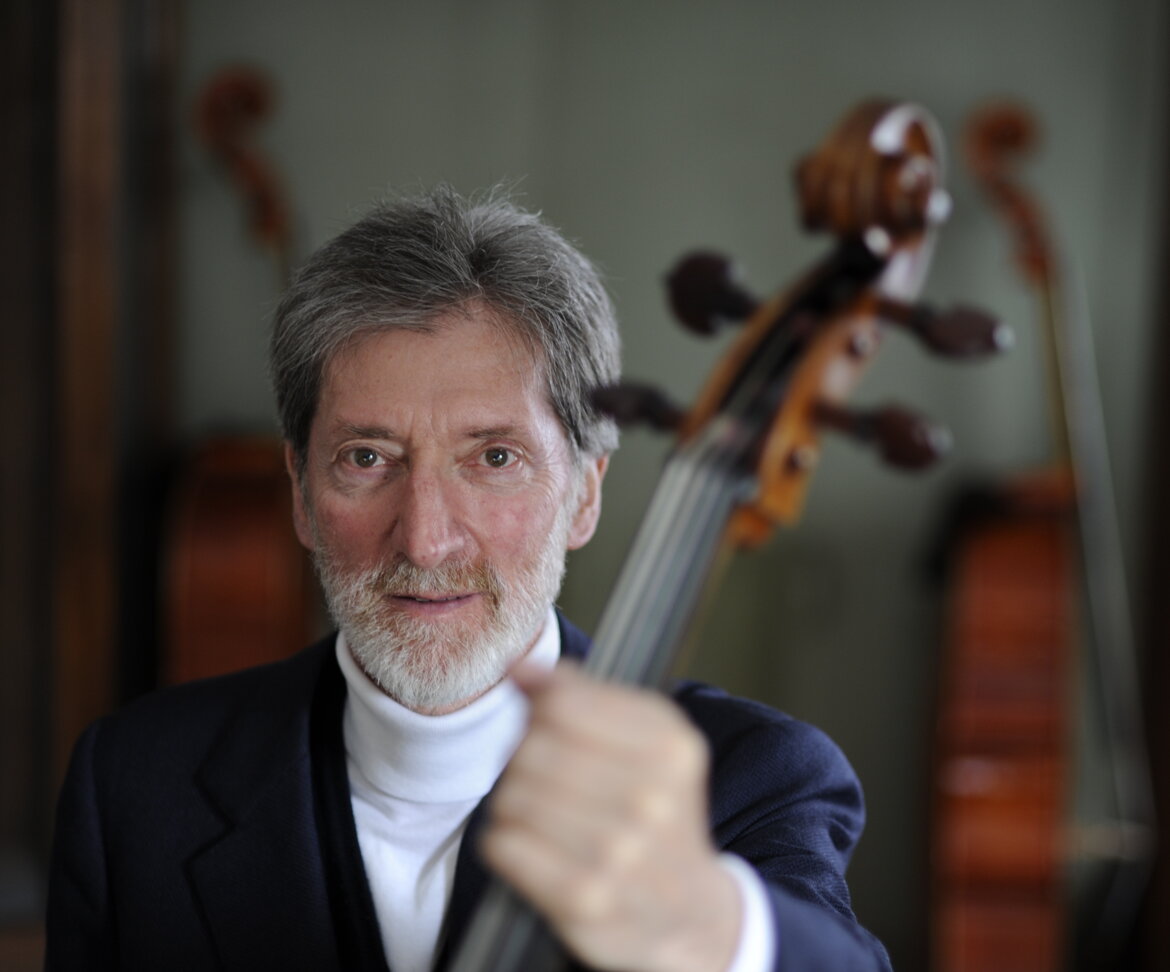
The great cellist Rocco Filippini. Wanna Zambelli: "I almost certainly made my best cello in 1984 for Maestro Filippini; he had seen one of my instruments and liked it, so he came to my workshop, we chose the wood together, and he oversaw every stage of the process. It took a long time to make, but it turned out well, and he was very satisfied." Photo: © 2009 Cosimo Filippini, Milan
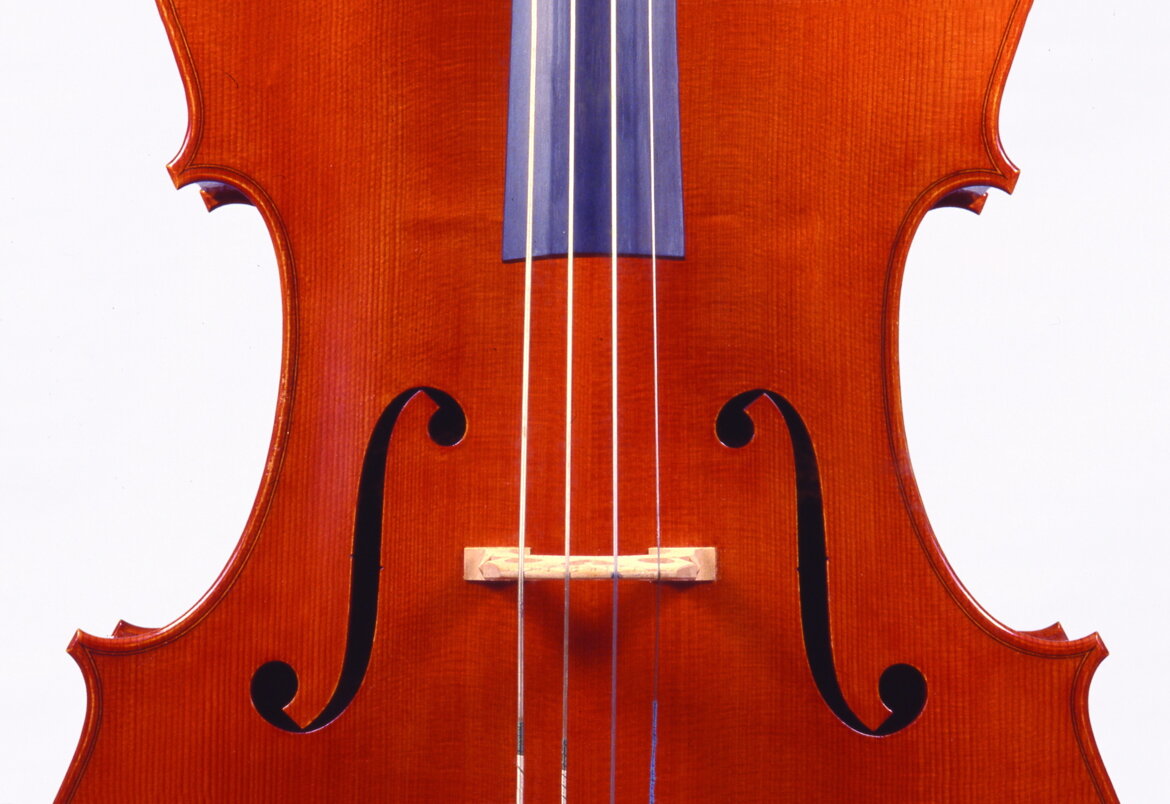
Detail of the belly of the cello built by Wanna Zambelli in 1984 for the famous Swiss concert artist Rocco Filippini. Photo © 1984 Mino Boiocchi, Cremona
Ancient and modern instruments in concert with the Lindsay String Quartet
In collaboration between the Pistoia Theatre Association and Aclap (the Cremonese Association of Professional Artisan Violin Makers), the Lindsay String Quartet held an exceptional concert on April 2, 1985, at the Teatro Comunale «Alessandro Manzoni» in Pistoia. To a packed house, the renowned English quartet played the first movement with three instruments by Antonio Stradivari and a cello by Francesco Ruggeri; the second movement with violins and violas by Francesco Bissolotti and cello by Wanna Zambelli, demonstrating the ideal and enduring continuity of the Cremonese classical school.
The quartet performed for the first time at the Royal Academy of Music in London in 1965 to compete for a prize and set out to make the string quartets of Béla Bartók and Ludwig van Beethoven the core of their repertoire. In 1967, they were awarded the Leverhulme Scholarship at Keele University and, in 1970, changed their name from Cropper to the Lindsay String Quartet, in honor of Lord Lindsay, founder of Keele University. In 1984, the quartet won the Gramophone Award for Beethoven Quartets.
In 1974, the Lindsay Quartet became Quartet-in-Residence at the University of Sheffield, and five years later, they held a similar position at the University of Manchester, where they performed regularly in concert seasons, led workshops, and taught chamber music. For many years, they performed in a festival at the Studio Theatre of the Crucible Theatre in Sheffield and toured the world, achieving great success and widespread recognition. In 2005, after 39 years, he announced his retirement with a series of farewell concerts, culminating in four final performances in his hometown of Sheffield in July of that year. Lineup: Peter Cropper (first violin); Michael Adamson (second violin, 1965–71); Ronald Birks (second violin, 1971–2005); Roger Bigley (viola, 1965–85); Robin Ireland (viola, 1985–2005); Bernard Gregor-Smith (cello).
At the Teatro Manzoni, as scheduled, Ludwig van Beethoven's Quartet, Op. 18, No. 4, and Felix Mendelssohn's Quartet, Op. 80, were performed on period instruments (Stradivari violins and violas, and a Ruggeri cello); while Mendelssohn's Quartet, Op. 33, No. 1, were performed on period instruments (Stradivari violins and violas, and a Ruggeri cello). 2 by Franz Joseph Haydn on modern instruments built by master Cremonese luthiers Francesco Bissolotti (violins and viola) and Wanna Zambelli (cello).
This concert, as well as Bissolotti and Zambelli's encounters with Salvatore Accardo, Uto Ughi, Bruno Giuranna, and Rocco Filippini, confirms the intrinsically symbiotic relationship between luthier and musician, an ongoing dialogue that has shaped the evolution of music and the instruments themselves. To express their art and realize their sonic vision, musicians require an instrument that is more than a mere object; it must be a "continuation of themselves," a vehicle that amplifies their intentions and emotions, allowing them to translate abstract ideas into tangible sound.
This profound connection means that the instrument's tonal qualities, response, and playability directly influence the performer's technique and expressiveness.
On the other hand, to create excellent instruments, the luthier must understand the needs and acoustic preferences of the player, collaborating closely to personalize and customize the instrument according to their needs. This interdependence manifests itself in the creation of instruments that are not merely functional objects, but true works of art, whose "voice" is the result of the synergy between the intrinsic sonic potential of the wood and the skill, intuition, and care of the luthier.
The luthier is not a simple craftsman, and the musician is not simply a performer. Wood possesses a "sonic potential" that the luthier "reveals" and "shapes" to create an instrument. This process goes beyond mere craftsmanship: it is an act of transforming the material into something with a "voice" that the musician perceives as his own. Violin making acts as a bridge, an interface between the physical and the spiritual or emotional worlds. The luthier, through his mastery and profound knowledge of wood, extracts and shapes the sonic soul of the material, making it available for the musician's artistic expression. This elevates the relationship to an almost metaphysical level, where material creation becomes a catalyst for immaterial expression. In short, the relationship between luthier and musician exists in a continuous and crucial interaction.
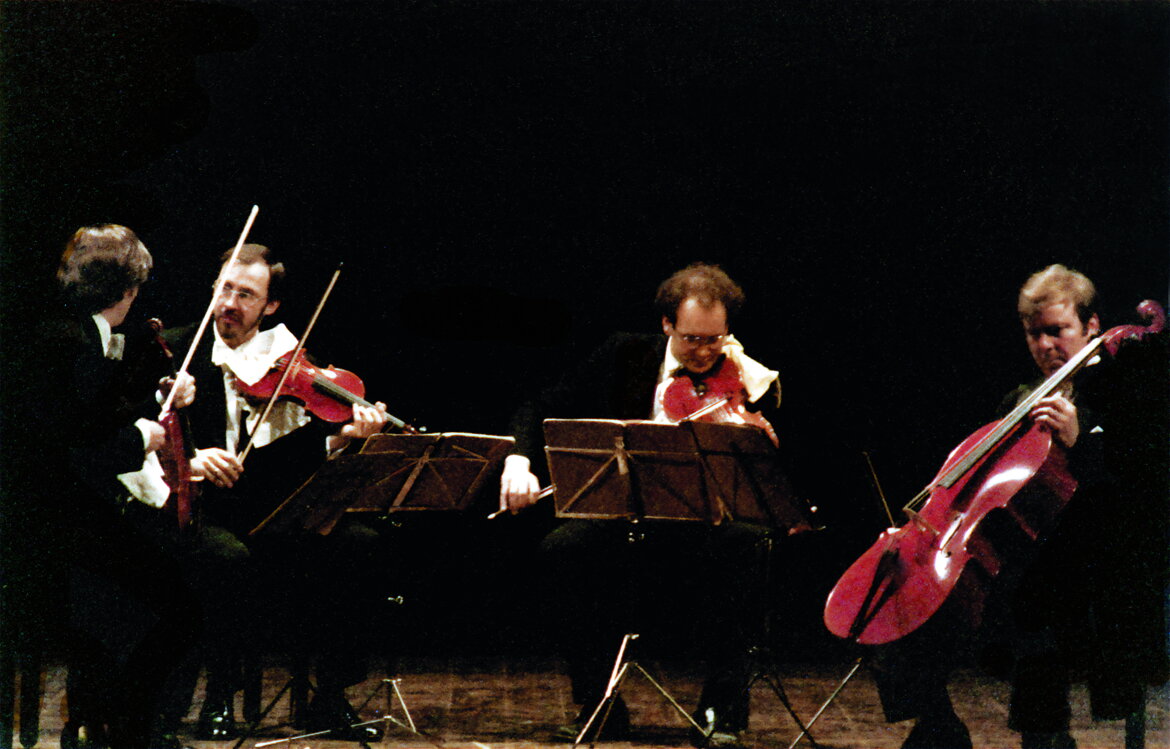
The Lindsay String Quartet in concert at the Teatro Manzoni in Pistoia on April 2, 1985, with violins and viola by Francesco Bissolotti and cello by Wanna Zambelli. Photo: © 1985 Zambelli Archive
The project «Homage to Stradivari. A Violin for a Concert»
The original CNA project entitled «Homage to Stradivari. A Violin for a Concert» was launched as part of the events organized by the Municipality of Cremona in 1987 to celebrate the 250th anniversary of the death of Antonio Stradivari.
Original because it is unique, this initiative aimed to pay homage to the figure of the greatest violin-making genius by enhancing modern, high-quality Cremonese violin making and promoting the creative and artistic skills of young Cremonese violin makers. This initiative parallels the valuable work carried out – on a musical level – by the «Walter Stauffer» Foundation of Cremona and the masters of the eponymous advanced courses (Accardo, for the violin; Giuranna, for the viola; Filippini, for the cello; Petracchi, for the double bass).
The project, conceived as a meeting point between young violin makers and young violinists, was divided into three distinct phases. The first coincided with the selection of the winning violin of the violin-making competition by a prestigious jury chaired by Salvatore Accardo and composed of Andrea Mosconi, Conservator of the City of Cremona's Violin Heritage, and master luthiers Francesco Bissolotti, Giancarlo Guicciardi, Wanna Zambelli, and Giorgio Cè.
Loeiz Honoré, 27, a Frenchman living in the province of Cremona, who created the best instrument among those examined by the jury, was then awarded the prize during an official ceremony held in Cremona's Town Hall, attended by Mayor Renzo Zaffanella and a large representation of industry professionals, institutions, and the Cremonese cultural world. In addition to a substantial cash prize, the young violin maker had the satisfaction of seeing his violin recognized as a gift to violinist Massimo Quarta, 22, from Lecce, one of the best students of the violin master classes held in Cremona by Maestro Accardo. Today Massimo Quarta is an internationally renowned concert performer.
Having reached the final stage, the concert by violinist Quarta (accompanied on piano by the astonishing Stefania Redaelli), on the instrument of the luthier Loeiz, on September 28, 1988, was a resounding success in the splendid setting of Palazzo Martini in Cremona.
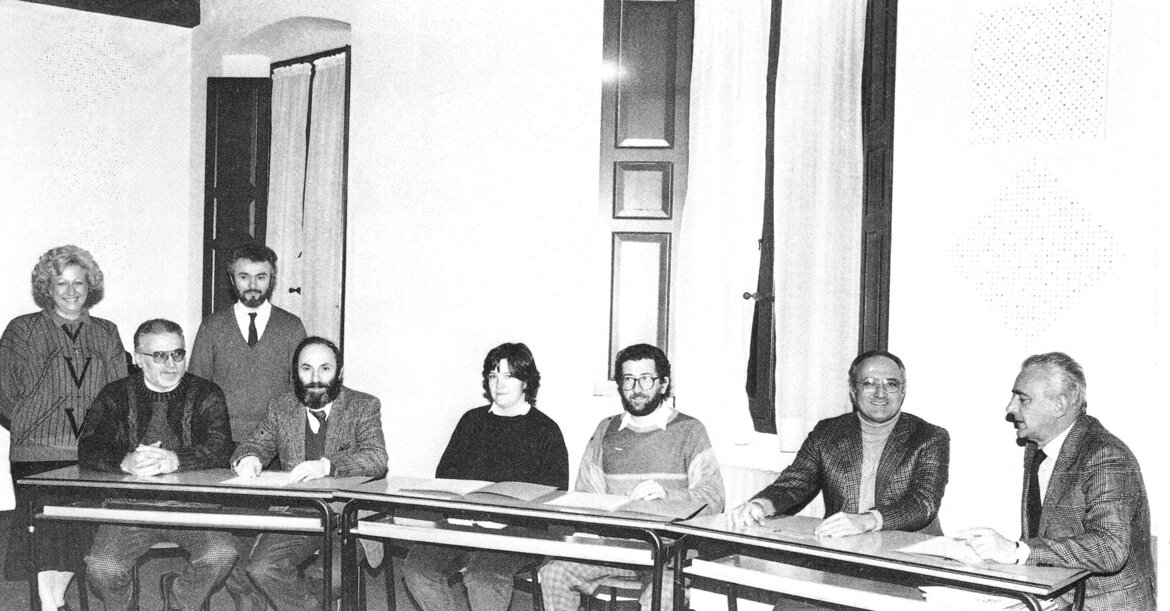
The Jury of the «Homage to Stradivari. A Violin for a Concert» Competition.
From left, seated: master luthiers Giancarlo Guicciardi, Francesco Bissolotti, Wanna Zambelli, Giorgio Cè, violinist Salvatore Accardo, and Andrea Mosconi, curator of the City of Cremona's violin heritage. Standing, Giulia Penci Danieli and Giuseppe Mazzini, secretary and president of the CNA of Cremona. Photo: © 1987 Zambelli Archive
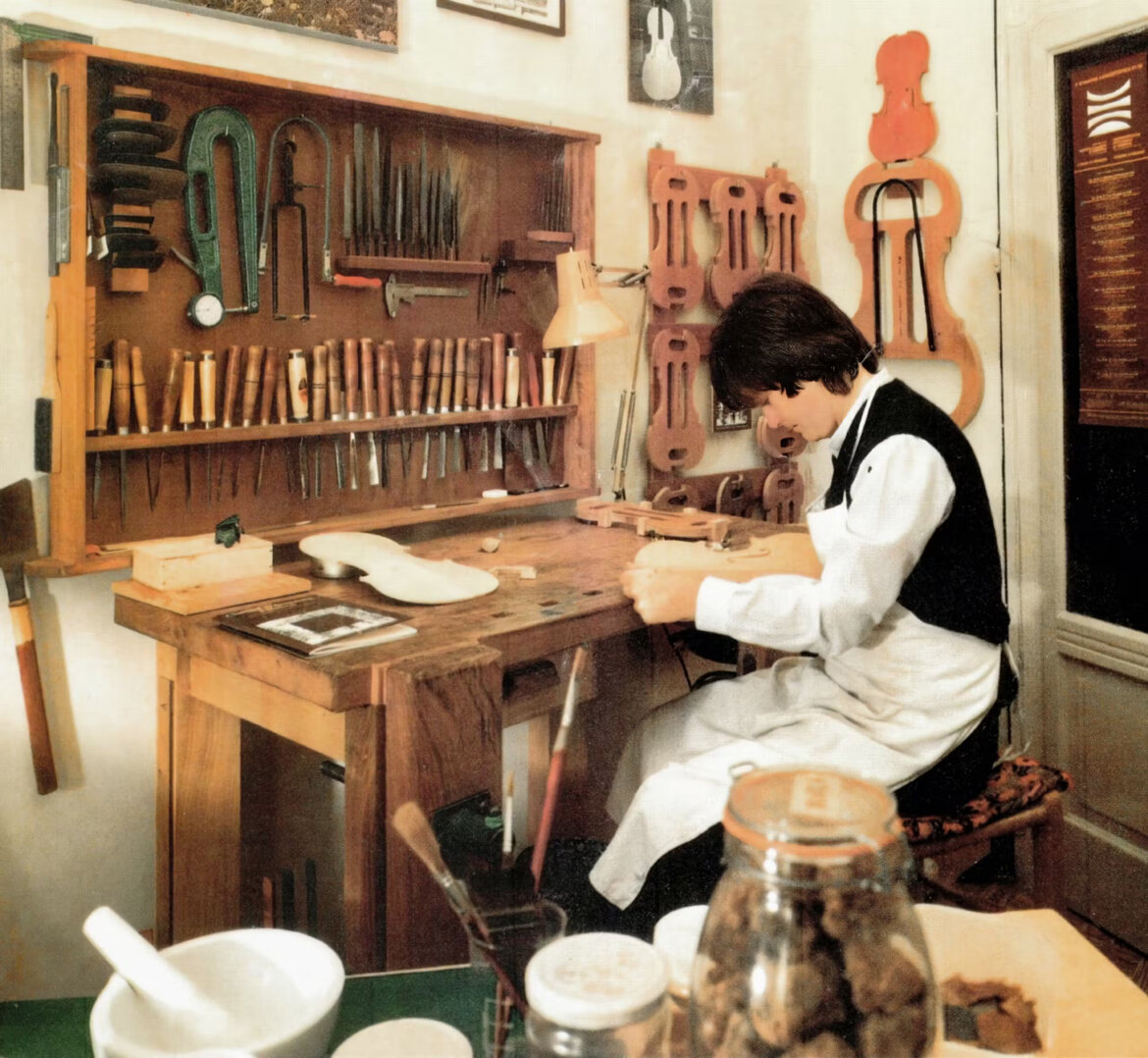
Wanna Zambelli at her workbench. Photo: © 1989, "Artigianato e Piccola Impresa," a bimonthly periodical of the Lombardy Regional Committee of the CNA. Milan, December 1989.
Sacconi, the value of work
The legacy of the Italian-American master embraced by today's artisans: "He revived artistic craftsmanship"
by Nicola Arrigoni
La Provincia
Cremona daily newspaper
June 27, 2023
"To put it in the language of today's kids: Sacconi was great! He put the value of creativity in craftsmanship back at the center of our modern industrial civilization, he put the value of patience and care in work back at the center, he put passion and the desire to do things well back at the center. The excellent luthiers working today in Cremona should look to him with gratitude." Thus, in a passage from her remembrance of Maestro Fernando Sacconi on the fiftieth anniversary of his death, Wanna Zambelli emphasized the legacy of the master luthier, who was remembered over the weekend in two intense days of discussions involving former colleagues, former students, and the violin-making community, gathered at the Violin Museum. The "A Life for Stradivari" initiative was organized by Wanna Zambelli, along with Vinicio Bissolotti, who in various capacities and on different occasions had the opportunity to know Sacconi.
Master and Students
The study day on Saturday, June 24, 2023, and the presentation of the book "Simone Fernando Sacconi. Violin Maker, Restorer, and Expert Among the Greatest of the Twentieth Century" – on Sunday morning – were intended to pay tribute to a great man who owes his passion, mastery, and gentle determination to revive violin making, in the wake of Stradivari's great Cremonese tradition. "Many people participated in the initiatives marking the fiftieth anniversary of Sacconi's death," Zambelli commented, "I believe the maestro would have been delighted and honored. As his somewhat sui generis student, a student during those summers spent in Bissolotti's workshop, I felt compelled to express my gratitude, recalling the lesson that has shaped my life as a violin maker and teacher." In Vinicio Bissolotti's account, offered in the book as well as throughout Saturday morning, the intimacy of family interaction was palpable: "I shared my testimony, what Sacconi passed on to me, but perhaps the most moving moment was the reading of his wife Teresita's letter, interpreted by Daniela Coelli. I was moved to tears, and so were Wanna and many others."
Rebirth of Violin Making
"Sacconi is responsible for the rebirth of violin making," commented Fausto Cacciatori, curator of the MdV (editor's note: Violin Museum), during the two-day event. Cremona owes much to Sacconi.
It was he who curated the instruments arriving from the States during the Stradivarius bicentenary in 1937. It was also Sacconi who first reorganized Stradivarius's memorabilia. It was also Sacconi whom Alfredo Puerari and Andrea Mosconi called upon to assist them in the purchase of the 1715 Stradivarius, which began the Municipality's collection of stringed instruments. Unless you study Sacconi, you cannot understand the passion, enthusiasm, and vision with which violin making was reborn. His book, "The 'Secrets' of Stradivari," recounted and documented the stages of violin making by the greatest violin maker of all time, a study born from Sacconi's experience as a violin maker and restorer. And then there was Sacconi's love for the city, for its tradition, the love you see in those who, coming from outside, consider Cremona the magical and ideal place to make violins.
The book – strongly desired by Zambelli and Bissolotti – leaves its mark on the fiftieth anniversary: "We have republished some of the edited works from the 1985 volume and added previously unpublished photos," explains Zambelli. "The goal is to preserve his memory, to demonstrate the esteem of those who knew him and worked with him. The book is a way to tell Maestro Sacconi that his teachings are more precious and important than ever for us."
From the written page to the volatility of music through Sacconi's instruments, the step is a short one, and it was accomplished in the crowded audition where Gian Andrea Guerra played the Simone Fernando Sacconi 1941 violin: "An incredible violin, a copy of the 1715 Stradivarius but without the adaptations the instrument has undergone based on the evolution of musical practice," observes Cacciatori. The 1941 Sacconi violin has provided unprecedented sounds that we are perhaps no longer accustomed to, a true leap back in time, in search of the authenticity of Stradivari's lost voice." And this too is one of the 'miracles' performed by the great Sacconi, so in love with Stradivari that he dedicated his entire life to the greatest violin maker of all time, coming to Cremona on pilgrimage every summer, often as a guest of Andrea Mosconi, whose hospitality was also expressed in the care with which his wife prepared the omelettes for his American guest, which he was so fond of.
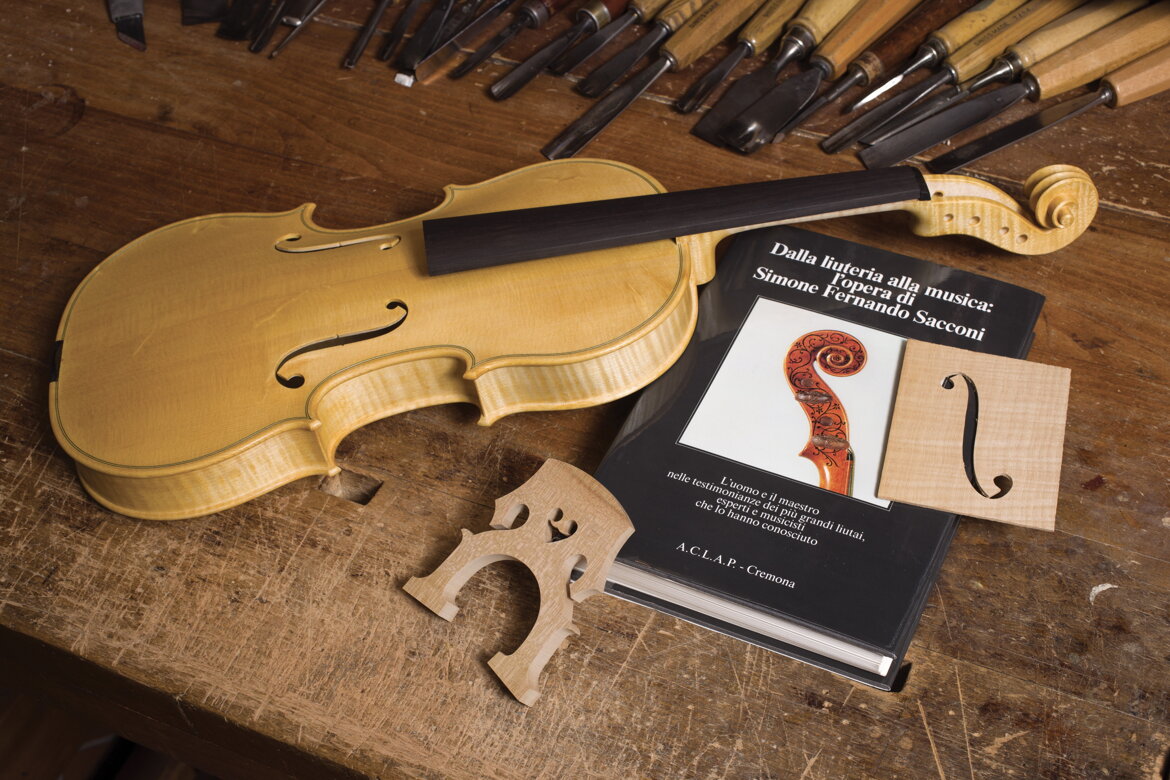
The multilingual book «From Violinmaking to Music: The Life and Works of Simone Fernando Sacconi» conceived and promoted by luthiers Francesco Bissolotti and Wanna Zambelli, published in 1985 by Aclap of Cremona (Production Coordinator, Franco Feroldi) and presented in December of the same year at the Library of Congress in Washington, D.C.
Library of Congress: LC Catalog - Item Information (Full Record). Photo: © Claudio Mazzolari, Cremona
Zambelli has been a key figure in events celebrating the legacy of Cremonese violin making. In June 2023, as the preceding article notes, she participated in the Study Day at the Violin Museum commemorating the 50th anniversary of the death of Simone Fernando Sacconi, giving a talk on "Simone Fernando Sacconi, Adoptive Father of Young Violin Makers" and participating in a panel discussion on The 'Secrets' of Stradivari. This ongoing engagement with the historical foundations of his craft and her role in interpreting his legacy are evident.
Another significant contribution of Wanna Zambelli to Cremonese violin making is her collaboration with Marco Vinicio Bissolotti (son of the late Francesco) on the book «Simone Fernando Sacconi. Luthier, restorer, and expert among the greatest of the 20th century», published in 2023 on the 50th anniversary of Sacconi's passing and presented on June 25 of that year at the Violin Museum in Cremona as part of the project «A Life for Stradivari», curated by violin maker Fausto Cacciatori, then curator of the same museum. On October 8, 2023, Wanna Zambelli was chosen to unveil the plaque in the «Sacconi Room», which the Violin Museum dedicated to the great Italian-American master.
This initiative highlights the importance the Cremonese violin-making community places on preserving the knowledge and insights of past masters. Zambelli's personal involvement with Sacconi made her participation in this project particularly valuable. Her close relationship with Sacconi allowed her to gather unique anecdotes and perspectives that enrich the book, offering a more intimate and comprehensive portrait of his life and work.
The book includes the republication of several testimonies from the 1985 volume she conceived and promoted with Francesco Bissolotti («From Violinmaking to Music: The Life and Works of Simone Fernando Sacconi»), along with previously unpublished photographs, with the aim of preserving Sacconi's memory and the esteem of those who knew him. Through this co-authorship, Zambelli has made a lasting contribution to the history of violin making, ensuring that Sacconi's legacy continues to inspire and inform future generations of luthiers and scholars. Publications play a crucial role in the preservation and dissemination of knowledge, ensuring that the contributions of influential figures remain accessible to a wider audience over time.
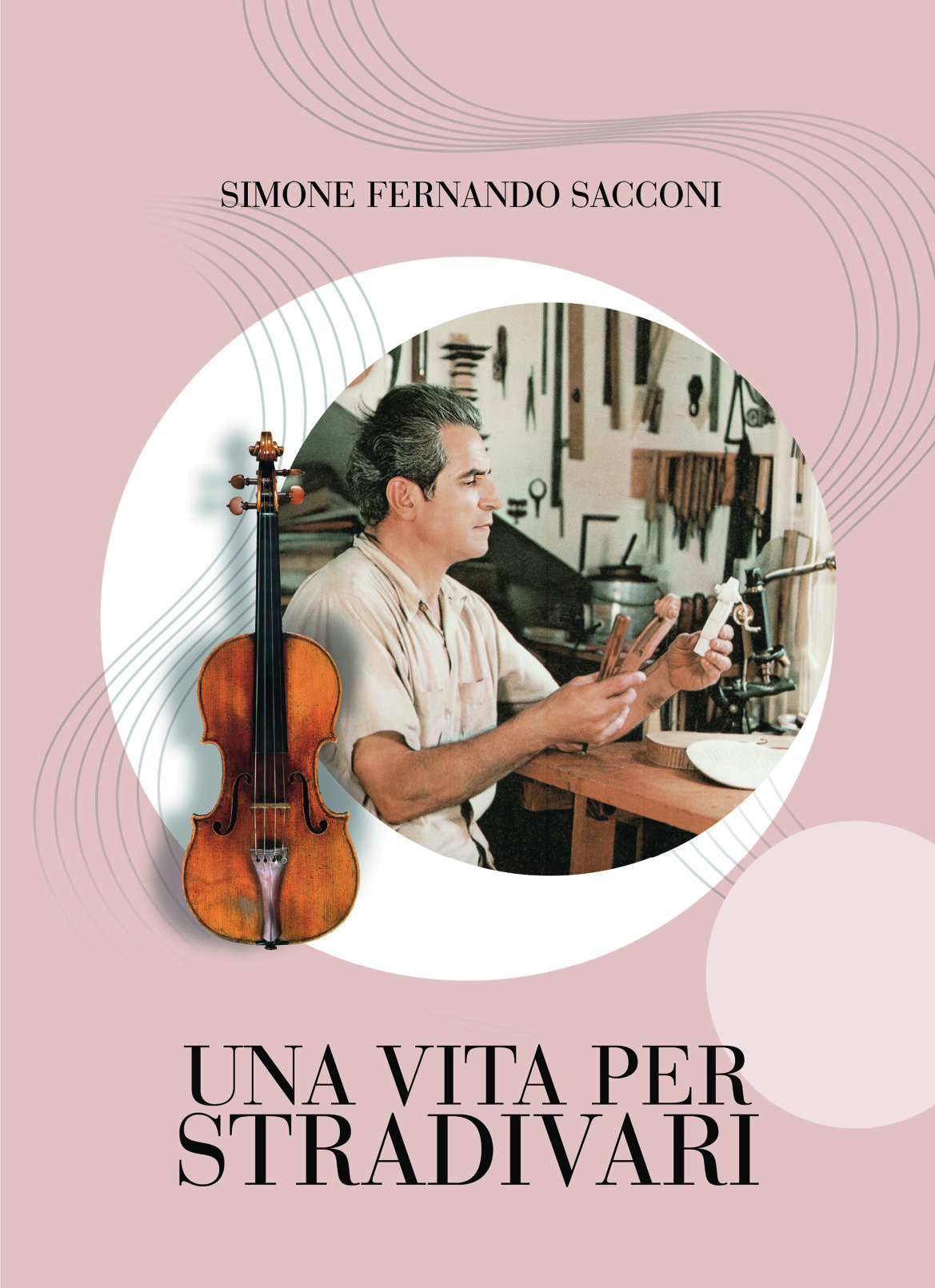
Logo recalling the title of the project dedicated to Maestro Sacconi on the 50th anniversary of his death. Cremona, Violin Museum, June 24-25, 2023
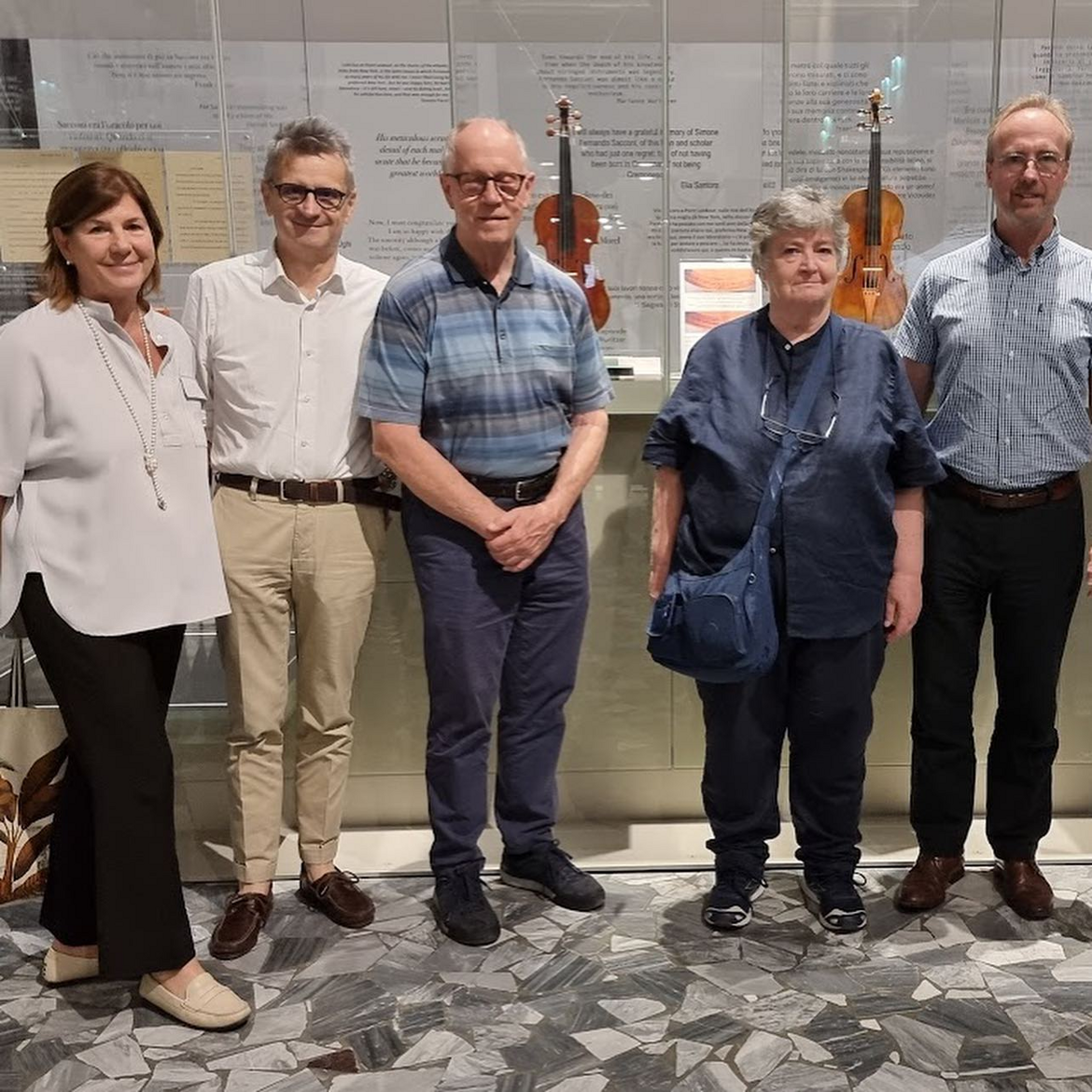
Pictured below: at the Violin Museum on the occasion of the Study Day dedicated to Maestro Sacconi on June 24, 2023.
From left: Virginia Villa, general director of the Violin Museum; Fausto Cacciatori, curator of the museum's collections; Bruce Carlson, renowned Cremonese restorer; Wanna Zambelli, violin maker and Cremonese student of Maestro Sacconi; Peter Beare, English violin maker and restorer (son of the great expert Charles Beare, a student of Sacconi). Photo: © Fotolive/Calvi, Cremona
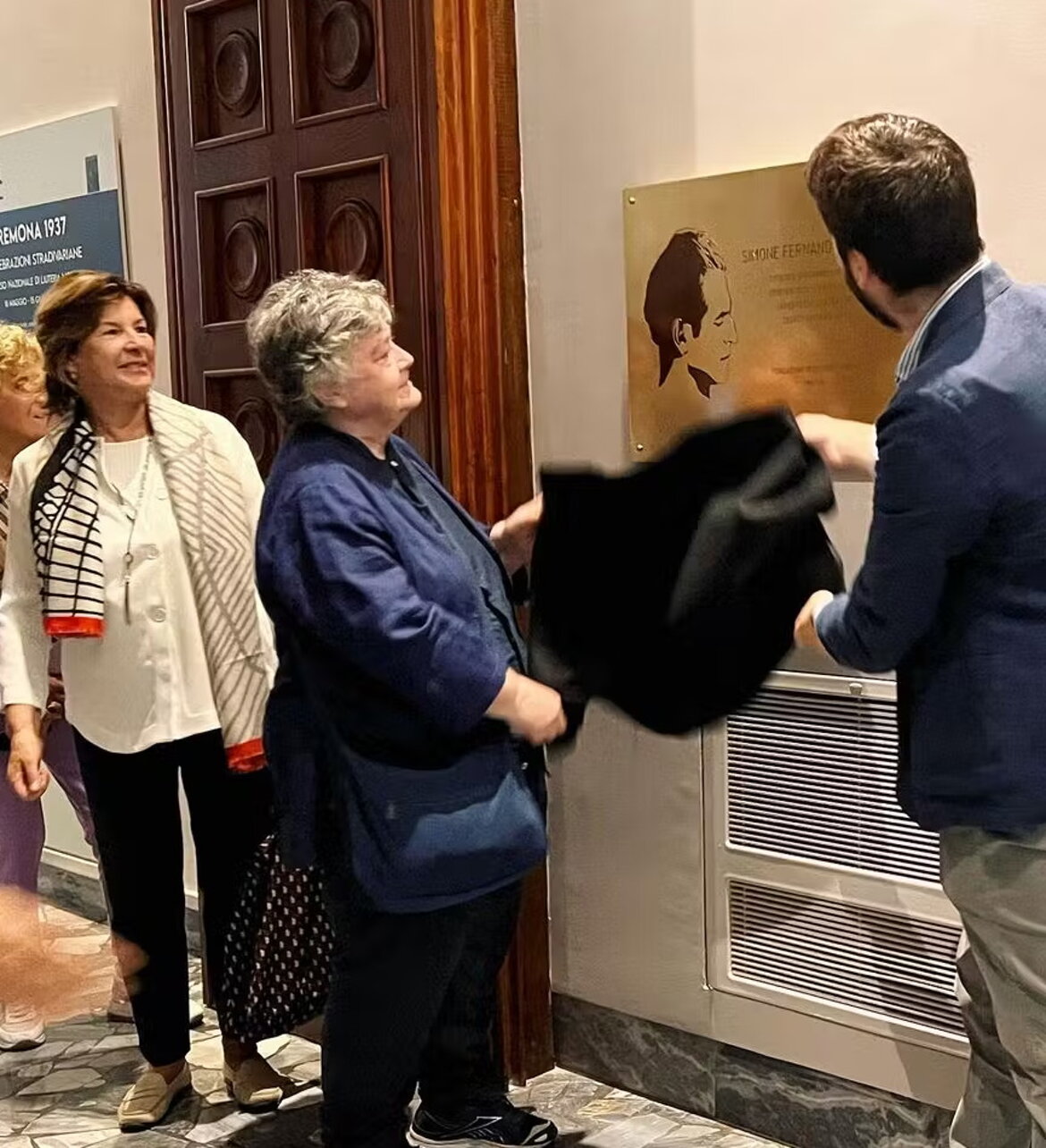
Wanna Zambelli and Luca Burgazzi, Cremona's culture councilor, unveil the plaque for the new «Sacconi Room» at the Violin Museum, named after the Maestro, during an official ceremony on October 8, 2023. Left: Virginia Villa, general director of the Museum.
Photo: © 2023 Violin Museum and The Strad accompanying the article Cremona Violin Museum dedicates room to Simone Sacconi, London, October 9, 2023
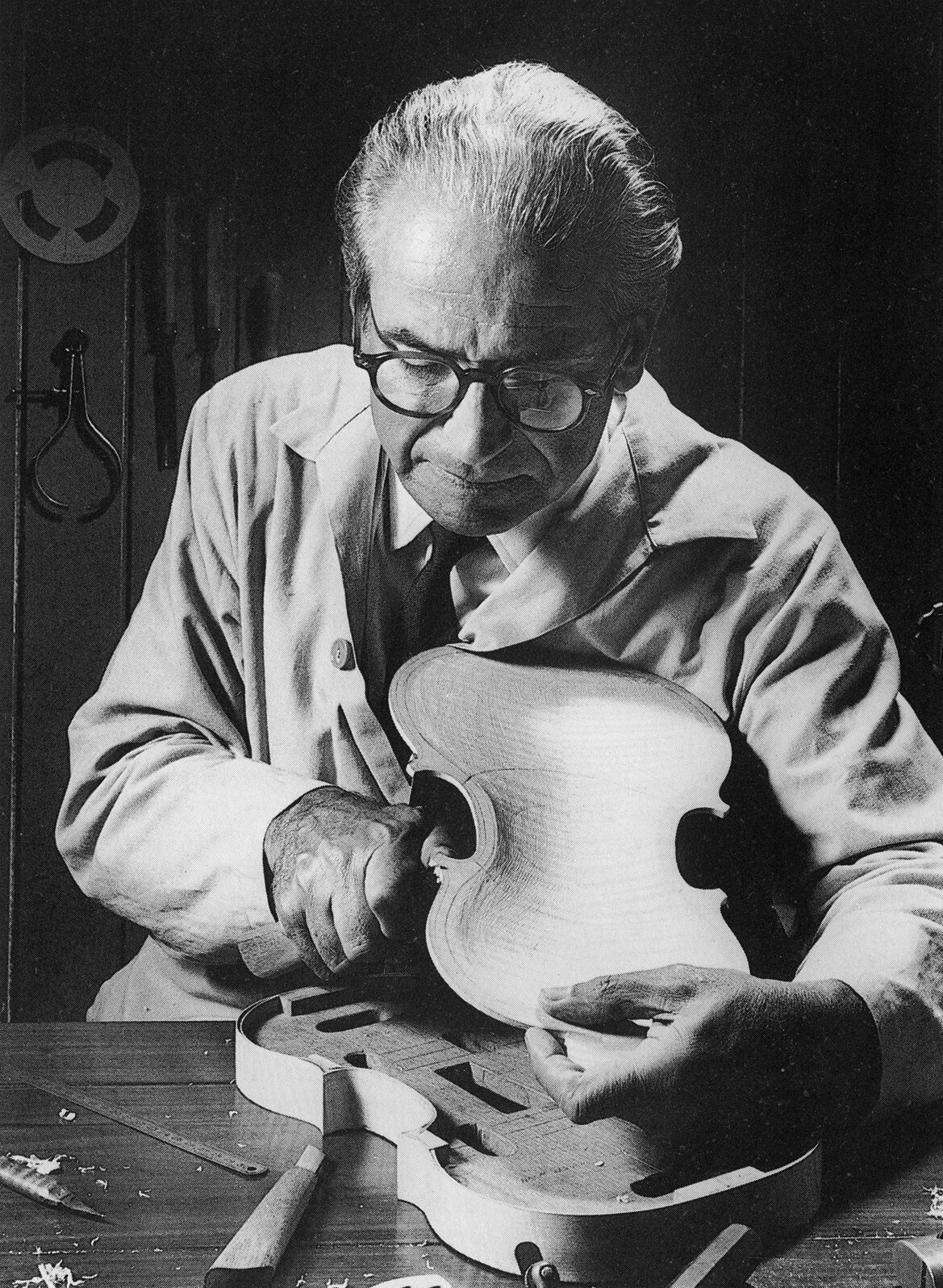
Simone Fernando Sacconi busy roughing out the outline of the back of an instrument. Photo: © 1965 Wurlitzer Archives, New York.
Maestro Sacconi is a pivotal figure in the history of Italian violin making, but particularly in the twentieth-century rebirth and reinvention of classical Cremonese violin making. Without the great Sacconi, violin-making expertise, recognized by UNESCO in 2012 as an intangible cultural heritage of humanity, would not exist.
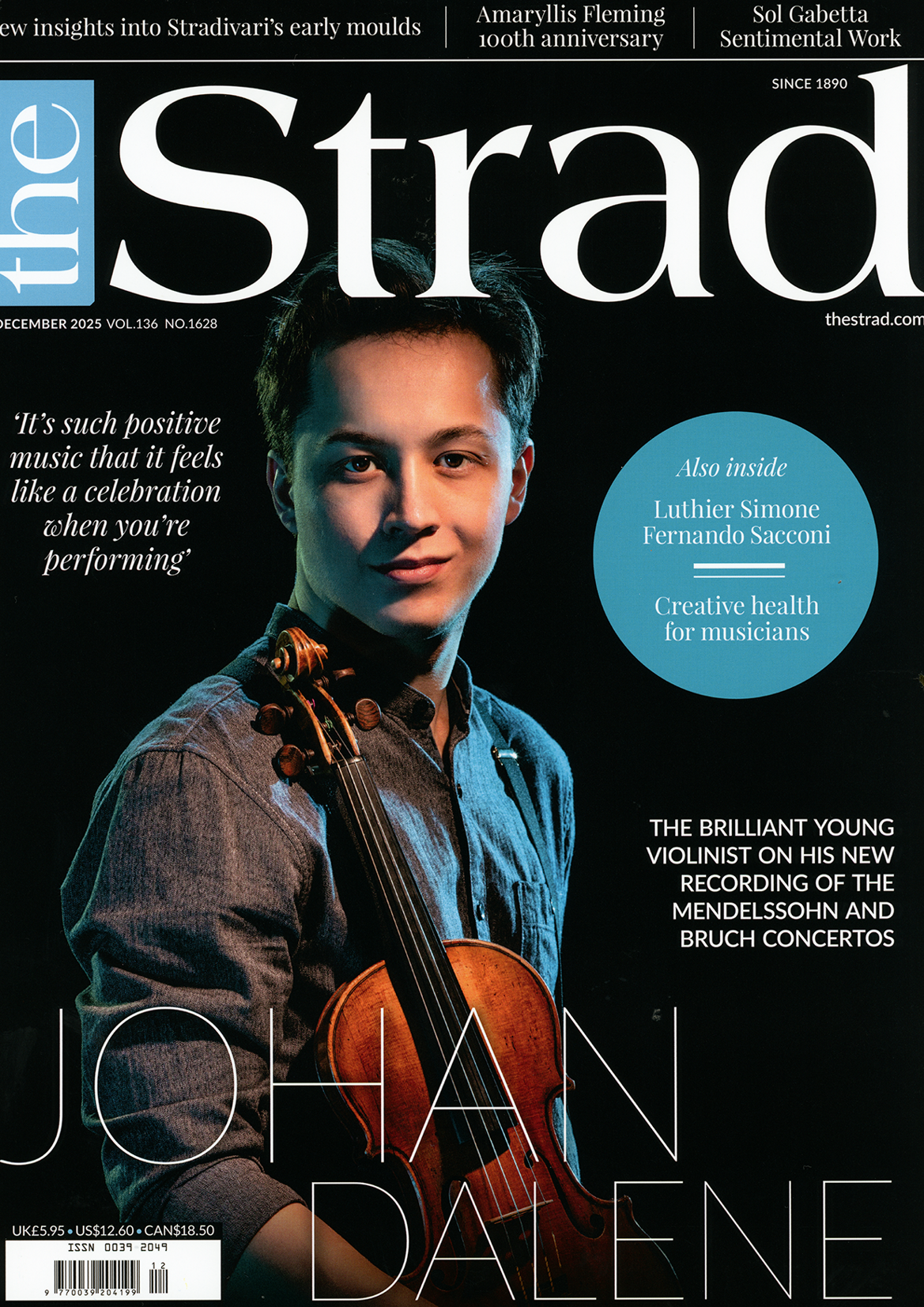
Cover of the December 2025 issue of The Strad magazine, which contains an extensive article on the great master luthier and restorer Simone Fernando Sacconi
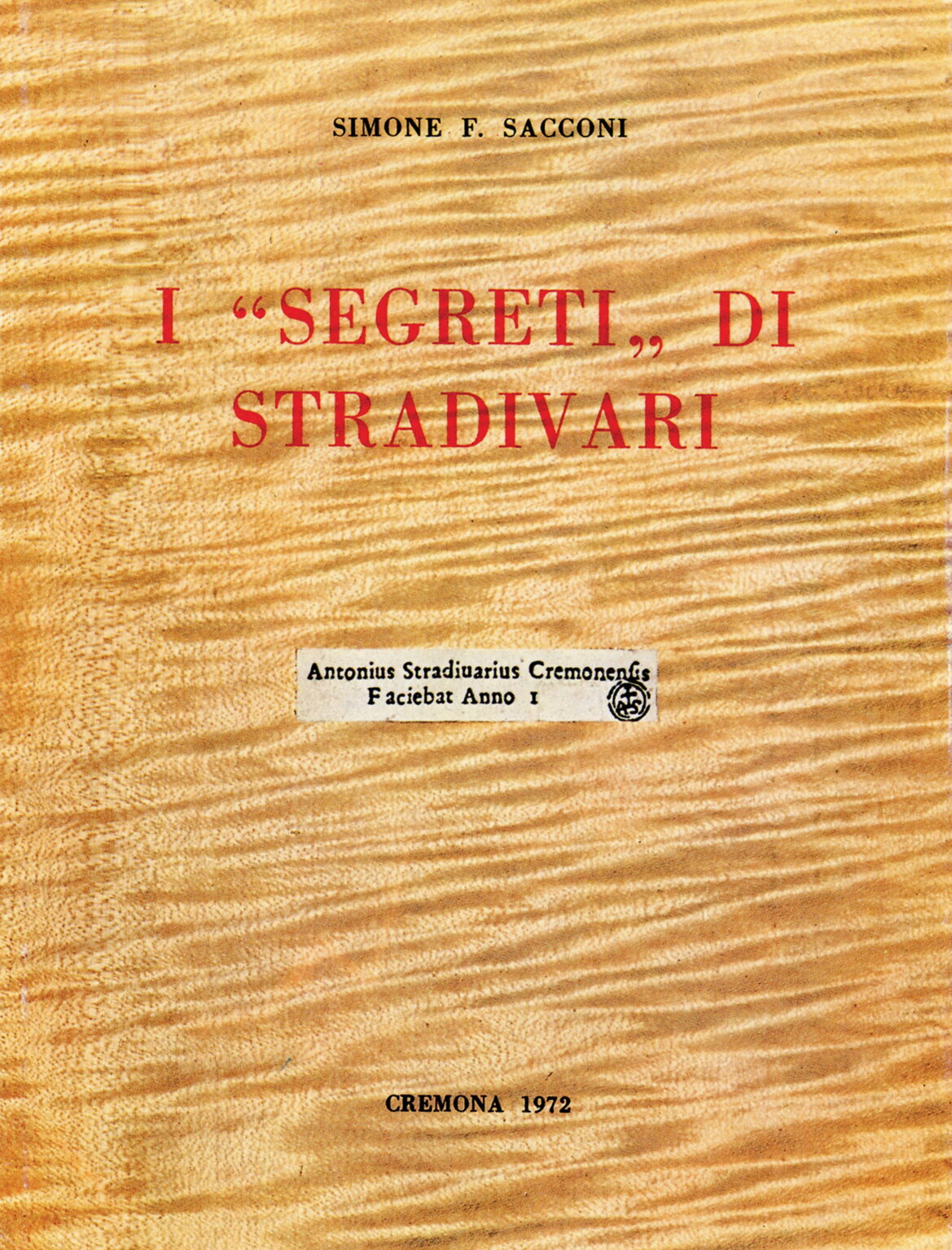
Cover of the book"I 'segreti' di Stradivari" ("The 'Secrets' of Stradivari") bySimone Fernando Sacconi, published in Cremona in 1972 by Libreria del Convegno Editrice di Maria Rivaroli Lombardini
A master of his craft: Simone Fernando Sacconi
by Peter Somerford
The Strad, London
December 2025
Simone Fernando Sacconi was a brilliant violin maker and restorer, a respected teacher, and, quite literally, a celebrated author. From pages 48 to 53 of the magazine, a group of musicians and violin makers pay tribute to Sacconi on the 130th anniversary of his birth. Author of the seminal work "The 'Secrets' of Stradivari," (I 'segreti' di Stradivari) he was a generous man who freely shared his knowledge and is fondly remembered.
Peter Somerford provides a biography of Sacconi and interviews master violin maker Wanna Zambelli, violinist Salvatore Accardo, and American restorers Carlos Arcieri (along with Rosanna Arcieri) and David Segal.
The article includes numerous period photos and a video.
The video ("The world of music. The instrument maker") is set in 1965 at Rembert Wurlitzer's violin-making workshop in New York. In this unique American workshop, the ancient art of violin making is still practiced, using techniques, tools, and designs inherited directly from the hands of the great 17th-century Cremonese master, Antonio Stradivari. Host Morton Gould watches a violin-making demonstration by Simone Fernando Sacconi, the workshop's master craftsman. Gould also speaks briefly with Lee Wurlitzer, who took over her husband's workshop after his death in 1963, and their daughter, Marianne Wurlitzer, who works at the bench with Maestro Sacconi and the other luthiers, including Dario d'Attili, Sacconi's future successor.
Watch the video for free:
www.loc.gov/item/2023602026
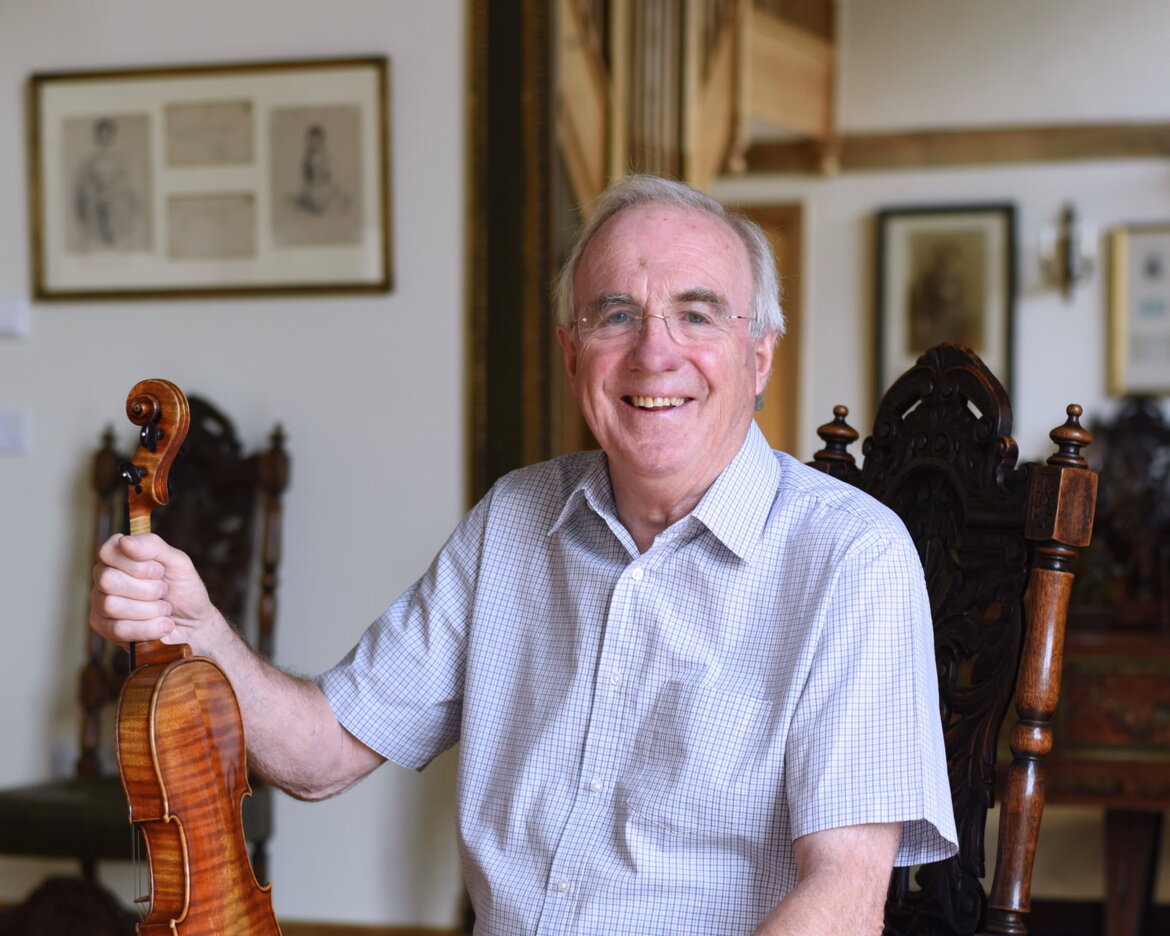
The great violin expert Charles Beare (1937-2025).
Wanna Zambelli recalls: "Beare was one of Simone Fernando Sacconi's most important students. I met him in 1972 at Francesco Bissolotti's workshop in Cremona, where I perfected my violin-making skills after graduating and where I learned from Sacconi himself. I collaborated with Beare and Bissolotti on the 1985 book «From Violinmaking to Music: The Life and Works of Simone Fernando Sacconi», for which Beare wrote the introduction and a moving testimony. In September 1973, Beare himself presided over the jury of the 5th National Biennial of Stringed Instruments in Cremona, replacing Sacconi, who passed away on June 26 of the same year. For me, Beare, along with Bissolotti, was Sacconi's true heir in Cremona, spreading the teachings he learned at the famous Wurlitzer restoration company in New York. Cremona owes much to Beare, both for his organization and his work. of the Stradivariana of 1987 and for the collaboration with the Walter Stauffer Foundation for the purchase of precious classical Cremonese instruments now preserved at the Violin Museum." Photo: © Peter Beare, London
A Tribute to Mstislav Rostropovich on the Great Cellist's 60th Birthday
In the evocative setting of Villa Albergati in Zola Predosa, near Bologna, on the great cellist's 60th birthday, on April 27, 1987, a remarkable concert was held by Mstislav Rostropovich in a trio with Anne-Sophie Mutter (violin) and Bruno Giuranna (viola) as part of the "Bologna Festival '87" violin festival. The Mayor of Cremona was present, along with the Stradivari Cremonese 1715 violin, which was exhibited at the Aclap exhibition «Classical Violinmaking: a Method. Stradivari and the Cremonese School,» held at the Galleria d'Arte Moderna at the Palazzo dei Congressi in Bologna.
In the Cremona newspaper "La Provincia" on April 29, 1987, Elia Santoro published this article titled "Cremonese violin making takes center stage in two splendid evenings in Pesaro and Bologna," with the subheading "A particularly important success for Aclap":
"Antonio Stradivari has, in popular parlance, been a major force in recent days. And we couldn't otherwise describe the events we attended within 48 hours of Sunday and Monday, first in Pesaro and then in Bologna. Stradivari electrified us with his violins and his great tradition. Indeed, in Pesaro, the Rome-based Fismed (Italian Federation of Musical Instruments, Electronics, and Records), a member of Confesercenti, awarded the Cremonese Association of Professional Violin Makers (Aclap) a plaque and gold medal for their achievements in recent years in promoting and raising awareness of violin making craftsmanship and the Cremonese tradition of stringed instrument making.
In Bologna, however, the presence of the great cellist Mstislav Rostropovich (who owns an extraordinary Stradivarius instrument and who enjoyed an evening of honor with an unforgettable concert held in the sumptuous seventeenth-century Villa Albergati in Zola Predosa, near Bologna), the very young violinist Anne-Sophie Mutter, who recently began playing a 1710 Stradivarius, and the renowned violist Bruno Giuranna, who plays an instrument of the Venetian school inspired by Cremona, brought a breath of extraordinary joy and evocative musical charm to the capital of Emilia-Romagna, in honor of an artist who dedicated his life to music, dedicating the cello to the most prominent part of his vast interests (he is also a pianist, conductor, composer, and admirer of young talents with whom he often plays).
The other evening, he had Mutter at his side, and it was, with a program dedicated to Beethoven's string trios, an event that will not be forgotten by the six hundred guests gathered in the enchanting hall of Villa Albergati, which Marquis Girolamo – a senator and Bolognese ambassador to Rome in 1659 – wanted to be grandiose to host Baroque culture, masterfully combined with the architecture of Sochi and Monti and the fresco cycles of the Bolognese school of Colonna, Bigari, Burrini, and Valiani.
On April 27, Mstislav Rostropovich was celebrated with music and Stradivari, with the presence of Aclap (which brought the exhibition «Classical Violinmaking: A Method,» open to the public until May 20 at the Galleria d'Arte Moderna at the Palazzo dei Congressi), its president Francesco Bissolotti, vice president Franco Feroldi, several Aclap members, including Wanna Zambelli, the mayor of Cremona, Renzo Zaffanella, his wife, and Maestro Andrea Mosconi, who escorted the Cremonese 1715.
While the three concert performers performed their program, the guests' attention suddenly shifted to the Cremonese group, who unsuccessfully attempted to "anonymize" the presence of Antonio Stradivari, for whom, in truth, a seat had been reserved. News had spread that a Stradivari violin had been brought especially from Cremona, the city where the instruments were also born, played by Rostropovich and Mutter. It has been said that this was a unique evening, one that could not be missed by those who are the standard-bearers of the great violin-making tradition, represented by the City Council for the 1987 Stradivarius celebrations, by the ex-Joachim 1715 violin, and by AClap, which, since 1973, has brought a successful exhibition around the world, reaching its twentieth edition in Bologna.
Elia Santoro's story continues: "Among the many episodes of the Bologna evening, two hilarious ones concern the gala dinner in the splendid Villa Albergati. The story tells of one of the most splendid architectural works of the European Baroque, at the center of Bologna's social and cultural life. Villa Albergati has hosted kings, queens, princes, musicians, writers, scientists, and adventurers. An unspoiled place, immersed in a centuries-old park, just minutes from the city center, where the gaze wanders between the plains and the rolling hills.
After poorly disguised assaults on the lavish buffet, the end of the dinner in honor of Maestro Rostropovich is incredibly sweet: on a large table in the center of the main hall, a life-size cello made entirely of the finest dark chocolate is placed, from which the guests remove and suck the pegs, sound post, scroll, and pieces of soundboard. Unobtrusively, Feroldi passes a white handkerchief to Professor Mosconi so he can wipe away the two prominent brown mustaches he's drawn on his face by greedily sucking on a peg.
The funniest scene, however, takes place on the large outdoor balcony of the Villa, where all the guests have moved to watch the fireworks in honor of the maestro (a huge illuminated sign flashes in the sky with the words Thank you, Mischa!, the nickname by which Mstislav Leopol'dovich Rostropovich is familiarly called). Many artists were present, including violinist Uto Ughi, violist Bruno Giuranna, and the attractive twenty-four-year-old violinist Anne-Sophie Mutter. And so Ughi, who doesn't speak German well, starts flirting with the German Mutter through Giuranna, who acts as interpreter. Mutter responds in German, and Giuranna translates into Italian. Feroldi smiles from the sidelines, but Ughi notices and with a wave of his hand indicates that it's worth it. The funny thing is that Mutter smiles too, whether because of Ughi's compliments or his unusual way of courting a woman.
Set up in the Galleria d'Arte Moderna at the Palazzo dei Congressi in Bologna's Fiera district, the Aclap exhibition opened its doors to the public on the morning of April 27, who immediately crowded the rooms to visit the various sections: From the Tree to the Violin, The Violin Maker's Workshop, the photographic sequence on the Restoration of the Instrument, and A Masterpiece of Classical Cremonese Violin Making: Antonio Stradivari's 1715 Cremonese Violin, owned by the Municipality of Cremona and displayed in a secure case.
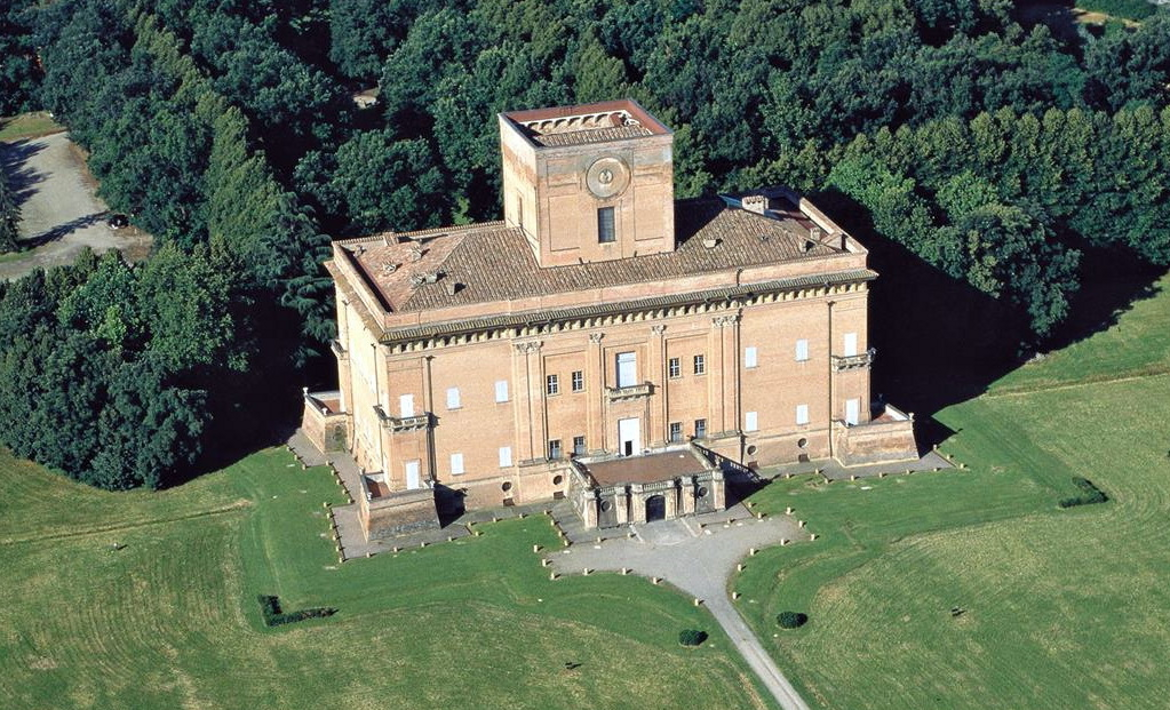
Villa Albergati in Zola Predosa, near Bologna. Photo: © Bologna Welcome
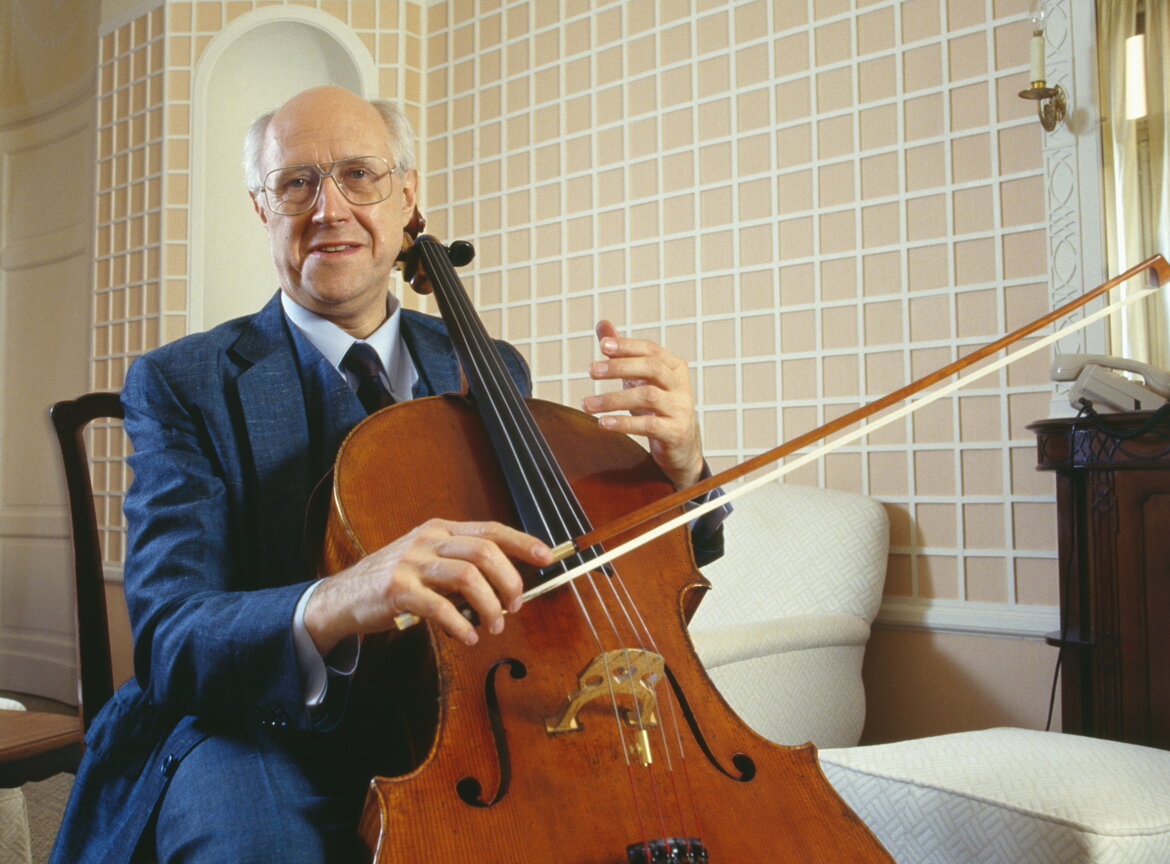
Mstislav Leopol'dovič Rostropovič (Baku, 27 March 1927 - Moscow, 27 April 2007) with the cello of Antonio Stradivari Duport 1711. Photo: © gettyimages
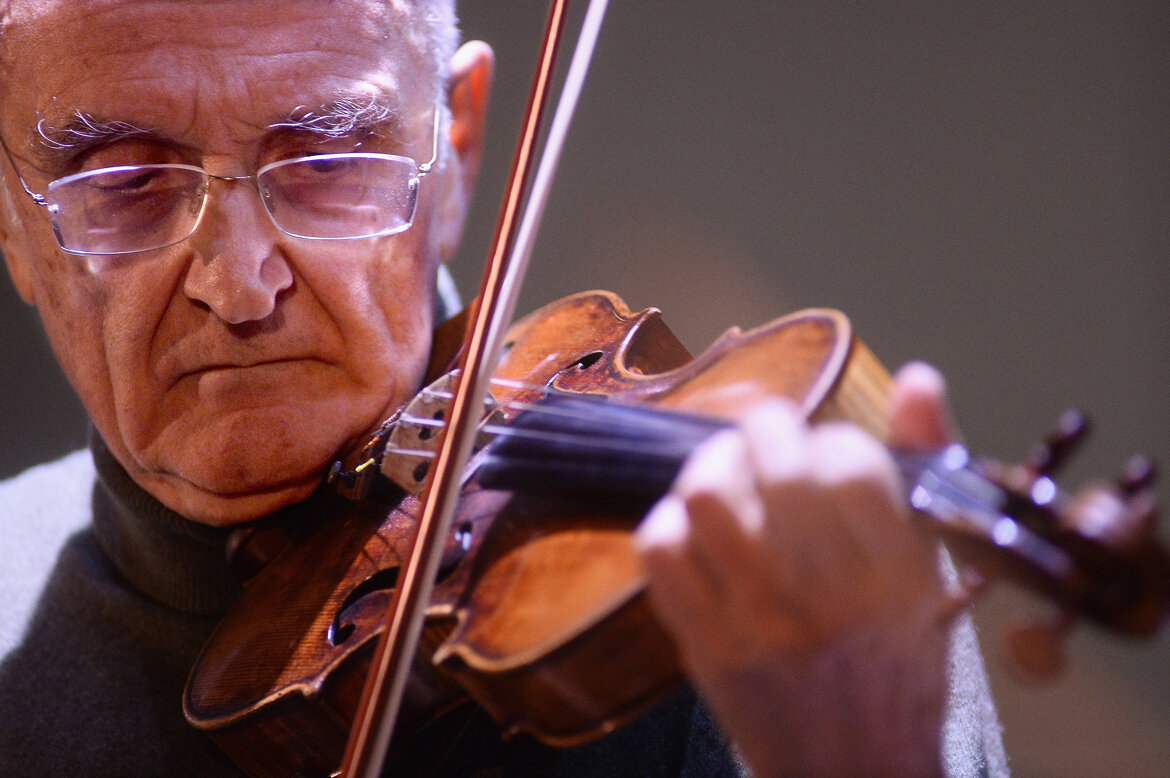
Violinist Salvatore Accardo. In October 1983, RAI's Rete 1 broadcast an extensive report in Francesco Bissolotti's workshop in Cremona, where Salvatore Accardo was interviewed about the special five-string viola that Bissolotti had built for him. Accardo himself gave a brief acoustic performance of a prized violin by Wanna Zambelli. Photo: © gettyimages
Perspectives on Cremonese Violin Making: Tradition and Challenges
Wanna Zambelli is also a keen observer of the various contemporary dynamics affecting Cremonese violin making. She is aware of the challenges posed by growing competition from other regions, such as China.
The concern expressed by Zambelli underscores the need for Cremona to focus primarily on quality and maintain its unique identity to remain competitive. The increasing quality of instruments produced in China, combined with more affordable prices, could put significant pressure on Cremonese violin makers. In response to this challenge, Zambelli has publicly emphasized the need for a system to protect Cremonese violin making from illegal practices, ensuring that those who open a workshop in the city possess the necessary qualifications and certified training. The Lombardy Region's law protecting Cremonese violin making (Regional Law No. 44 of July 8, 2025) moves in this direction, although certain aspects remain unresolved and will need to be better defined in a desirable implementing regulation. Implementation of this law could help preserve the high artisanal standards associated with Cremona and protect the Made in Cremona brand, ensuring its prestige and value on the global market. From classical to quality violins.
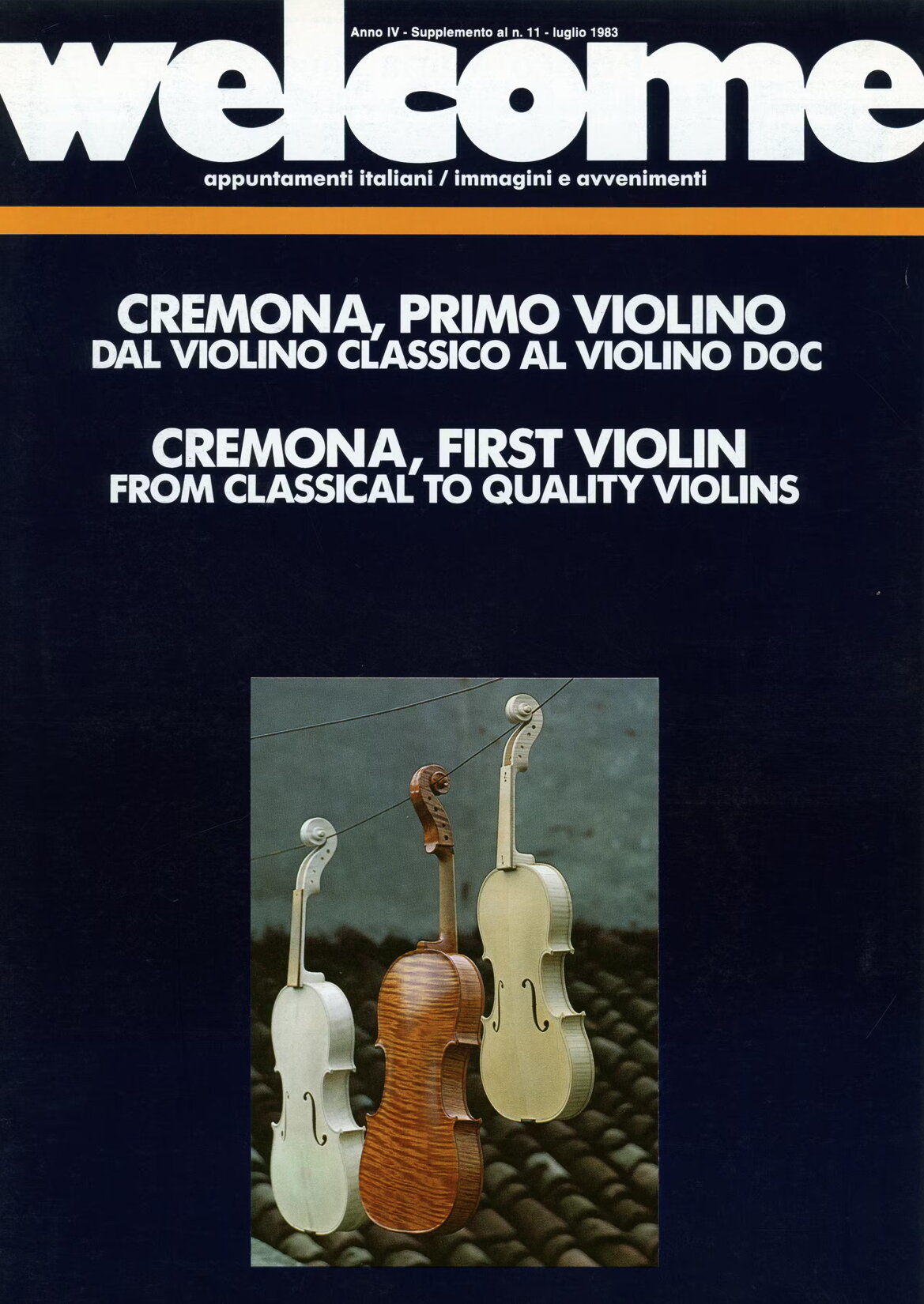
International magazine in four languages, «Welcome, Italian Appointments.» Milan, July 1983. Photo: © 1983 Fulvio Roiter
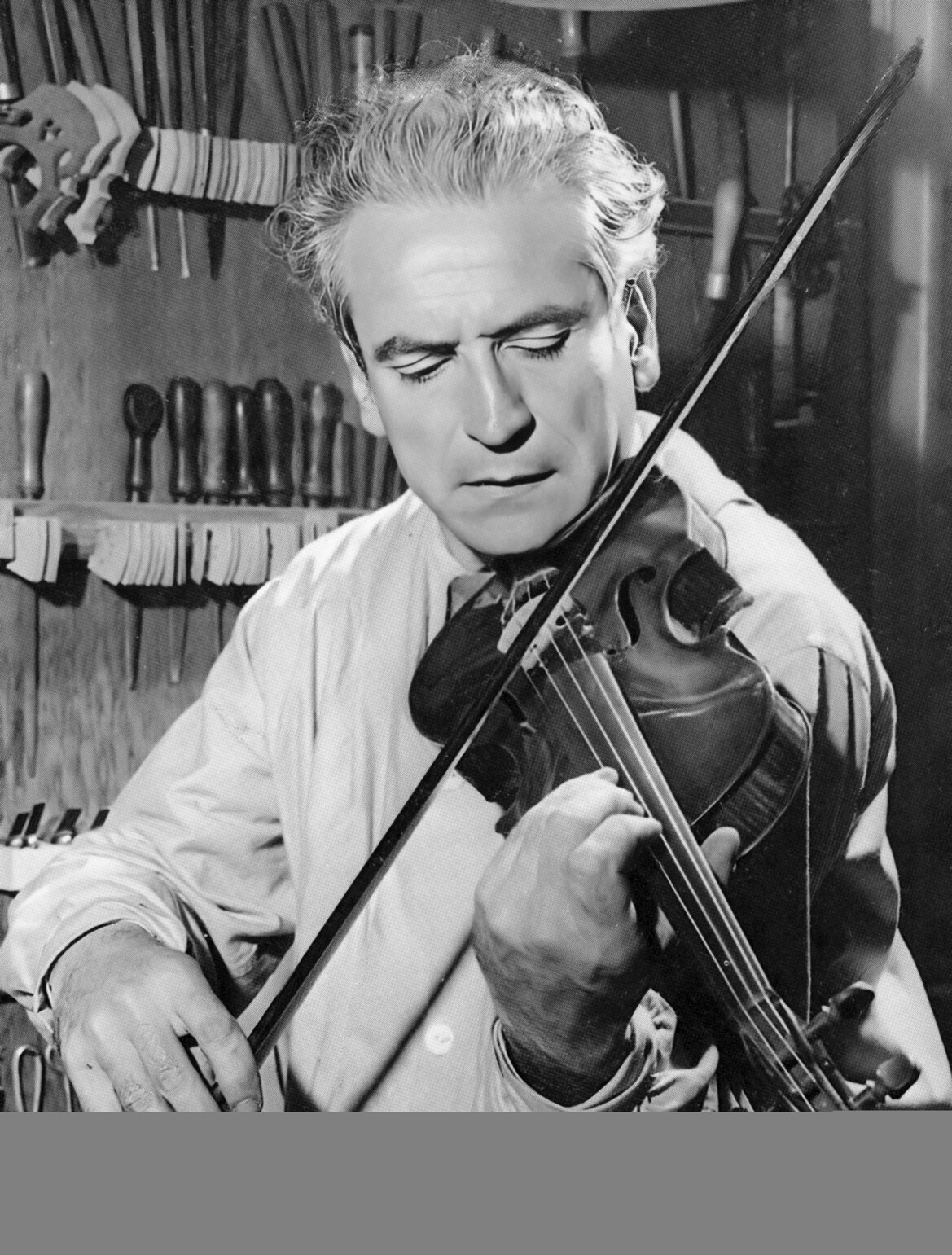
Simone Fernando Sacconi tests the sound of an instrument. Photo: © 1965 Wurlitzer Archives, New York.
The Last Masters of the Workshop
"I Listen to the Soul of Wood"
How a Violin Is Made: Zambelli's Secrets
by Isabella Mazzitelli
La Repubblica / Milan, June 21, 1992
Questioned about her singular career, she responds with a smile: "Do you want the poetic version or the truth?" Wanna Zambelli smiles, her beautiful blue eyes flashing with recalcitrant joy. At just under forty, Zambelli is the most skilled and famous violin maker in Italy, and one of the most renowned in the world. She is a craftsman, a solid, sincere, and rugged craftsman. But she is also an artist, a refined interpreter of wood, who extracts its soul from the secret laws that govern the material and delivers it, lustrous and perfect, to those who, playing her violins, violas, and cellos, seek the greatest harmony of sound between the strings.
"My mother consulted a painter."
His was a great career, with a casual beginning and a breathtaking progression, like a cumbersome and happy love that stumbles into your lap when you're thinking of something completely different. "It was '68, I was sixteen and I lived in Volongo – I'm not from Cremona, I'm from the other side of the Oglio River, from the town of Carla Fracci's youth, so there's a big difference."
"My problem in Volongo was that I didn't know what to do with my future. I'd finished middle school, a year of technical school with a few exams in September, and no desire to study. The alternative was to go to a factory, to make shoes or sheets, like everyone else. My mother, desperate, had asked a painter, a wise man in the village, for advice. 'Let's try the violin-making school in Cremona, and if it doesn't go well, there's always the furniture course.' Instead, it was love at first sight, an immediate, captivating, and total passion."
"Maybe because I suddenly went from the hundred grueling subjects at the ITIS to a handful of lessons," she downplays, trying to bring her sentiment back to the lines of her exposed rudeness. "I didn't have to take English or physics, and there were ten of us and two teachers." The girl who didn't want to study is the first Italian student at the school, which opened in 1938 to celebrate the anniversary of the master of masters, the native Antonio Stradivari. And before her, there were only two women, a Swiss one years ago and a French one later.
"Now the school is full of girls, they make up almost half the enrollment. But then very few actually embark on the profession," she explains, implying that it's a tough profession, requiring absolute dedication, meant for the patient and the stubborn: "Also because the situation in Cremona is tragic, the competition is ruthless. The truth is that there are too many of us," she adds with sincerity, even though she shouldn't have any reason to care about competition.
In the city of the classical method, of the DOC school that the world envies us, there are luthiers galore, in proportion to the market: about seventy in the dedicated association, as many outside. That makes at least 140 people: very few are good, many are mediocre, all there to share the cake of musicians, concert performers, apprentices, and amateurs. Thus it happens that the music-loving tourist, especially the Japanese – who, due to their solvency, are the most sought-after even in this corner of the province – is courted and enticed with rock-bottom prices, even 800,000 lire for a violin handmade in Cremona, when a piece by a master actually costs several million.
The difference is there, perhaps visible and certainly audible, but so it is. The Japanese browse, buy, and leave, taking home "lemon boxes," as they cruelly call the cheap instruments, perhaps made by students at the violin-making school to support themselves.
In the resin-scented empyrean where she lives and works, Wanna Zambelli approaches this topic reluctantly, casting intense blue glances at the instruments, as if an answer might come from their beloved woods. It's clear that it's not her style – direct but kind, sincere but not brutal – to talk about others, about those who tear up a violin in a few hours when she takes two hundred; and it's clear that she doesn't like talking about money. Yet, the topic, in its vulgar concreteness, helps us understand something more.
Zambelli gives up when she realizes she risks being seen as a soundboard tsarina, a capricious and expensive imitator of Stradivarius. "Okay, let's do some math. A violin maker is a craftsman, right? And how much does a craftsman – let's say a plumber – get for an hour's work: say thirty thousand lire? My two hundred hours of work making a violin would therefore be worth six million. Not to mention the material, and perhaps it's a different kind of work. Well, I consider myself very lucky if they give me seven, because if they're musicians and know what they're doing, they don't argue, but if the customer is a gentleman who wants to give a gift to his son who's learning, then getting a fair price can be tough."
Maybe, we venture, you can make a violin worth seven and one worth two. Maybe you can make twenty a year and that way the numbers add up. The master violin maker exclaims irritably, her eyes flashing menacingly: "When I start an instrument, it's not A, B, or C. I make it to the best of my ability. And let's be clear: when I sell one, if everything goes as planned, I'll never see that customer again. We're talking about violins, not coats." As for quantity, Zambelli's production is extremely limited, no more than four pieces a year. She has no time to make more, because her dedication to the violin-making school is immense.
A student of one of the world's most famous violin makers, Francesco Bissolotti, Wanna Zambelli believes deeply in teaching. Bissolotti noticed her after two days of school: "When you graduate, come and work with me," he told her, seeing her good hand from the first gouge. After a few years with the master, the violin maker set up shop of her own, in a room of her house in the old city. Rubber flooring, order, simplicity, no concessions to the iconography of the dying craftsman, covered with age and dust. On the benches, work in progress.
Zambelli builds mostly violins, and then violas and cellos. He has never made double basses, "also because, if I tell them how much they cost – twenty million – they run away."
He made a cello for a concert pianist of Filippini's caliber, but he never says so first, he doesn't show the reference. "I don't bet on the greats; I prefer to work on those who will become great." Not out of modesty. Wanna Zambelli isn't modest; on the contrary, she's very proud of her work and emphasizes it, when appropriate, with calm, satisfied smiles that say, "I'm good, thank you, I know." The reason for this choice is a confirmation of her strong, calm character: "A maestro like Filippini doesn't play my instrument very often, and it's generally difficult for a professional to use a new violin full-time."
The violin maker prefers to cite "musical families" as her clients. Families in the truest sense of the word, brothers and sisters with a passion for the bow. "The Ronchinis from Milan, for example, who are Filippini's students. They are a pianist, a cellist, a violist, and a violinist who is growing musically. They're waiting for their sister to be ready to form a quartet. And I'm building the instrument for her." Then there's the German musical family. His father commissioned the first violin for his son, then came the order for a cello for his brother, and now, says the violin maker, beaming with genuine good humor, "I hope he has another daughter who plays the viola, so I can settle down."
A profound faith in the school
That's just how Mrs. Zambelli is, all passion, irony, and good-natured practicality. But if the lyre were foremost in her thoughts, she wouldn't be a violin maker, or she wouldn't do it with the artistic meticulousness she's recognized for, or she wouldn't dedicate much of her days to teaching the art at the Cremonese school. The curious thing is that Wanna Zambelli doesn't consider herself a priestess of the lute. She doesn't propose, she doesn't speak, she doesn't pose as a vestal virgin of a mysterious cult, she doesn't defend the secrecy of Stradivarius' laws that allow inert matter to transform into sound, harmony, music. Rather, it disseminates and spreads, quietly and serenely, well planted in its peasant roots.
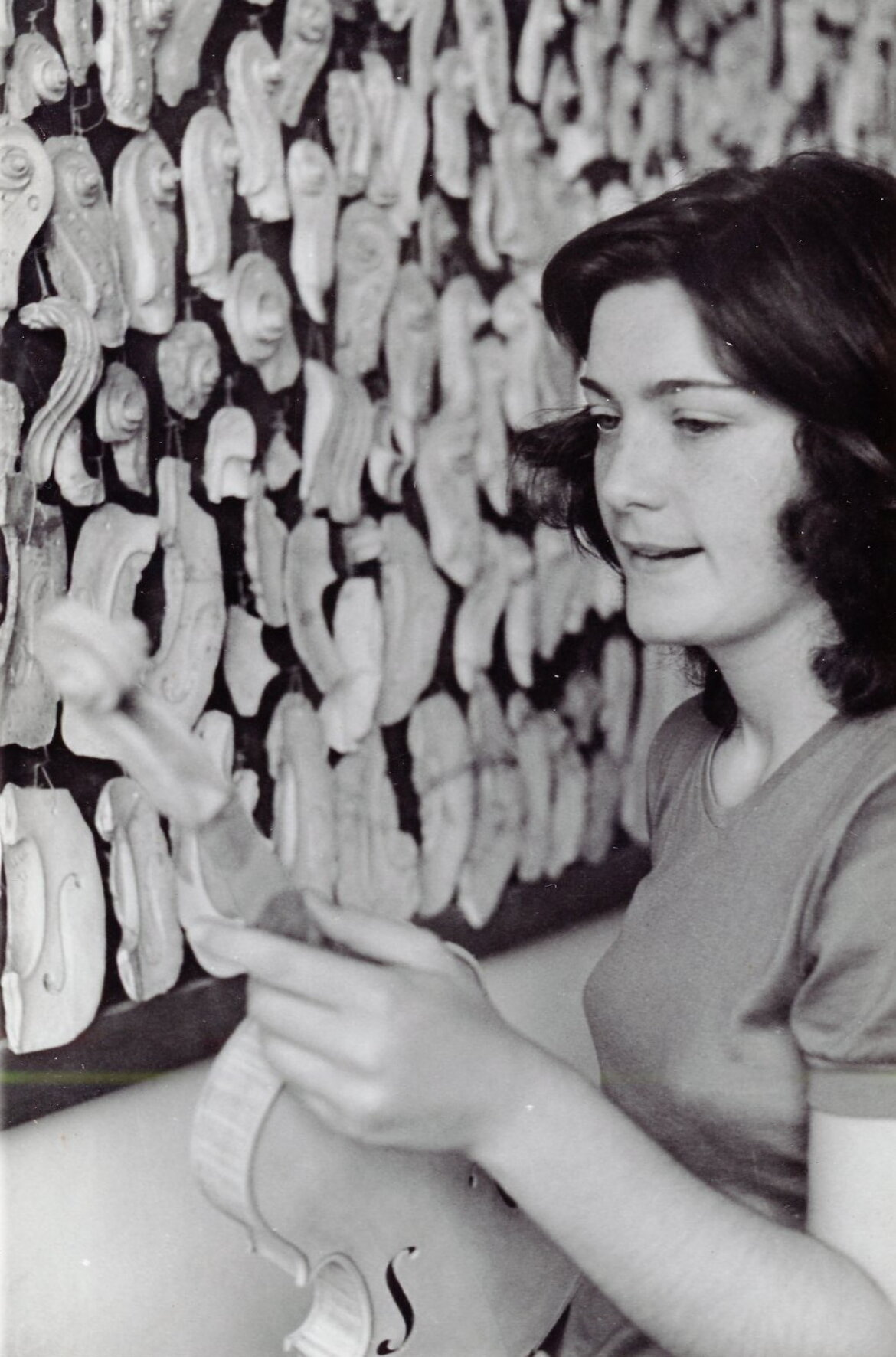
Wanna Zambelli at the Cremona Violin Making School. Photo: © 1972 Zambelli Archive
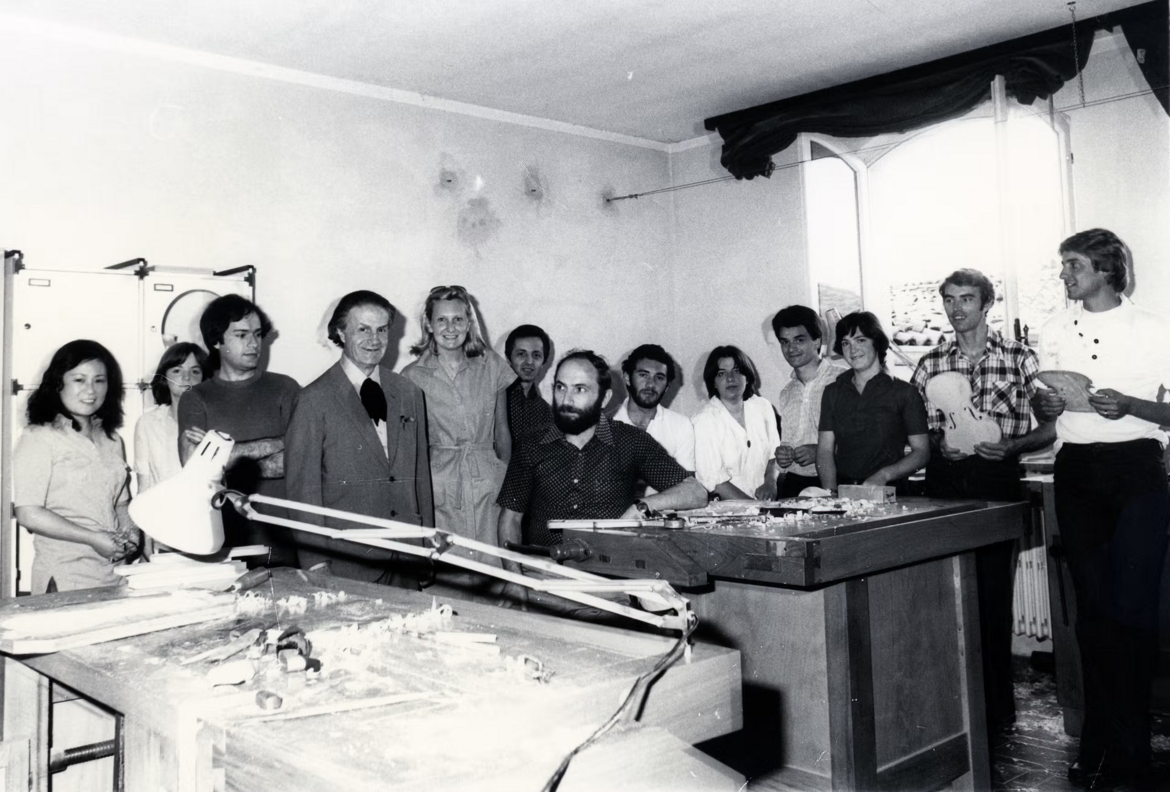
Wanna Zambelli (third from right) in 1977 at the Violin Making School, with some of her students and the master luthiers Alceste Bulfari, Pietro Sgarabotto and Francesco Bissolotti (third, fourth and seventh from left). Photo: © 1977 Zambelli Archive
Women Who Work with Heart
The Violin Tree
Wanna Zambelli, Master Violin Maker in Cremona
by Laura Pazzaglia
8:30 a.m.: workshop class at the «Antonio Stradivari International School of Violin Making» in Cremona. Escorted by the caretaker, I hurriedly climb the four flights of stairs of the sixteenth-century school building to the attic where "master" Zambelli's classroom-workshop is located.
The door is open; a skinny Chinese girl is on the landing stretching her legs. I enter and am overwhelmed by a Bach overture blaring from a large radio on a table; in the shaft of sunlight streaming in from two windows overlooking the rooftops of Cremona, a light dust floats, produced by the woodworking. We are in an attic, with exposed beams and a supporting column in the center.
Workbenches are arranged on each side, tall solid wood tables. Each station has a hanging table lamp, a stool, and a wall cabinet containing the tools. There are countless of them, each with ancient and mysterious names: a file chisel, a vernier caliper, a smooth oval file, a flat bastard file, a half-round rasp file, a Kunz plane, a scraper, chisels, a hacksaw, gouges, a square, and a ruler. Only the last two names mean anything to me. In one corner of the classroom is a large sink where the tools are sharpened: water and a natural gray stone are used.
Wanna hastily shakes my hand: she has fourteen students and only a few hours of lessons, so we'll talk later, alone. She's a stout woman in jeans and a sweater, with a short mop of brown hair and a smooth, ruddy face, in which two small, blue eyes sparkle. He's a man of few words.
I wander among the desks. Each student is intent on a different stage of the process: some are smoothing the arching of a wooden back that already has the shape of a violin with a small plane, others are drawing the characteristic "ff"s (f-holes) on the surface of the soundboard: they check their inclination and position because they will have to cut them later; others, a wooden board in hand, are looking for the teacher to begin cutting the shape.
The students are a Korean with a big smile, the Chinese woman who was outside on the balcony, a Japanese man with hair standing on end from gel and dressed like a manga, the Japanese comic book for teenagers. I speak to the only Italian in the class: a boy from Lucca who worked as a wood and fresco restorer. He had to give it up because he suffered from vertigo, and then decided to make violins.
Then there's a thirty-year-old from Barcelona, an elementary school teacher and violinist. She gives concerts with a violin she made herself. She came to Italy to specialize, and she speaks with reverence of Maestro Zambelli. The youngest is a sixteen-year-old Bulgarian boy; his sister is working at the desk next to him. They are the children of a violin maker who also graduated here in 1985. Then there's a French boy from the Savoy mountains, the son of a carpenter. He also knows how to work with wood to make furniture, but at the age of three he saw a violin on television and pointed to it and said, "I want to do that." And finally, a woman from Liverpool who plays Celtic music. Her eyes are shining, she's talking incessantly with Wanna, trying to repair a hasty groove she's made on the violin's soundboard. What strikes me about Wanna is the attentiveness and love with which she simultaneously speaks and follows three students. To one girl, she suggests they stop working and go smoke a cigarette. To another, she takes a plane no more than a centimeter long and runs it delicately over the wood for several minutes, producing a cascade of fine sawdust curls. To yet another, she explains three times that she hasn't sharpened her scraper sufficiently, enunciating a few simple words in Italian: everyone speaks it, but a little imaginatively.
When the lesson ends, the students vanish down the stairs in a flurry of farewells, instrument cases, and backpacks; with them, Bach's music also vanishes.
Article from the book: Laura Pazzaglia, "Women who work with their hearts," chapter "The Violin Tree" (Reggio Emilia, Aliberti Editore, 2004, pp. 63-65)
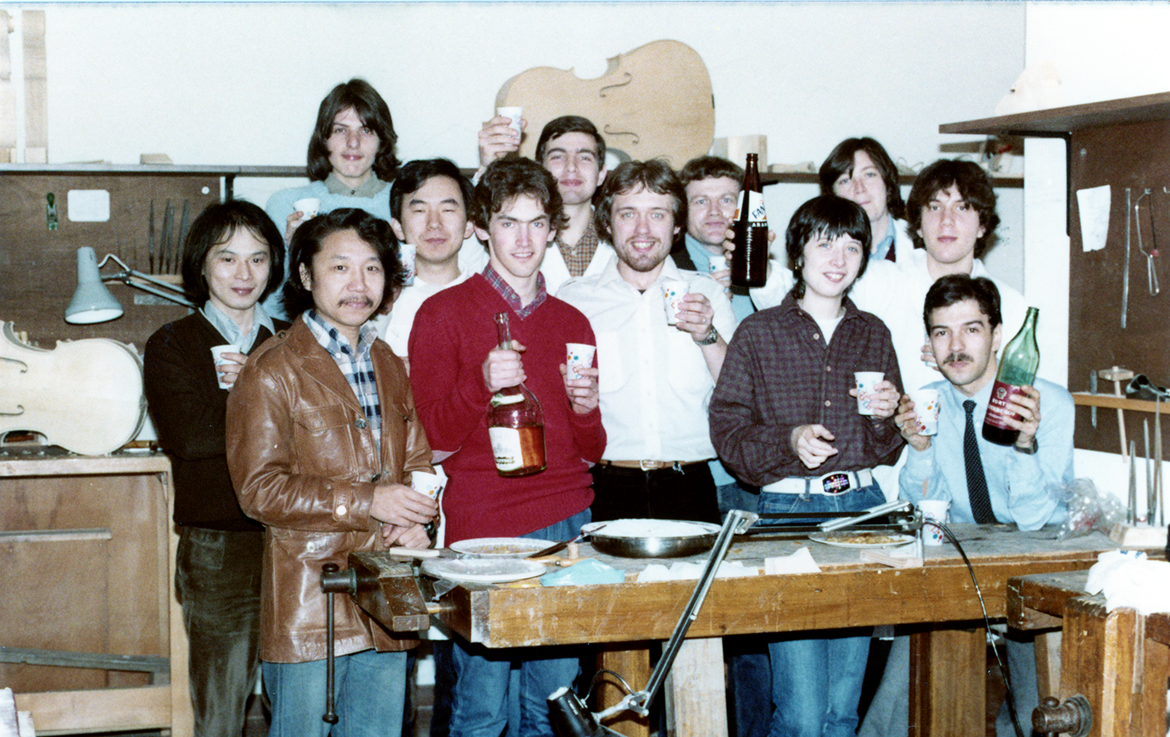
Master violin maker Wanna Zambelli (first from right, third row) in 1980 with her students at the International Violin Making School in Cremona. Photo: © Archivio Zambelli
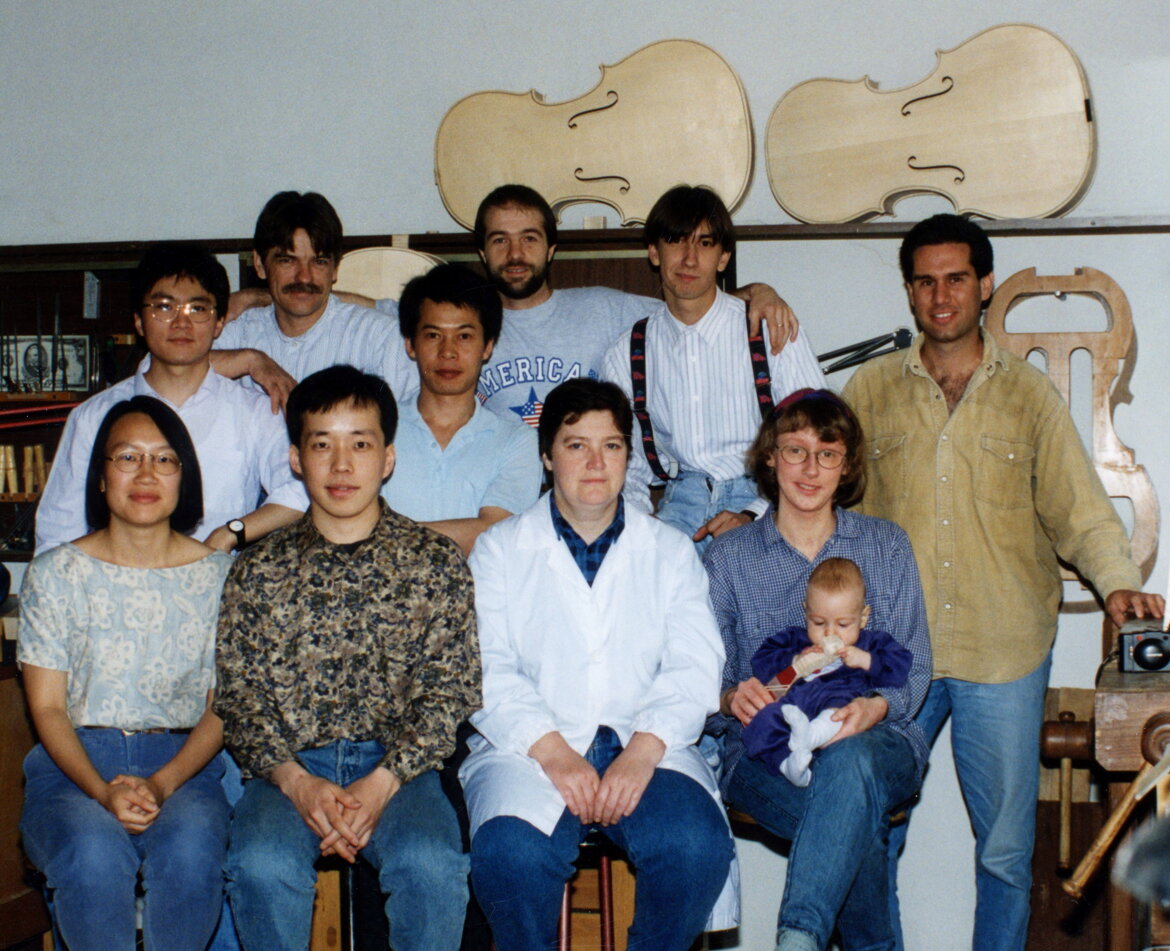
Wanna Zambelli (center, wearing a white coat) in 1995 with some students from the Cremona Violin Making School. Photo: © Zambelli Archive
The best portrait of Wanna Zambelli is given by herself, again in the interview with Laura Pazzaglia in 2004 for the aforementioned volume (ibid., pp. 67-74, excerpt):
I don't play music; I came to violin making through other paths; after all, in my generation, in Italy, how many people could play? Even if I'd wanted to, I couldn't have found anyone to teach me, or even bought an instrument. I learned to play a little at the Violin Making School, where music is mandatory, but then I had to make a decision: you can't play and work. I'm originally from a small town called Volongo, on the border with the provinces of Mantua and Brescia; to get to school in Cremona, I left home at seven in the morning and returned at eight in the evening.
I was born in 1953. But seeing the film «The Tree of Wooden Clogs,» which is set in these parts, things hadn't changed much. I remember my mom still ironed with a hot iron, I remember when we got our first refrigerator, not to mention the television! Back then, we all lived with my grandparents. My grandfather had a small amount of land, sharecropped some, and had only a few animals. So, with the little work there was, my father would go out with the farm machinery to thresh, cut grass, and make bales of hay for the other farmers – he was a craftsman, in short. My mom was always at home, but she was a seamstress, and she did that all her life.
Back then, when girls finished school, they went to work in factories; after middle school, I, on the other hand, had no desire to end up in a factory: it wasn't conceivable to be indoors all those hours. So, there was the option of continuing my studies. I ruled out high school because I wasn't in my mindset to know how to organize my studies. I liked chemistry, so I enrolled in a technical institute for a year. However, I realized that I had to focus on a job where you can see the things you do; Doing something you can't see, like math or physics, was too difficult; let alone being a teacher or a company secretary: in short, I knew what I didn't want.
Until a professor, who taught painting at the local art school, said to my mother: "Why don't you enroll her in the violin making school?" From the first few days, I felt great. While at the technical technical institute there were many students in each class, at the violin making school there were six students in total, from different years: we were like a family. And so I no longer had any difficulties. I liked sitting down and figuring out how to do it. Even before I finished school, one of my teachers, Maestro Bissolotti, asked me to come and work in his workshop.
In the meantime, the school had grown considerably, so in 1972 I graduated and in 1974 I started as a teacher. I also kept my own workshop until 1993, then I closed it because the costs were too high. Among the teachers at the school, I was always the only woman.
The Violin Making School has existed since 1938. The first female student was a Swiss girl in the 1960s, then a French girl who was in her fourth year when I entered, and then for many years there were almost none left. Now here in Cremona, several female violin makers have opened workshops, but then they all have families, and so...
I'm not married, but I've been living with a partner for thirty years. I've always been against marriage, and if I had to do it again, I might not even live with a partner. I don't have children, I just devoted myself to violin making: it's hard enough to do something and try to do it well. And then you have to feel what you're supposed to do: I've never had much of a maternal instinct, or perhaps, if I did, I express it every day when I go to school. In short, complicating things didn't seem like the right thing to me.
My first teacher, Pietro Sgarabotto, who was an old-fashioned maestro, with a bow on his apron and long, artist-like hair, used to say that, looking at an instrument, you see the person who made it. Indeed, that's true: if it's made as it should be, that is, one at a time, in my opinion, you put a bit of who you are at that moment into it. Over the years, you understand that it's not so important to make violins absolutely perfect, but rather to give them a little more personality. Or perhaps it's natural that it's this way: at first you try to imitate, then gradually you give up. I don't know if it's age, I don't know if it's because I can't make them very well anymore!
To make a violin, certain measurements are fixed, others aren't; the length of the neck, for example, is fixed because there aren't frets on a violin's neck like on a guitar; the note is determined by the position of the hand, so the length of the neck must always be the same; the weight must also remain within a certain limit. The shape, on the other hand, always varies. Musicians usually choose the shape they want based on existing violin models. For example, one might want an Amati-style violin. But we must distinguish between a model and a copy of a historical violin: if you ask me for a copy of Guarneri's "Cannone," the wood, color, and shape must be identical. (Editor's note: the "Cannone" is the name of a historical violin played by Niccolò Paganini, famous for the power of its sound, hence the name.)
I especially enjoy starting a violin and carving the head. I enjoy the entire initial phase, right up to the final finishing touches. Afterward, it's a matter of finishing, of doing things with precision. The character of the instrument is evident in the arching, in the "ff"s, how they're made, and especially in the head: it's a job any carver could do; the difficulty is making the two "profiles" equal and symmetrical. I haven't managed it yet. The shape of the head, the scroll, may vary slightly from the canons established in the Baroque era, but these are variations I can notice; for you, they would all be the same.
The F-holes, the two characteristic openings on the soundboard, facilitate the release of sound, but they should be discussed in terms of acoustic physics. However, there are different types of f-holes, depending on the maker. The last thing added, once the violin is finished, is the soundboard. The soundpost is a small cylinder of maple wood that is placed inside the violin case, between the back and the top (the soundboard), at the point where the bridge over which the strings pass rests; it's more or less there, but it varies from instrument to instrument. It's inserted with a hook-like tool and must be slightly wedged into the right position: to do this, you look inside the violin through a hole in the back, where the button will then be placed, from which the tailpiece and strings will extend. The soundpost serves to transmit vibrations from the back to the soundboard and connects these two parts.
In my entire life, I haven't made many instruments, no more than three or four a year. And I almost never sold to dealers, but always to musicians who perhaps had spread the word, because some of them already owned one of my instruments. I sold the first ones in America. Orchestral musicians on tour in Italy would often come to Cremona specifically for this purpose, buy a certain number, and then resell them to colleagues in the United States.
I almost certainly made my best cello in 1984 for Maestro Filippini; he had seen one of my instruments, liked it, so he came to my workshop, we chose the wood together, and he oversaw every step of the process. It took a long time to build, but it turned out well, and he was very satisfied. (...)
The demand for musical instruments is obviously not great, and there are several reasons for this. First of all, there is a widespread prejudice among conservatory teachers that an old instrument sounds better than a new one; obviously, that's not true: it depends on the quality, on how it was made. So they always recommend buying an old one. Look at how many new string instruments there are in an Italian orchestra: very few. And then here in Italy we have the idea that if someone plays, it must certainly be a profession, in an orchestra; in Germany, for example, people play even as a family, each with their own instrument. I don't think it's just a question of money; perhaps it's also a question of education. (...)
And then consider that those who play don't own more than one violin at a time: a few very successful concert musicians can own three or four instruments; those who play for pleasure buy one in a lifetime. In short, there's not much demand. And so a violin made by a master must cost twenty or thirty million lire; so, if someone here in Cremona sells them for two million, there's something wrong... (...)
I think you're born a craftsman; no one pushed me! Sometimes I think about why I do this job, and I can't understand it. I wouldn't have liked taking orders from anyone, that's for sure. But that's not the only explanation for my choice. Maybe there's something that drives you to do something for yourself.
The hardest thing to get across at the School is that one should enjoy making an instrument: if one does it just to sell it in the end, or makes five in a row because one needs money, that's no good. (…)
You need a predisposition for violin making; I can't teach talent. Very few have the instinct and speed to understand how it should be done, but the others who aren't like that don't mean they won't become good craftsmen. I see girls who start out, then if no one encourages them, they give up, become mothers, or do something else. This profession requires a real desire. I too, now that I have to look after my elderly parents, don't have the time I'd like to get back to building. (…)
I, and a few other colleagues, are a bit like violin making dinosaurs; we're still the kind of people who like to sit there, at the workbench. Going on vacation, having a nice house, changing cars every two years – for those of us who take things a bit philosophically, these things aren't really an option.
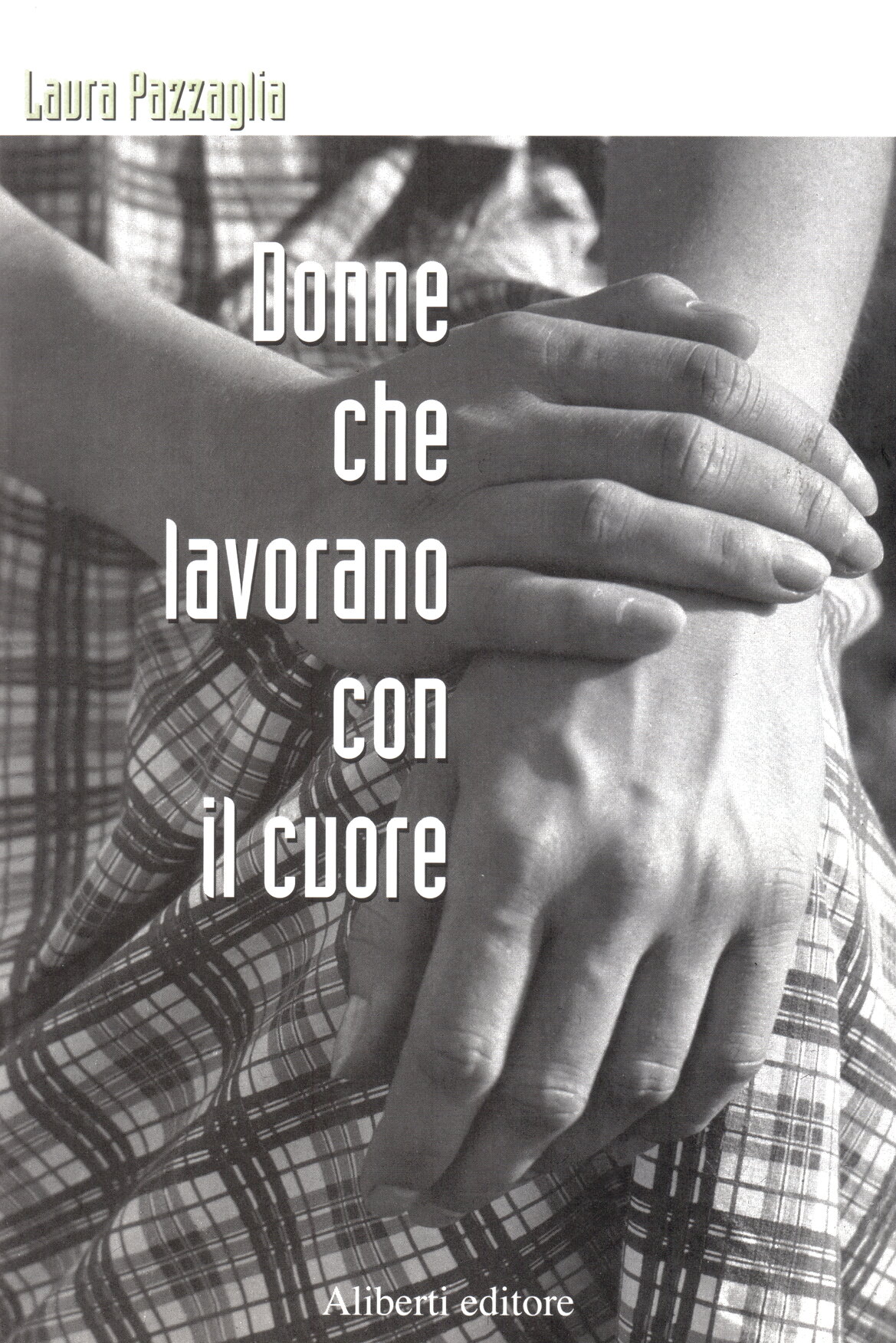
The book "Women Who Work with Their Hearts" by Laura Pazzaglia. Reggio Emilia, Aliberti Editore, 2004. In the chapter "The Violin Tree," the story "Wanna Zambelli, Master Violin Maker in Cremona"
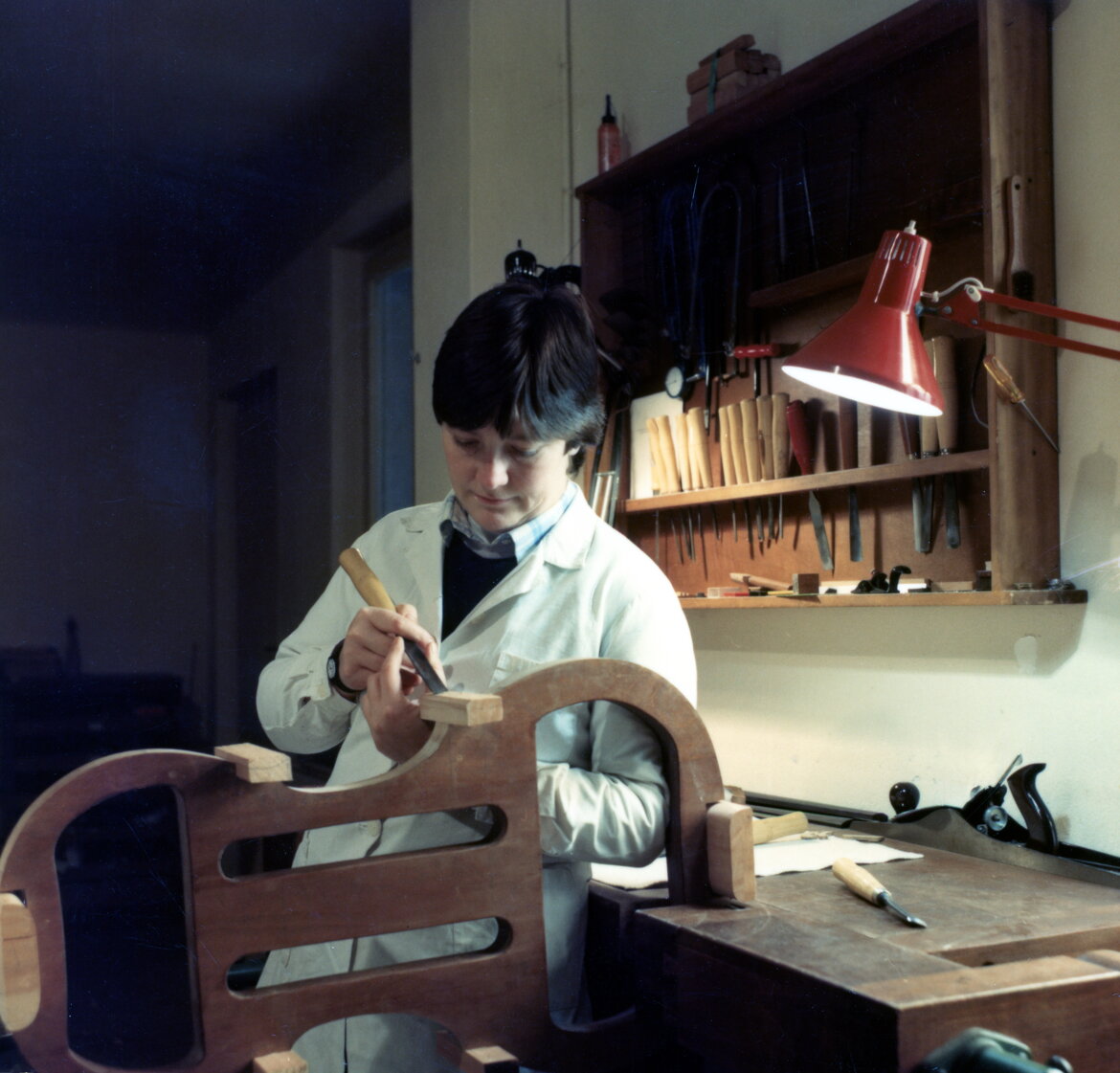
Wanna Zambelli in her workshop, busy roughing out the blocks of a cello. Photo: © 1983, Ezio Quiresi, Cremona
Simone Fernando Sacconi, the greatest violin maker of the twentieth century, in memory of his former student Wanna Zambelli
More than a century after his birth, former student Wanna Zambelli invites us to rediscover the story of a man who championed artisan creativity, grounded in patience, deliberation, and sensitivity.
by Ludovica Palmieri
Artribune, Rome. May 23, 2025
May 30, 2025, marks the 130th anniversary of the birth of Simone Fernando Sacconi (Rome, 1895 – New York, 1973), an Italian-American master violin maker, one of the twentieth century's foremost experts in this timeless art. Today, his former student Wanna Zambelli remembers him fondly in this "narrated" interview, recognising not only his remarkable ability to convey even the most complex knowledge with simplicity and clarity, but also his consistently warm, affectionate, and human approach to everyone he encountered, regardless of their status.
Simone Fernando Sacconi, as remembered by former student Wanna Zambelli
After a disheartening year at a technical school, unsure of what to do next, I sought advice from a painter in my hometown of Volongo, near Cremona, who directed me to the Violin Making School (Scuola Internazionale di Liuteria). And it was in the Palazzo dell'Arte – now home to the Violin Museum, but then the school building – that I met the Italian-American luthier and restorer Simone Fernando Sacconi in 1968, during my first year of study, on one of his rare visits and extraordinary lessons.
The great luthier Simone Fernando Sacconi and his illustrious acquaintances
I remember him surrounded by students – there were only about ten of us – all curious and intensely focused on his explanations. Well before his arrival, the anticipation had been palpable: his visit was considered a major event. I wondered who this renowned expert from America was – the man famed for having repaired over three hundred antique instruments and worked with exceptional musicians such as Casals, Kreisler, Enescu, Heifetz, Elman, Cassadó, Huberman, Flesch, Busch, Francescatti, Feuermann, Milstein, Piatigorsky, Zimbalist, Salmond, Fournier, Szigeti, Stern, Menuhin, Oistrakh, Ricci, Szeryng, Rostropovich, Primrose, Rose, Perlman, Accardo, Ughi, Zukerman, and Du Pré. It was said that he had even had personal relationships with Toscanini and many of the era's leading composers – Strauss, Debussy, Zandonai, Respighi, Casella, Mascagni, and Pizzetti.
I longed to speak with him, but as I was just starting out, I didn't have the courage. Then in 1971, during another visit, I had the chance to talk with him. I remember him walking past the workbenches, stopping at mine, and carefully examining the cello I was building. He gave me valuable advice with genuine interest.
Fernando Sacconi at master luthier Bissolotti's workshop in Cremona
Later, I met him again at the workshop of master luthier Francesco Bissolotti, where I continued my training after school. It was between the summer and autumn of 1972 that I had the opportunity to get to know Sacconi better. His passion for violin making was infectious and, even after more than fifty years, remains one of the driving forces in my life.
At the workbench nearly every day, he was busy building a violin based on the 1715 Stradivari Cremonese model, working alongside Bissolotti and constantly surrounded by people seeking explanations and guidance. During this period, he was finalising his book The "Secrets" of Stradivari, with assistants frequently visiting him to discuss the manuscript. However, he was so busy that, after a while, he began arriving at the workshop ahead of schedule to work in peace – early in the afternoon, when I was the only one there, as I stayed through lunch because I lived outside Cremona.
Those were unforgettable moments, filled with precious lessons. I spoke to him naturally, without fear, knowing he would understand exactly what I meant – even if my questions were vague. And he, even though I was the newest student, spoke to me as if I were a peer or a famous violinist. He explained things so clearly and simply that they seemed obvious. He was not only a great luthier, but a great teacher and a great man.
Simone Fernando Sacconi: a tireless experimenter
Alongside tool-making in Bissolotti's workshop, and with his help, Sacconi had begun the preparation of a new varnish that he wanted to resemble that of Stradivari. He later described the preparation process in meticulous detail in his book. Always in pursuit of rare natural substances and elusive resins, he was constantly experimenting.
He even spoke to me about violin making while I drove him in my tiny Fiat 500 to visit his wife Teresita, who was hospitalised in Cremona. I fondly remember his initial hesitation, as if unsure about getting into such a small and fragile car – but then, out of necessity, he took courage, and he never once complained about the driver.
Simone Fernando Sacconi's love for antique instruments
I was captivated by his deep love for antique instruments. He loved them more than anything else; when he took them in his hand, it was as if he was caressing them, handling them at the same time with a certain strength. He talked about the instruments by name, as if they were people, and he remembered all the details – he had an incredible memory. He said he would have liked to write a book on restoration, to explain all his techniques perfected over the years at Herrmann and Wurlitzer (great restoration houses in New York); unfortunately, he did not have the time.
The importance of Simone Fernando Sacconi's teachings
Over the years, I've come to appreciate the importance of Sacconi's teachings. I've realised that his method – rooted in a specific mental approach, even before the technical aspect, and in demanding the highest standards, following the tradition of the old masters and respecting the natural rhythm of artisan work – is the key to achieving quality results. There must be joy in creating an instrument: working solely for financial gain, or even mass-producing them, does a disservice to the craft.
Simone Fernando Sacconi and the celebration of artisan creativity
Simone Fernando Sacconi brought the value of artisan creativity back to the forefront of modern industrial society – a creativity shaped by patience and meticulous care. He brought passion and the desire to do things well back to the forefront. That, to me, is the legacy he left behind, and the one I have tried to pass on to my many students during my 44 years of teaching at the Cremona Violin Making School, with the hope of having planted a fruitful seed.
Some say that in a few years, artificial intelligence will be able to produce "perfect" violins, eliminating the need for luthiers, their sensitivity, creativity, and knowledge – their ability to feel and understand wood, which varies so much by origin, seasoning, and countless other variables. But what I learned from Simone Fernando Sacconi is this: true violin making can only come from human hands. Because real Instruments – with a capital "I" – whether violin, viola, cello, or double bass, can only be born and truly sing when crafted by a human being.
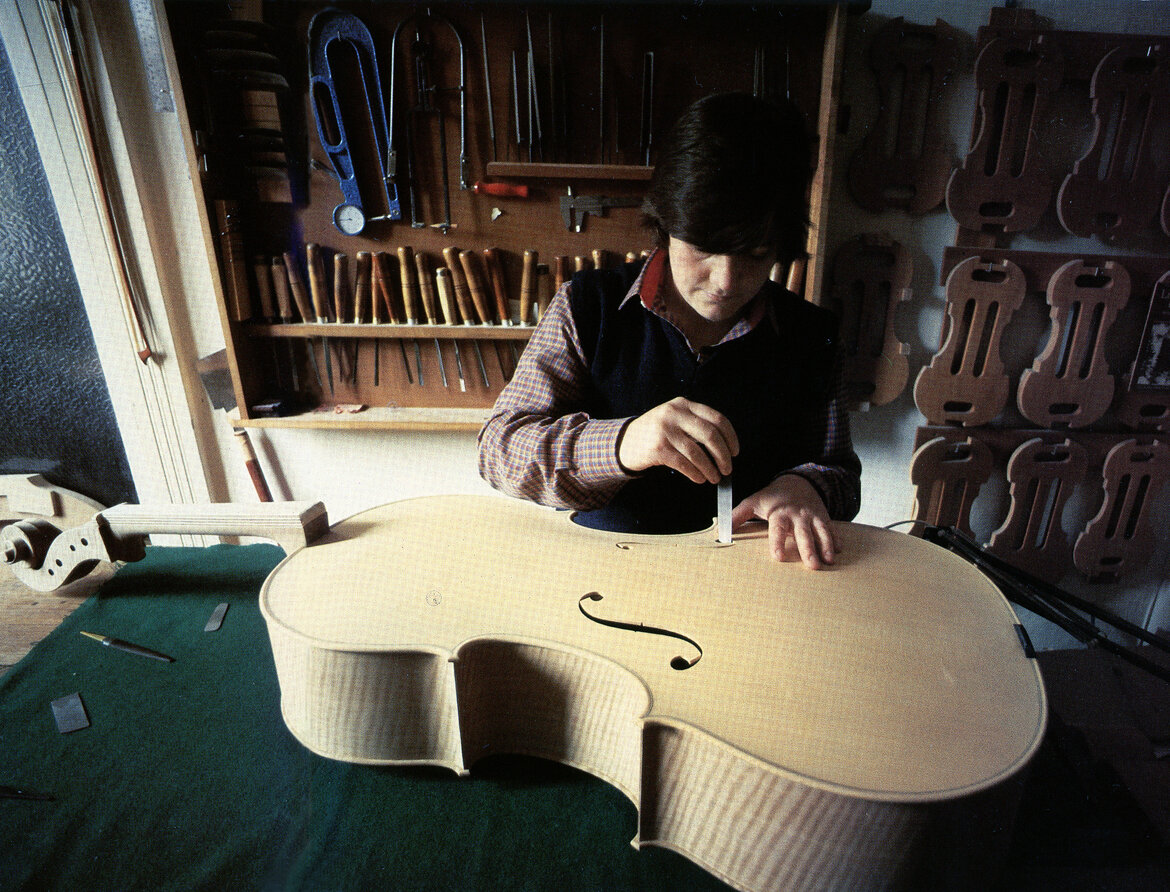
Wanna Zambelli in her workshop in Cremona. Photo: © 1983 Cesare Gerolimetto
With Sacconi, the history of violin making becomes memory
130 years after his birth, the role of the violin maker in love with Stradivari
by Nicola Arrigoni
Amadeus, the monthly magazine of great music. Milan, May 2025
"Respect for time, patience, the ability to ensure that varnish and wood find their magical balance are the ideal legacy that Sacconi left us. It is his intuition that places violin-making know-how in a context of high craftsmanship, in an era when this was not discussed and when continuous production dictated the law, or perhaps still dictates the law," observes Wanna Zambelli, a student of Francesco Bissolotti and a firsthand witness to Simone Fernando Sacconi's summers in Cremona in the late 1960s and early 1970s. Some question the reliability of Sacconi's observations, but his book The 'Secrets' of Stradivari is certainly the first attempt at a systematic analysis of violin-making in the classical and golden age of Cremonese violin making. Sacconi had the opportunity to work and analyze more than 350 instruments from the Cremonese school, 300 of which were by Stradivari. From this experience, he developed his observations, which he collected in the volume The 'Secrets' of Stradivari published in Cremona in 1972. He immediately glossed and revised these observations, starting with the printed edition.
It is a good idea to begin with a firsthand account to remember Fernando Sacconi, 130 years after his birth on May 30, 1895. Why remember Sacconi, and why begin with a firsthand account? Because recounting Fernando Sacconi's passion for violin making means grafting history into the memory of the violin-making community. Indeed, Sacconi is a central figure, a cornerstone of the reinvention of Cremonese violin making in the second half of the twentieth century. Indeed, Sacconi is a sort of guiding thread that characterizes the drive to revive Stradivari's great mastery.
Sacconi's love of stringed instruments began in childhood, when he began his interest in violin making by opening up a violin belonging to his father, Gaspare, an orchestra professor, to see how it was made inside. This gaze, looking inside, has characterized Sacconi's entire life as a violin maker and restorer, but also committed to using his experience as a tool to recover the ancient violin-making know-how of the Cremonese masters, now recognized as an intangible cultural heritage of humanity by UNESCO. Thus, the fact that Sacconi was a student of the Bolognese Giuseppe Fiorini is no coincidence; it was Fiorini who introduced him to the secrets of stringed instruments and introduced him to the great Cremonese violin-making tradition. Fiorini owned relics from Stradivari's workshop, molds and drawings that Sacconi had the opportunity to examine, before they were donated to the city of Cremona in fulfillment of a wish: that they not only be part of a museum dedicated to violin making, now the Violin Museum, but above all serve as a starting point and study for reviving the great Cremonese tradition.
After moving to the United States in 1931, Sacconi worked in New York for Herrmann and later for the renowned Wurlitzer company, where he honed his skills as a restorer. Sacconi was in Cremona in 1937 as a consultant for the exhibition of the master violin maker's instruments on the bicentenary of his death. After the war, in the 1950s, he began to visit the city regularly, bringing with him his immense wealth of knowledge. In 1962, he felt the urge to catalog and study the Stradivarian artifacts donated to the city thirty years earlier by Fiorini, making a decisive contribution to the reconstruction of Stradivarius's construction methods.
"I remember the lessons and conversations Sacconi gave at the violin-making school, but above all, the summer days spent working in Bissolotti's workshop remain indelible in my memory. Sacconi had a visceral love for violin making, for Stradivari, and for Cremona. He spent his summers in the city and was a friendly, helpful person, unafraid to pass on his knowledge to those young people working at the violin-making bench and taking their first steps in the art of violin making." Thanks to him, classical violin making was rediscovered and adopted as the gold standard for modern violin makers. His legacy is evident in the 1972 volume The Secrets of Stradivari, which, as Zambelli recalls, he immediately began to elaborate on, confirming that the study of Stradivari's construction practice is not a dead letter, but rather an ongoing investigation.
This is perhaps the most important lesson left by Fernando Sacconi: violin making and Stradivarian know-how are a living entity, simultaneously practice and theory, and thrive on research and experimentation, as Antonio Stradivari taught throughout his life.
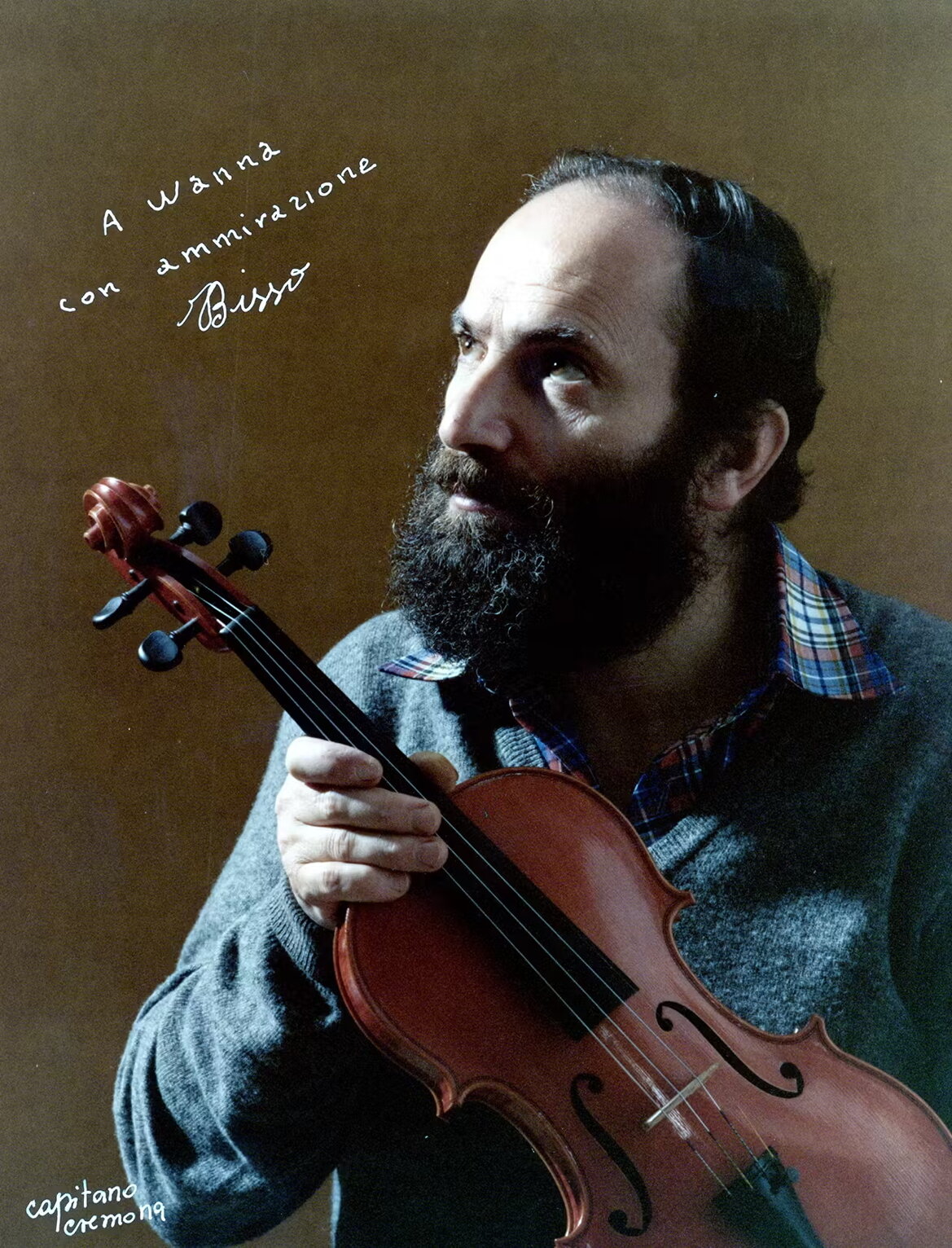
"To Wanna with admiration": a dedication from master violin maker Francesco Bissolotti to Wanna Zambelli. Photo: © 1989 Arturo Capitano, Cremona
In Stradivari's Footsteps
Introducing Cremona to the world means presenting the image which represents its greatest prestige and renown: the image of a city of violin-makers, steeped in the great classical Cremona tradition, by now a must on all international sightseeing tours.
Classical Cremona violin-making got its start with the glorious names of the Amati, Stradivari and Guarneri families, but was rooted in a more remote past, perhaps in the very culture of that majestic European gate to the East: Venice.
It was in the 18th century, which tor Europe represented the century of the great modern enlightenment of modern times, that Cremona became the focal point of a craft that Cremona – had reached its highest perfection: the craft of making violins. From the 16th century on, an accumulated culture grew out of the workshops of the Amati and Stradivari families whose crowning achievement was to be the birth of the classical Cremona school of violin-making. This achievement had, however, the misfortune to run into the new reforms introduced by Maria Theresa of Austria. So that, paradoxically, the end of the guilds and the inauguration of free trade marked irremediably the hasty decline of this artistic craft and the beginning of a disbandment which, alas, the sons of Antonio Stradivari himself were to facilitate. This disbandment had the effect of making it practically impossible for later generations to grasp the notions and know-how that had been filtered and distilled for ages, giving rise to the myth of the "mystery" of Stradivari's varnishes.
So that the moment of greatest splendor coincided with the rapid decline of the classical Cremona school and the beginning of an adventurous story of legacies and forgeries. The subsequent modification of the historical and cultural context, aside from the demands of the market itself (with ever greater requests for instruments connected with the rise of the large 19th century orchestras), would increase this phenomenon of forgeries and imitations, along with the mythicizing of the figure of Stradivari. So the cultural sources of his work became practically almost incomprehensible. The recovery of the classical Cremona tradition in its full significance is, in fact, a largely modem achievement.
This rediscovery necessarily had to start from the thorough reunderstanding of the working methods and techniques of the classical Cremona craftsmen. For this, the work of a great personality and a true passion were indispensible. Both were to be found in Simone Fernando Sacconi, the great Italian violin-maker and restorer who died some ten years ago and who in the Thirties moved to New York, working first for the Hermann Co. and then, up to the end of his life, for the prestigious Wurlitzer Co. Though Sacconi often visited and lived at length in Cremona, not everyone appreciated his genius and his example. An example which led him to share the enormous and priceless heritage of technical experience gained at Wurlitzer's, where all the most important international concert artists, from Oistrach to Stern, Menuhin, etc. took their magnificent instruments to be repaired.
It was by taking apart these instruments that Sacconi became aware of the originality and the importance of the structural method adopted by the classical Cremona violin-makers, based on the so-called "internal-mould". So the rebirth of classical violin-making was to be based on the rediscovery and re-evaluation of that method.
The opportunity to create the beginnings of a collection of ancient instruments in Cremona was offered by Sacconi himself and in the Sixties by Prof. Alfredo Puerari, at that time Director of the Cremona Museum and President of the local Tourist Board. In this way, Cremona came into possession not only of the two Amatis already collected by Sacconi (the Andrea Amati, ex-Charles IX of France, 1566, and the Nicolò Amati, ex-Hammerle, 1658), but also of one of the most magnificent examples of the classical school, the 1715 Stradivarius, known as Cremonese.
These instruments are now a part of the civic collection on display at the Palazzo Municipale, recently enhanced by the 1734 Guarneri del Gesù purchased by the Walter Stauffer Foundation. A reorganized Stradivari Museum has now been set up alongside this nucleus of precious instruments, which has been insured tor over two million dollars.
But Sacconi's technical example was to have a further-reaching effect. The very year of his death, 1973, the Associazione Cremonese dei Liutai Artigiani Professionisti (ACLAP: Cremona Association of Violin-Making Craftsmen and Professionals) was founded, which represented the continuation of that example as well as its ideal inspiration. On a technical level, Sacconi's example was taken up in Cremona by Francesco Bissolotti, who had worked with him for years, and by Bissolotti's most direct pupil, Wanna Zambelli, who is also the first woman violin-maker in Italy, the winner of the prize named after Simone Fernando Sacconi at the 5th Biennale of String Instruments in Cremona.
Today, M° Bissolotti and Wanna Zambelli represent the most complete expression of the classical Cremona School of violin-making. One of the most complex results of this culture is certainly to be found in the new relationship between builder and performer, that is between the violin-maker and the great concert artist. For example, the special 5-string viola ordered from Bissolotti by Salvatore Accardo (which he will use next spring in Cremona to perform the world premiere of a Paganini Concerto) and the cello ordered from Wanna Zambelli by Rocco Filippini.
Sacconi's technical-constructional recovery of tradition was then reinterpreted and further explored on a theoretical level by Prof. Giuseppe Tuminello, ACLAP's cultural executive, in a book called «Arte Artigianato Società» (Art Crafts Society). Thus the violin-maker's work concept, reconsidered in its creative and individual aspect, becomes the basis of a radical renewal of the philosophy of violin-making itself, by placing the whole "case" of violin-making back into discussion on historical and sociological grounds. Creativity and individuality as modern problems are in fact reclaimed in the light of the meaning of work in the pre-industrial world, in what this may suggest or restore to the anthropology of modem man.
«Arte Artigianato Società» also contains photographs of the large four-section ACLAP exhibit entitled «Classical Violin-Making: A Method. Stradivari and the Cremonese school» – assembled by Bissolotti and other violin-makers – where the basic phases in the process of making string instruments are shown. Both the book and the traveling exhibit (from the Teatro alla Scala to the Municipality of Paris, etc.) are the results of an interdisciplinary collaboration between the members of the Association that has been going on now for some ten tears.
The ACLAP experience is, moreover, set into a framework of Cremona-based institutions and undertakings, ranging from the prestigious International Triennale of String Instruments to the Stradivari Museum (directed by Prof. Andrea Mosconi), where historical artifacts (original molds, drawings, tools, etc.) are preserved, to the great concerts of the Violin Festival of Cremona down to the basic training courses offered by the International Professional Institute of Violin-Making.
The reality of Cremona seems to provide eloquent proof of what Italian "flair" and genius are capable of giving to the world. In particular, this extraordinary artistic craftsmanship makes it possible to export a personalized product, born of an ancient tradition and in a position to stand out from mass-produced assembly-line articles (e.g. Japanese and German violin factories).
The link between production and tradition has, moreover, reoccupied a central place in this critical period of industrial evolution. Especially in those countries with a long industrial tradition has the attitude towards work undergone a change today, to the point that a distinguished economist like John K. Galbraith maintains that "the last frontier is the artist" and not technique. For this reason the great American economic thinker reconsiders the importance of beauty in industrial products, and of the Italian tradition in particular: "Italian manufactured goods are more beautiful than those of any other country." A remark that applies all the more to classical violin-making, that is to one of the Italian traditions of the highest quality and the most solid international prestige. So much so that its public is by now a cosmopolitan public.
So the Made in Italy lable is nicely suited to this Cremona tradition, which can worthily represent the creative image of Italy. A Made in Cremona violin can become one of the happiest expressions of high-class Made in Italy craftsmanship and industry.
Article from the magazine "Made in Italy" (No. 2, Spring 1984, pp. 72-79). "Made in Italy" is a luxury publication printed in English by "The Made In" Inc., a subsidiary of the Italian-American "Fideurart Publishing Group," with offices in Rome and New York.
by Claudio Gallico
Professor of History of Music and Director of the Institute of Musicology at the University of Parma
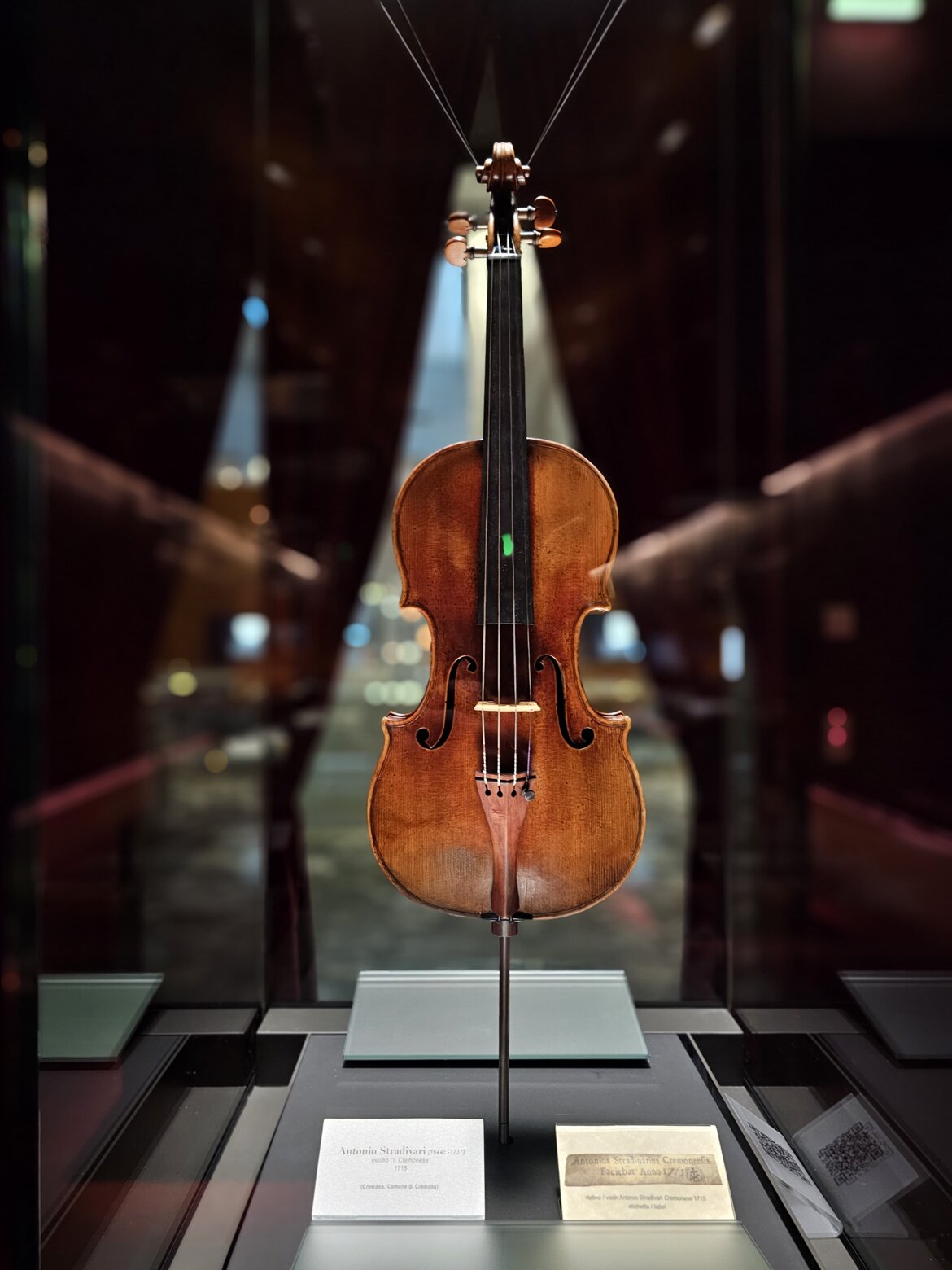
The violin by Antonio Stradivari, known as the Cremonese, 1715. Cremona, Violin Museum. Photo: © 2023 Luca Valcarenghi, Cremona
Cremona. The Torrazzo, the Cathedral, and the Baptistery
Myth and Creation in the Classical Violin-Makers' Tradition
byGiuseppe Tumminello*
Those who contend that the finest violins today can be made by less than master craftsmen ‒ or liutai as the specialists are known in Italy ‒ cannot see the wood for the trees. Paul Cézanne struck the right note when he observed how rewarding it was for artisans to use the most natural of raw materials and work wonders with it. The great Stradivari's home was Cremona, which is also where a body dedicated to approaching the master's microscopic perfection of workmanship is based.
This is the Associazione Cremonese Liutai Artigiani Professionisti, or Cremona Master Artisan Violin-maker's Association. In this noble city, the tradition of violinmaking has maintained the same high standards characteristic of those of the great Italian makers from the 16th century onwards. The back is cut from very handsome wood and the sound-holes, executed with painstaking precision, continue to exhibit much grace, with the maximum attention still being given to the acoustics, which are extremely complex in this much-loved instrument.
The Cremona masters recognize that there is poetry in nature and their art succeeds in bringing the wood to life and giving it a most moving voice, sweet or poignant, but always enchanting. In the hands of a virtuoso, the perfectly made violin would appear to be echoing the dream of the ancient alchemists and making it come true.
Perhaps, in another sense, it is the machinery and the technology so characteristic of modern industry and manufacturing that is a dream world, albeit a less artistic one. And the sight and sound of a fine Cremona violin wakes us up to the reality of pure, unchanging art that stands apart from the turmoil in so many other developing areas of present-day life that have introduced robots and are now swamping us with computers.
It is undoubtedly true that a reaction is setting in; this is evidenced by the very strong re-emergence today of an absorbing interest in the bygone times and the traditions of yesteryear. The Cremona Violinmaker's Association, known as ACLAP for short, has recognized this movement ‒ surely music for the master artisans' ears ‒ and has dedicated a lot of effort in catering for it in the most artistic way.
ACLAP has not only taken the revered violin from its case and given it a careful dusting. It has helped to set the stage metaphorically to enable violin lovers to become steeped in the environment that produced these melodious masterpieces fashioned by such greats as Stradivari, Niccolò Amati and Giuseppe Guarneri.
The history of violinmaking in Cremona is a glorious one and the Association is ensuring that the link with the past will continue to gleam like a golden chain. The master artisans of past centuries took passionate pride in their work, something not easily fitted into the productive world of today with its priorities based on speed and commercial viability.
Stradivari had his own concepts. He had his own secrets, too. So much has been written on the subject of the varnish he used, for instance, that the very fine orange-red-brown one which coated most of his work has become a legend. Stradivari was able to produce a resonating chamber that was indeed perfection and Paganini's performances were destined to turn new pages in the violin's contribution to music's most expressive form.
The 'internal mould' of violinmaking had been in the very talented hands of the great Simone Fernando Sacconi, who gained the most revealing experience in the subject matter in his 30 years or more of restoring the oldest models by the famous makers, principally with Wurlitzer in New York. Francesco Bissolotti proved to be a good pupil of the Sacconi school and has continued this classic tradition in Cremona. Bissolotti echoed the concepts of Sacconi, which were picked up in turn in his own Cremona school by Wanna Zambelli, the very first Italian violinmaker of her sex and winner of the Sacconi prize at the 5th National Biennial Competition of String Instruments in Cremona itself.
Making violins the Cremona master's way means giving them the personality and that identity card that only instruments made in basically one piece can have. Such violins distinguish themselves from others not made this way: as can be readily imagined, the master artisans positively recoil from modern quick production methods based on assembling component parts.
Great musicians studied before composing, prima donnas also win fame by long practice, perfecting their vocal powers. And so it is with the celebrated Cremona violinmakers ‒ their school is one of perfection, or striving for it, in the tradition of those who first linked their names with this most artistic of crafts in the centuries gone by.
But though they spend so much time at their benches, they are not standing still in terms of progress. Modem violin music has an increased compass and raised pitch, requirements Cremona caters to in every detail, the violinmaker's work being a blend of the excellence of the old-time craftsmen and the modem adaptation to new requirements in playing performance.
So the Cremona artisans' art emerges ever more clearly as a rarity today, when everything tends to be increasingly impersonal despite the new horizons opened up by advanced technology. Pushbutton production set-ups may be taking over in the manufacture of many products, and boutiques may be getting the edge on the kind of shops that once were the bulwarks of the retail trade, but there will never be any replacement for the violin masterpieces still produced in Cremona.
Classic violins in the Cremona mould have a body or resonating chamber that is not far removed from being a magic box. For there is undoubtedly something akin to magic in the acoustics of the very fine specimens. And yet the explanation is clear for everyone to see ‒ and to listen to. It is no secret that the superlative effects come from the construction method, from the precision with which the wood is worked and from the fine craftsmanship so evident in the making of the Cremona instruments.
The seasoning of the wood used in violinmaking is an art in itself, one that has been well mastered by the liutai or Cremona artisans. They set their own exacting standards for the seasoning, just as they exercise the greatest of care in the selection of the soundest and most handsome wood.
The time-honoured varnish is also equal to the stain of quality, offering guarantees tested over many generations. The adding of chemicals to the natural resins would take away much of the beauty apparent in the wood of the best violins.
The thickness of the wood used in the construction of the resonating chamber must be the prescribed classic one, otherwise the beauty of tone will suffer. Thinner layers will only increase the volume and inevitably lose much in sound quality. The Cremona instrument, being so well-made, tends to mellow with age, the function of the resonator getting even more perfect with years of use.
The great violins were revered like religions; and, like all religions, they conserved their 'mysteries'. But the opinion in Cremona is that Stradivari had no real secret; he kept to the highest standards in every phase of his work and the results spoke ‒ or sounded – for themselves.
Violinmaking has long been legendary in Cremona, though continuing to be a reality to this day. The legend continued as the great makers passed on their superlative craftsmanship to their sons, who introduced improvements of their own, the Amati family, father Andrea and sons Antonio and Girolamo, being worthy examples. The example is still being carried on and the art is being preserved in a way that makes Cremona appear ‒ in these times of hectic, high speed production runs in modern industry ‒ to be something like a living museum.
These Italian liutai will never be threatened by the all-powerful technology that has made such massive inroads in other production fields. Their skills embody centuries of culture and tradition reflected in the products produced so painstakingly in their workshops.
Violinists who buy their instruments from the highly respected makers rooted to the Cremona tradition feel the personal relationship that is built up with their supplier. Few if any other trades can boast such relationships or see them prosper on a similar footing. For it is culture and craftsmanship that blends together in furthering the same burning interest in the subject.
Not all the violins that look the part have a Cremona pedigree, however, for counterfeiters have made their presence felt with instruments that look the part, just as they have done in coining gold sovereigns that also look genuine. Their work is quite spurious, though they are very skillful in applying the 'antique rub' to make their forgeries look very much like collectors' pieces.
But they are classic only in being examples of the dishonesty that one needs to beware of so much today! The best wine-bottlers in Italy already support a certificate of origin system called D.O.C. that guarantees the authenticity of the product. The violin is a most romantic instrument in the right bands, so much so that it lends itself to the spirit of "wine, women and song"; and, as with the wines, the genuine vintage specimens should be carefully protected from the activities of those who seek to pass off inferior articles as the genuine thing. ACLAP has been playing its part for a good ten years to protect the name of the Cremona violinmakers from the fraudulent practices of others. And their vigilance bear’s fruit. Those who know their violins cannot easily be taken in, of course.
As John Kenneth Galbraith bas said, there is "an Italian recipe", an "Italian flair" that is evident in creative industry that concerns itself largely with art. The Cremona liutai work with love and love their work, as the great poet Gibran Kahlil once wrote. "Working with love?... / Work is love revealed. / If you cannot work with love, but it repels you, / leave it, it is better to sit at the door of the temple / to receive alms from those who work with joy".
*Giuseppe Tumminello, sociologist and cultural director of Aclap. Article from the international magazine in four languages, «Welcome, Appuntamenti Italiani.»Milan, July 1983
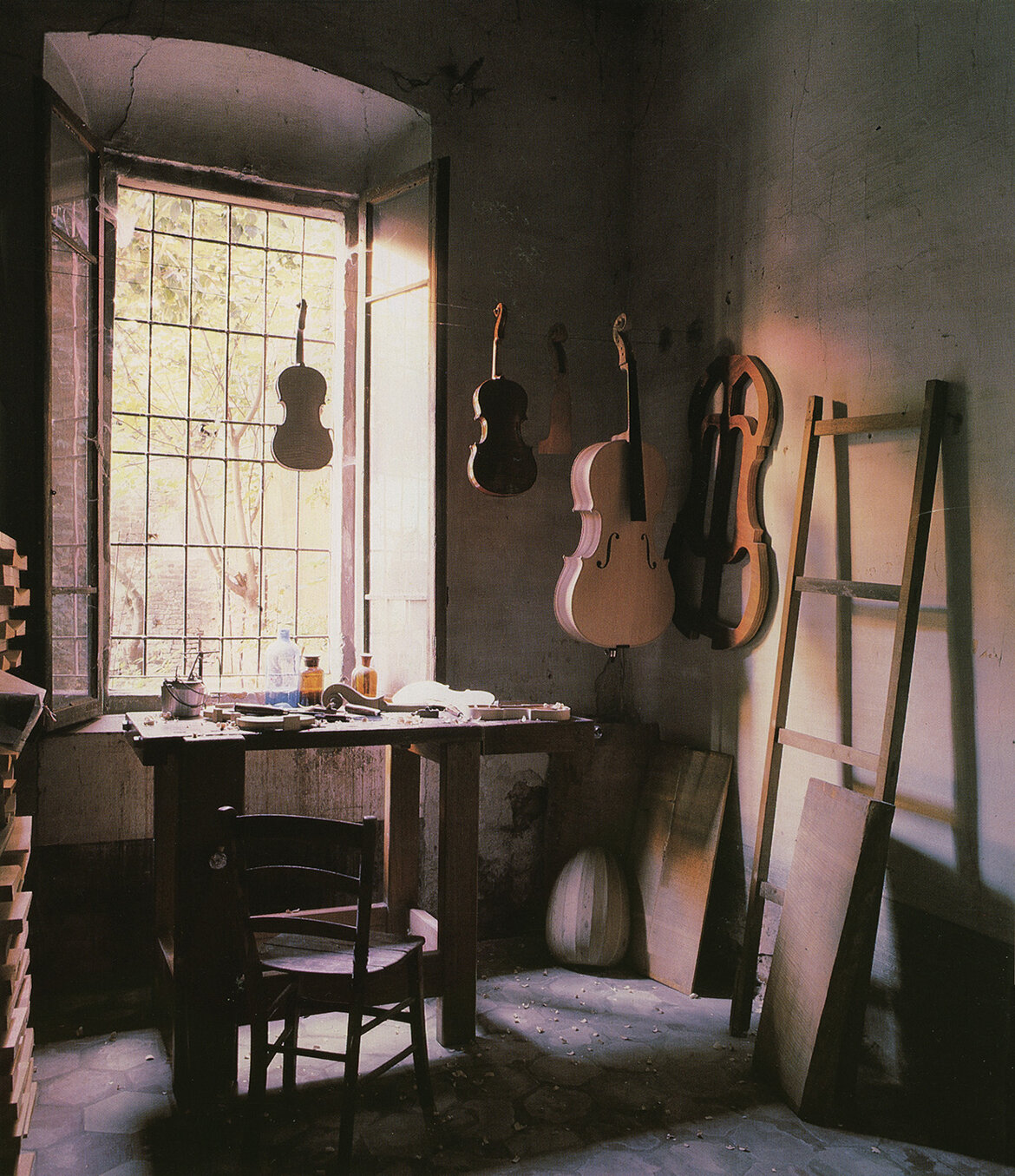
Reconstruction of an old violin-making workshop. Image from the storyboard of Giacomo Battiato's film Stradivari, starring Antony Quinn, Stefania Sandrelli, and Valérie Kaprisky. Soundtrack by Salvatore Accardo. Cremona, 1988. Photo © Mino Boiocchi, Cremona
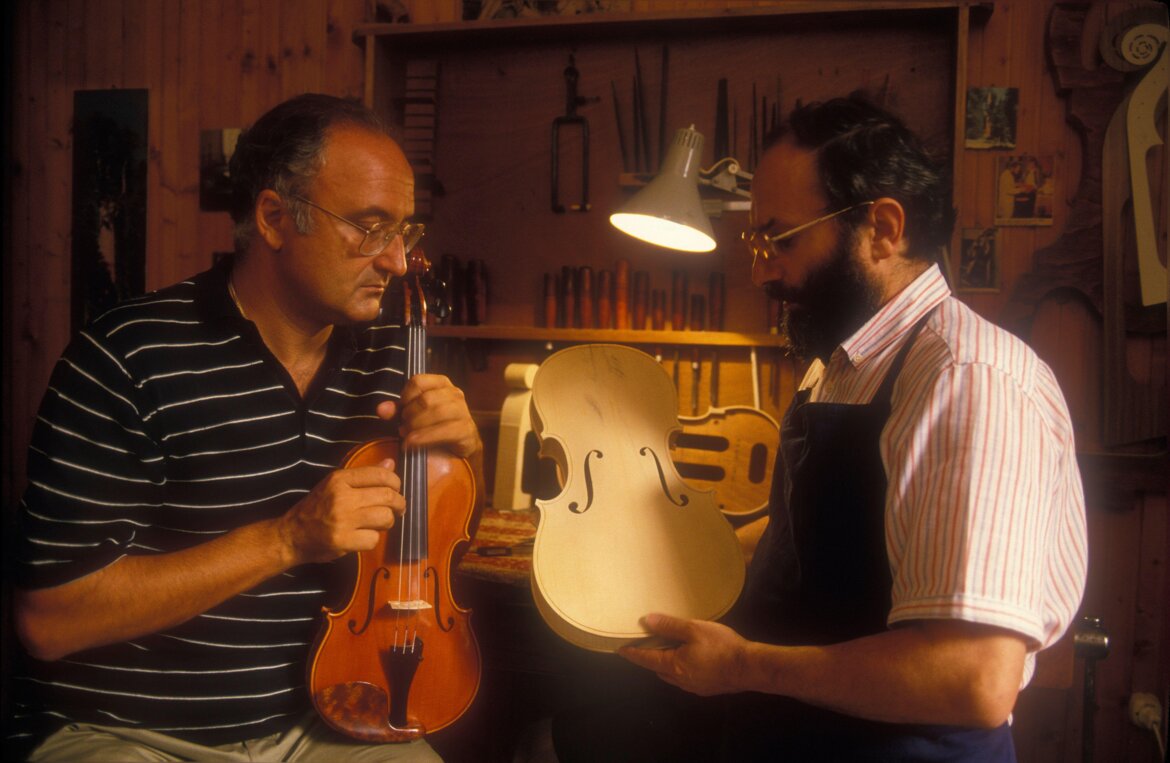
From left: Violinist Salvatore Accardo and master luthier Francesco Bissolotti in their workshop on Via Milazzo in Cremona . Photo: © Alamy Images
In the Stradivari Factory
"The Cities of Music / Cremona, where the famous violins are still made as they were in the 18th century"
by Ettore Mo
special correspondent for Corriere della Sera
Cremona, May 24, 1987
There is a magical moment every morning in the Wedding Room of Cremona's town hall: it is when a distinguished gentleman, Professor Andrea Mosconi, delicately removes a violin from a glass case and begins to play. There is something priestly in his gestures, as if he were celebrating a ritual.
And ritual it is, indeed. Mosconi, curator of violin-making heritage, has been entrusted by the municipality with the task of keeping alive the five violins kept there and protected by a three billion euro insurance policy. These are the quintessence of Cremonese violin-making art from the mid-16th to the mid-18th century. But precisely to prevent their souls from fading and dying, it's necessary to pluck them and make them vibrate a little every day.
This morning, the cardiac massage I witness in the midst of a schoolchildren enthralled and even a little intimidated – it seems – by the miracle of the instruments' immortality is for a Giuseppe Guarneri, known as del Gesù, born in 1734. Andrea Mosconi draws his bow and curls his fingers over the strings, for a Bach sonata: and the sound that emerges is fresh and pure, dense in the low notes, never shrill in the high ones. Experts maintain that his childhood voice remains intact.
The other violins are locked in glass cases, protected by a cloth, awaiting their turn: and so we are not fortunate enough to hear an Andrea Amati from 1566, a Niccolò Amati from 1658, a Giuseppe Guarneri (Andrea's son) from 1689, and, most importantly, an Antonio Stradivari from 1715, labeled with the name of the Hungarian violinist Joseph Joachim – who acquired it at the end of the last century.
Luthiery and Cremona are one and the same, even if some light-hearted people claim that nougat can claim the same right, in terms of identification. It remains difficult, however, to deny that if there is one city viscerally linked to music, it is Cremona. And the hallmark of this umbilical relationship lies in the fact that the Amatis, the Guarneris, and the Stradivaris – master craftsmen – are not a myth relegated to the tabernacles of the Saletta dei Matrimoni, or kept alive by concert performers who use their prodigious instruments. On the contrary. It is a reality still operating, untouched by computerization, machines, and mass production. A violin, a viola, a cello, a double bass are still born here from the hands of a man.
To see this, just stop by number 18 Via Milazzo. There is the workshop of Francesco Bissolotti, master luthier, and his three sons, Maurizio, Vincenzo, and Tiziano. Just step inside the door of the more than eighty workshops that sparingly produce stringed instruments, scrupulously adhering to the rules and procedures established three hundred years ago.
As soon as you enter Bissolotti's workshop, you wonder what difference there could possibly be – in objects, atmosphere, and smells – from the one Stradivari occupied from 1680 to 1737 (the year of his death) in the parish of San Matteo: the same artisan's bench with vices, the same ancient, essential equipment with gouges, planes, files, scrapers, saws, and compasses; the same scents of resin, alcohol, mastic, saffron, and dragon's blood, and, above all, that sharp mountain and forest aroma of Balkan maples and Val di Fiemme spruce.
Fifty-eight years old, agile, his still jet-black beard clinging to his strong, peasant-like jaw from the Bassa, this Mr. Bissolotti truly seems to embody the pure craftsman, who has placed his manual expertise at the service of a great, acute musical sensibility.
I was born in Soresina, nearby, on April 2, 1929. My parents were farmers; my father was a herdsman, or "bergamino," as they say around here. I picked up the first violin at nine; at 17, I built one. I attended regular violin-making school. I graduated with honors after four years. Then I taught at the same school for 22 years.
Bissolotti is humble enough to acknowledge that he owes much, indeed, a great deal, to the great violin maker and restorer Simone Fernando Sacconi, who emigrated to New York in the 1930s to work first at Herrmann and then at Wurlitzer, where he acquired the world's finest instruments: "But every year," he says, "Sacconi returned to Cremona to breathe the air that had once been Stradivari's. He came to visit me here, in my workshop. He would open the violins, smell them, study them: in short, he captured their soul. I watched him at work and learned a lot. He was the link between violin making of the past and that of today."
No one seems to doubt that, thanks in part to Sacconi's brilliant work, Bissolotti now deserves to be considered – along with his student Wanna Zambelli – the true heir to the Stradivaris and Guarneris: a title of merit bestowed upon him, even officially, in 1973, when he was appointed president of the Cremonese Association of Professional Violin Makers (Aclap).
"A new relationship has certainly been established between makers and performers, to their mutual benefit," Franco Feroldi, AClap's vice president, tells me, "a personal and direct collaboration. Each instrument is commissioned, with specific requirements. Bissolotti's workshop produced the five-string viola for Salvatore Accardo; Zambelli's workshop produced the cello for another great performer, Rocco Filippini."
The 250th anniversary of Antonio Stradivari's death, which falls this year (December 18th), cannot leave violin-making enthusiasts and enthusiasts indifferent. But these are certainly not events that can spark collective frenzy. It is a private, almost secret celebration for those few who have made the great luthiers of the 17th and 18th centuries their raison d'être, a single, exclusive passion.
This is the case for Elia Santoro, a local journalist who for years has combined his work as a local reporter with this specialization in music history. "I've been hammering away at this idea since 1953," he admits, "rummaging through archives and libraries." He speaks of Stradivari as if he had known him personally; indeed, as if he had worked in his workshop, so profound does his technical knowledge of wood, seasoning, and varnish seem.
He speaks of the eleven children he had by two wives ("he was a dutiful, moral man"), of the only two – Francesco and Omobono – who followed him into the trade, and finally of a third – Paolo – "a loafer, a slacker") who became a merchant, sometimes unworthily trading in his father's work. But the archives do not compensate for his curiosity and eagerness to research, and he eventually finds himself with a slender biography of Stradivari, also because "his life was not rich in events." Among the few certainties (...) is his death date of 1737.
The question now arises as to what kind of tone – given the paucity of biographical information – the TV film about to be made about the great violin maker might have: it is legitimate to suspect that a fictionalized version of his life will prevail over a rigorous documentary approach, despite Elia Santoro's historical expertise. Nor is it possible to predict how much credibility the on-screen presence of Anthony Quinn, who plays Stradivari, will lend to the character, while the actor's children will play the violin maker's children. But – last but not least – it will be the hands of Bissolotti and his offspring that manipulate the maple and spruce when the camera captures the joyful mystery of the violin's birth.
Luthiery certainly remains the most conspicuous part of Cremonese musical life, with its school – founded in 1938 – hosting 130 students from twenty-eight different countries, including, for the first time, China. But there are other activities and institutions, also linked to the names of two local geniuses, Monteverdi and Ponchielli: a civic school named after the former, a renowned opera house, recently municipalized, dedicated to the latter.
In terms of education, Cremona boasts a School of Musical Paleography (a two-year program leading to a diploma) and a Faculty of Musicology (a four-year program leading to a degree) with 450-500 students. "In both cases," Professor Ugo Gualazzini, a renowned jurist but keenly attentive to his city's musical affairs, tells me, "given that 'law and music have two equal structures, grounded in logic,' we are dealing with educational organizations run with extreme seriousness: rigorous selection, mandatory attendance, and first-rate teachers."
And what about funding? Well, here we enter a bit of a fairytale, a fairytale that goes by the name of the Stauffer Foundation. It's the story of a man of Swiss origins but born in the Cremonese area (Walter Stauffer, to be precise) who amassed an extraordinary fortune with a dairy industry. Having no heirs (he died in 1974), he left his estate to Cremona, to be used for the benefit of music, and violin making in particular. No one had ever imagined, until then, that such a fruitful relationship between cheese and violins could arise. It is certainly thanks to the Foundation's contributions (as well as the sensitivity of the Cremona municipal administration, headed by Mayor Renzo Zaffanella, and the enterprising spirit of the culture councilor, Luigi Magnoli) that Stradivari's city can now afford masterclasses led by internationally renowned concert artists such as Salvatore Accardo (violin), Giuranna (viola), Filippini (cello), and Petracchi (double bass).
"It's our flagship," says Paolo Salvelli, the Foundation's vice president. "The courses last eight months, from November to June. Eighteen hours of lessons per month. Completely free. They are all graduates, but the auditions are extremely rigorous. We have them from all over Italy, while the foreign presence is limited."
It's legitimate to wonder, however, while Accardo and his companions are forging the future aristocracy of concert music, whether the youth of Cremona aren't feeling lost, starved of oxygen, in the obsessive climate of the classical. No one has yet written on the walls, 'Death to Stradivari or death to Beethoven,' but it could happen.
"Oh no," says the mayor calmly, "there are so many projects for young people. We've created spaces for rockers; just the other day, the Cascinetto was inaugurated, a club all their own, where they can let off steam. There are pop bands, jazz bands, and student choirs.
It sounds good, in short, this Cremona at the end of May, where Monteverdi and Bach can coexist with impunity with the Beatles, Duran Duran, and Vasco Rossi. And if you wait until Wednesday, the day of the livestock market, the city reveals its other, no less authentic side, that of an ancient rural agricultural village, the Cremona of the "turun turazz tetazz," beautiful, vigorous, and indulgent, ranked seventh in Italy for per capita income.
And it makes you think, without fear, that in the veins of these big-time brokers and pig farmers flows the same blood as in the veins of master violin makers, like Bissolotti of Soresina: and that deep down, the grunts and sighs of violins They don't disagree with each other, because they're music from the same land.
Ettore Mo, Cremona, May 24, 1987 © Corriere della Sera
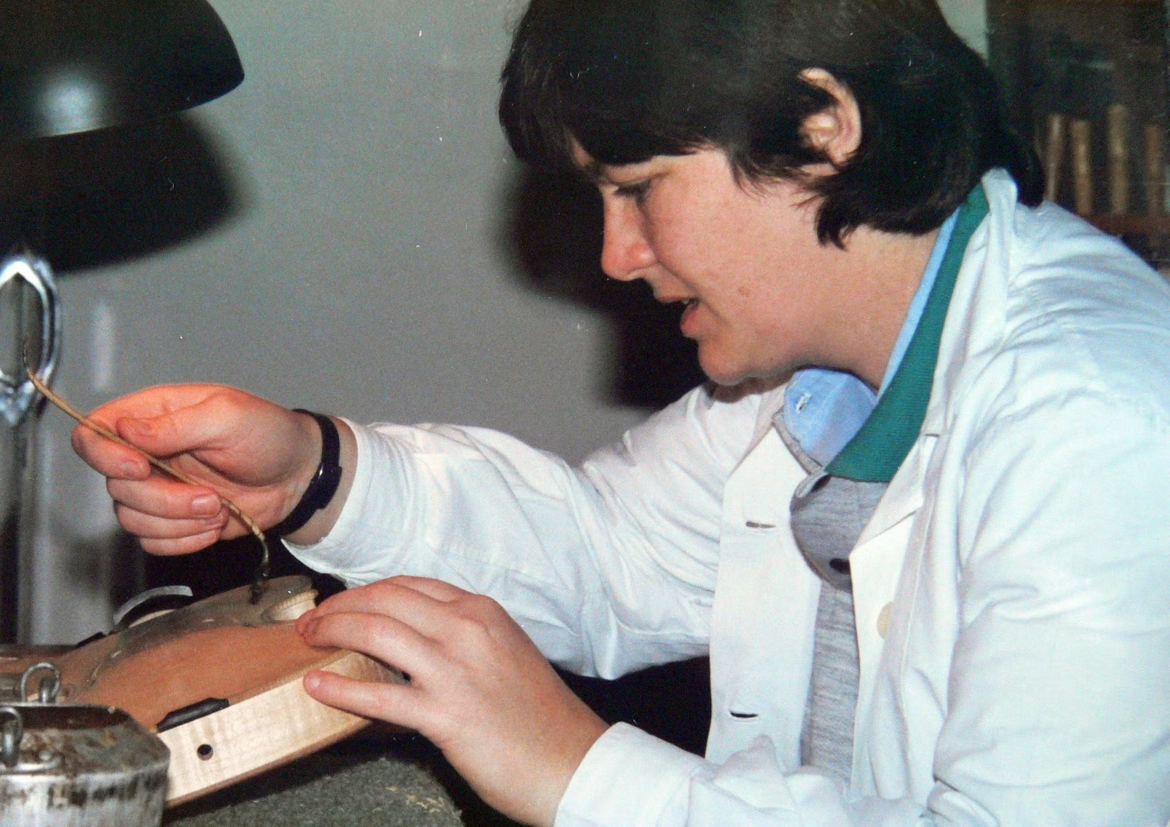
Wanna Zambelli in her violin-making workshop in Cremona. Photo: © 1985 Zambelli Archive
Violins, violas, and cellos from Wanna Zambelli's workshop
Wanna Zambelli's instruments are appreciated not only for their precision construction, but also for their highly recognizable voice, the result of her faithfulness to the classical Cremonese method and her obsessive pursuit of balance between wood and varnish. These are the main sonic haracteristics:
Warm, harmonically rich timbre: the sound has an enveloping depth, without harshness, ideal for lyrical and cantabile repertoire.Balance between registers: full and rounded bass, rich mids, bright but never shrill highs.
Projection and power
Great projection: the sound "travels" well in the room, maintaining clarity even at a distance. Prompt response: the note's attack is immediate, a quality highly appreciated by soloists.
Color and dynamics
Wide dynamic range: from the most delicate pianissimo to the most incisive forte, without loss of tonal quality.
Color palette: The natural varnish and well-seasoned wood contribute to a multifaceted sound, capable of changing "color" depending on the bow and pressure.
Construction factors that influence sound
Use of selected, extensively seasoned woods for optimal stability and resonance.
Natural-based varnishes, applied slowly, allow the soundboard to vibrate freely.
Models inspired by Stradivari, Guarneri del Gesù, Gasparo da Salò, Carlo Testore, Camillo Camilli, and other masters, adapted with personal sensitivity.
In short, his instruments combine the sweetness and melodiousness typical of the Cremonese school with a modern sound power, capable of satisfying both chamber musicians and concert performers.
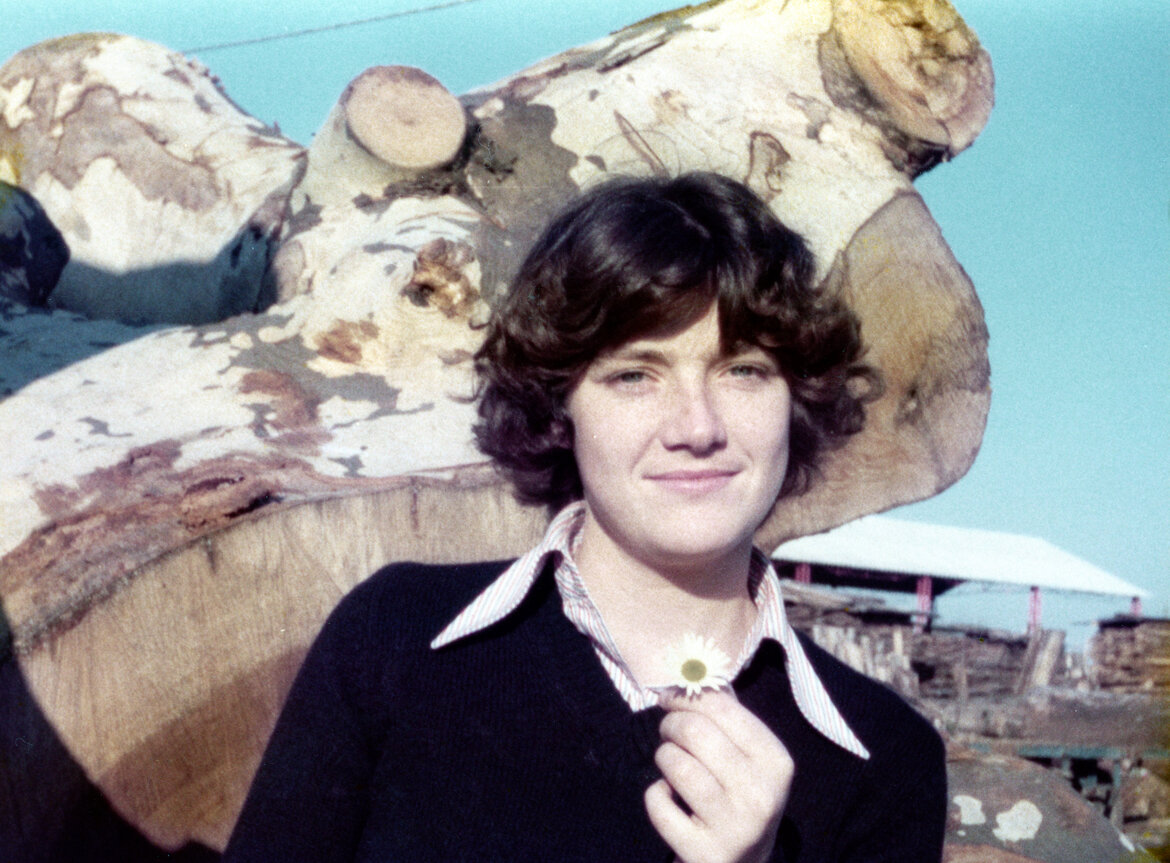
Wanna Zambelli in Volongo (Cremona), her hometown. Photo: © 1972 Zambelli Archive
A meeting with Wanna Zambelli, the first Italian woman to graduate in violin making
by Hélène Desbos
Deuxième Page, Paris
June 1, 2019
In 1972, Wanna Zambelli became the first Italian woman to graduate in violin making, following a traditional skill passed down since the 16th century. A year after graduating, at the fifth biennial national violin making competition in Cremona, she won the gold medal for best violin in the under-30 category. At just 21 years old, Wanna Zambelli received a teaching position at the International School of Violin Making in Cremona, where she taught for forty-four years. She agreed to answer our questions, reflecting on her impressive and resilient career.
First, can you briefly introduce us to the environment in which you grew up?
I was born in Northern Italy, in a small village in the province of Cremona, just like my parents. My father was a farmer and my mother a housewife and seamstress. At the time (the 1960s and 1970s, ed.), in my hometown, after middle school, we went straight to work. This meant ending up in a factory or helping out on the family farm, because we all came from modest farming families. Our entire lives were already mapped out: sons stayed home with their parents to work, and daughters left around age 20 to marry someone local.
Women were therefore treated very differently from men.
Yes. I was always bothered by the fact that, from childhood, girls couldn't do the same things as boys. For example, they couldn't go out to play when the boys left, at any time, for the soccer field. We had to stay home and wait for orders: "You have to set the table! You have to wear a skirt!" But I started wearing pants right away! Luckily, my mother was a seamstress and made them for me. At 18, my dream was to have a driving license, because in my day, few women had them.
Was it your desire for emancipation that drove you to choose violin making?
To be honest, that life wasn't really my dream. Before entering violin making school, I didn't know anything, not even what a violin maker was. But ever since I was a child – I don't know why – I always wanted to do things no one else did. For example, I was the only one in my class who studied. Unlike the others, I wanted to get ahead. I didn't have much choice because my parents' business was too small for me to work there.
How did you discover the existence of violin making school?
I've always been attracted to manual crafts. I think if I hadn't become a violin maker, I would have become a seamstress or a cook, but in Cremona there were no such training courses. I wanted to do something, go to school, but I didn't know where, because I realized I wasn't well enough prepared to continue my studies in high school. My mother asked for advice from a local teacher who taught at the art school in Cremona. He explained that the director of the violin-making school was always looking for students because no one was interested. We went, and there were only three students, including a single girl, a French woman who would graduate at the end of the year. Maestro Pietro Sgarabotto welcomed me joyfully because he was about to lose his only student.
Did you play a musical instrument?
No, not at all, although in my family, my father and my uncle played wind instruments. But at the time, only boys were allowed to make music.
How did you integrate into an all-male school?
When I started, there were six of us. It was the first year, out of a total of four. There were only two of us Italians; the others were foreigners and were over 20. No other girl entered the school during my studies, but I never felt treated worse than the others; probably because I was the best, or at least second, but never inferior. Gradually, the Cremonese school and violin making gained notoriety, and the number of students increased to 10, then 15 in my final year.
Did you like violin making right away?
As soon as I started school, I knew I loved it! I was lucky because Maestro Francesco Bissolotti, who had barely seen me on the first day, was immediately enthusiastic about my work. He said, "As soon as you finish school, come work for me." Going to school was fun for me. When holidays came, I got bored because I had nothing to do at home.
How did your family react to this unusual career choice?
No one knew what violin making was. People looked at me strangely when I talked about it. Lately, I've been thinking about all those years and my poor mother. She must have received a lot of criticism for having a daughter like me. But she never said anything to me, and I didn't care. I liked her and saw nothing wrong with it.
After school, what was your background?
I worked for two or three years in Maestro Francesco Bissolotti's workshop, and then he told me that if I wanted to start my own shop, he would help me sell my instruments. Meanwhile, as the number of students was steadily increasing, the violin-making school hired me. I was 21 years old and stayed there for forty-four years, until I retired. I had to close my workshop in 1993 (it opened in 1975, ed.) because with the school, and with my parents, whom I cared for, it was difficult to manage everything. I continued to make violins as a hobby, living off the school pension.
During your years of teaching, you saw the number of female students increase. Why was it so difficult for women to make violins?
When I was a teacher, there were only two or three women a year. Then, there were more and more. They knew how to do this kind of work, just like men. But society told them, "No, as a woman, you have to do that." So they didn't even understand that they were capable of doing something else. Once they were able to develop these skills a little, they became aware of their potential.
As a woman and a teacher, did you look at your students differently?
I've always done things without ever thinking that men could be better. It was spontaneous, without calculation. I was more attentive to women's follow-up, to encourage them.
Was it important to provide this support to women since it was more difficult for them to imagine becoming true luthiers?
A little, yes. Some seemed to think that, ultimately, their destiny was to get married and therefore give up luthiery. When children are born, things get too complicated. I've had students who returned to work several years after quitting. Those who wanted their own workshop and succeeded are ultimately few. But I also met students who were there because their husbands or boyfriends had come to Cremona to study violin making. At first, they accompanied them so they wouldn't have to stay home doing nothing, but then they discovered violin making. And some were much better than their husbands! I remember a Frenchman who wanted to do this job but wasn't precise enough, while his wife was much more precise. In cases like these, women didn't want to show off their talent.
Shortly after completing your studies, you participated in the biennial national violin making competition in Cremona and won the gold medal for best violin in the under-30 category.
The only time I entered a competition, I won the Sacconi Prize. I was 20 years old. In June, three months before the competition, Maestro Sacconi died, and it was decided to dedicate an award to him. Francesco Bissolotti asked me to participate because I had met Sacconi when he came to work in his studio. Sacconi had also asked me to go and work with him in the United States, but I didn't speak English and didn't want to leave because I didn't like violin restoration. I think I won this award because it was special: the jury thought it was right to honor a former student of the master, and I was under 30, as required by the rules. But it would have been impossible to proclaim a 20-year-old woman the winner if I'd been competing against 40-year-old luthiers.
The path to becoming a violin maker is therefore more complicated for a woman.
Yes. If I chose teaching as my main career path, it was because I didn't have much time. I also had to do the shopping and take care of my parents: all these things prevented me from having a workshop. A woman with a family can't manage everything, or she must be passionate and very resilient because it's extremely difficult. The burden placed on women's status limits our choices. You need phenomenal strength to keep going. It's always the same when you do anything.
Did anyone inspire this desire to move forward despite obstacles?
I think of my mother, who, despite living in a different era, pursued her passion, which was designing clothes. She came from a very patriarchal family, and to escape it, her only escape was to become a seamstress. It was one of the few jobs women could do back then. Every day, she traveled many miles to learn from a seamstress, which allowed her to get out and have a modicum of independence. I remember her flourishing in making clothes, and there were always women coming to the house for fittings. It was truly a blessing. Her environment, especially her husband, my father, was very harsh. Perhaps unconsciously, she inspired me.
N.B.: The original text of the article is in French.
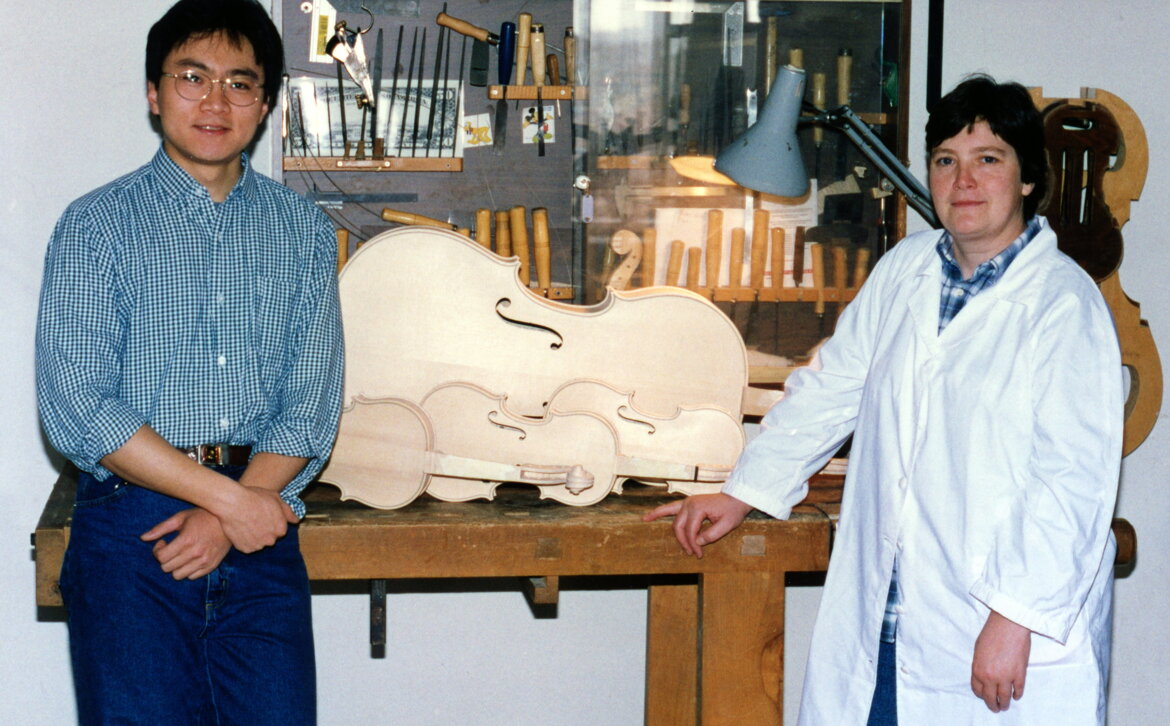
Gao Tong Tong, now director of the School of Violin Making at the Beijing Conservatory, poses with the classical quartet (before varnishing) built in 1995 under the guidance of master luthier Wanna Zambelli. Cremona, International School of Violin Making. Photo: © 1995 Zambelli Archive
Cremona's First Italian Violin Maker
Wanna Zambelli and the Story of an Ancient Craft Whose Tradition Has Been Passed Down for Over Four Centuries
by Barbara Manzini
«Il Globo», Quotidiano Nazionale
Sydney/Melbourne (Australia)
June 23, 2022
Wanna Zambelli was the first violin maker to graduate from what is now known as the Antonio Stradivari Institute of Higher Education, which at the time was the International School of Violin Making in Cremona.
Established by Royal Decree on September 21, 1938, the school was founded immediately after the celebrations for the 200th anniversary of Stradivari's death. Its aim was to create a highly qualified professional training center in the field of stringed instrument making and to maintain the tradition of the Cremonese school in this field.
Young Wanna, not yet 14, after finishing middle school, found herself having to decide which technical or vocational school to enroll in. Living in Volongo, a small town in the province of Cremona, she wasn't sure what to choose.
So, when a professor she knew suggested the violin-making school, always looking for students, the girl, accompanied by her mother, visited the school and enrolled. It was the fortuitous beginning of a great story of dedication and a career full of successes.
The international violin-making school welcomed students from all over the world, but the numbers were very small at the time; not many were interested in building violins, violas, cellos, and double basses.
"As soon as I started, I immediately knew I would love it. I've always enjoyed being able to create, to use my hands to build," Zambelli comments. "The teachers were some of the greatest luthiers, including Maestro Francesco Bissolotti, my mentor, who immediately made me feel at ease. The school lasted four years, and when I arrived, there were only six students in my first year and only one student in each year from 2nd to 4th. In my class, there were three Italians, an Israeli, a Swiss, and an American. This shows that the school was immediately international, despite always being public."
No musical knowledge was required to enroll, and in fact, Zambelli says it was at the school that he first picked up a violin and took music lessons.
"During the first two years, I became familiar with the tools, learning to carve wood; from the third year on, we began to build an instrument," explains the violin maker, who completed her first violin at the age of sixteen.
The construction technique has remained the same since the time of Stradivari, the famous Cremonese violin maker who lived between the second half of the 17th century and the first half of the 18th century. His instruments are sought after by top international musicians and exhibited in the most important museums around the world. Suffice it to say that a few weeks ago, one of his violins, the 'Stradivari Da Vinci-ex Seidel', was auctioned for approximately $20 million.
The instruments are still built entirely by hand by luthiers, starting from a single piece of wood, taking at least 200 hours – for a violin – and gluing together approximately 72 parts. A labor of passion and precision.
"I believe that one of the necessary qualities to be a good violin maker is patience," says Zambelli, who spent long hours bent over her workbench carving, measuring, gluing, and varnishing her instruments.
Once she graduated, Zambelli was invited by Maestro Bissolotti to work in his workshop, and a year later, in 1973, at the 5th National Biennial of Stringed Instruments, she was awarded the gold medal and plaque of the "Simone Fernando Sacconi Prize" for "best violin maker under 30." Sacconi, an internationally renowned violin maker, a Roman and Cremonese by adoption who had moved to the United States, was named the Simone Fernando Sacconi.
During those years, thanks in part to Sacconi's influence, the art of violin making in Cremona began to revive the ancient glories of the Stradivari era, with workshops multiplying, as did the number of students interested in attending the School of Violin Making, where Zambelli was invited to teach. Here, she spent 44 years passing on her passion and expertise to the students and, once again, being the first female teacher.
"I really enjoy making instruments and creating, but teaching children gave me great satisfaction. It was wonderful to interact with students from all over the world; I even had an Australian student. The classes were small, and those attending often had very different ages, because they enrolled from abroad even after finishing high school or university; once I remember having a retired student."
The instruments are still built using the same workmanship and techniques as four centuries ago, so each piece remains unique, as does the sound it produces. Two different types of wood are used for the violin, depending on the desired part: Balkan maple is used for the back, sides, and neck, because it is a hardwood and for its aesthetic qualities. Dolomite spruce, also known as "resonance fir," is used for the top – the upper part of the case.
One of the most important moments in Wanna Zambelli's long career was when Rocco Filippini, a famous cellist, asked her to make an instrument for him. It must not have been easy to build a cello for a musician who played a 1710 Stradivarius, but Zambelli recalls: "I told him I wouldn't try to make a copy of his Stradivarius, but rather I would make an instrument in my own style, and in the end, he was very happy."
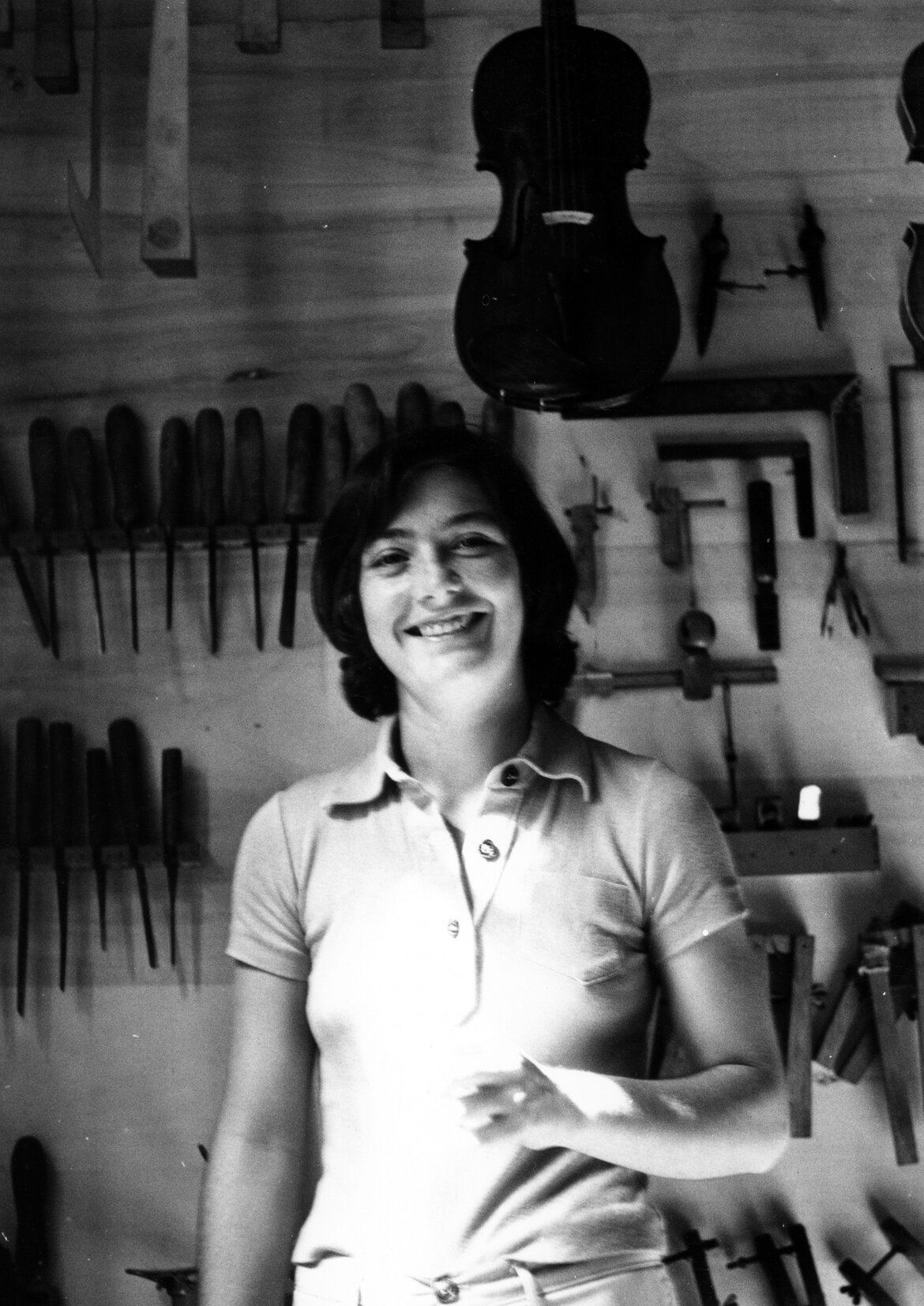
Wanna Zambelli. Photo: © 1974 Ezio Scarpini, Cremona
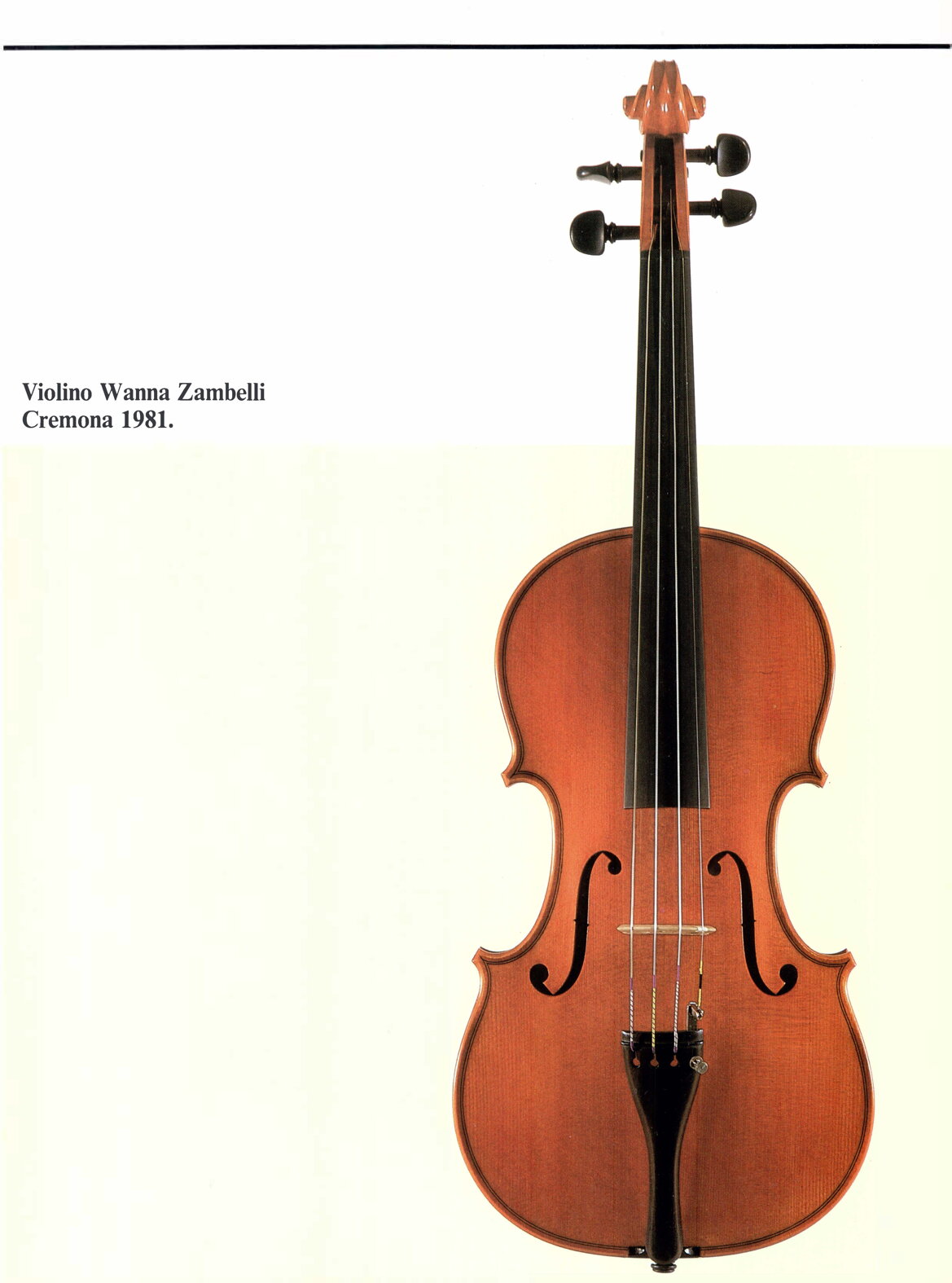
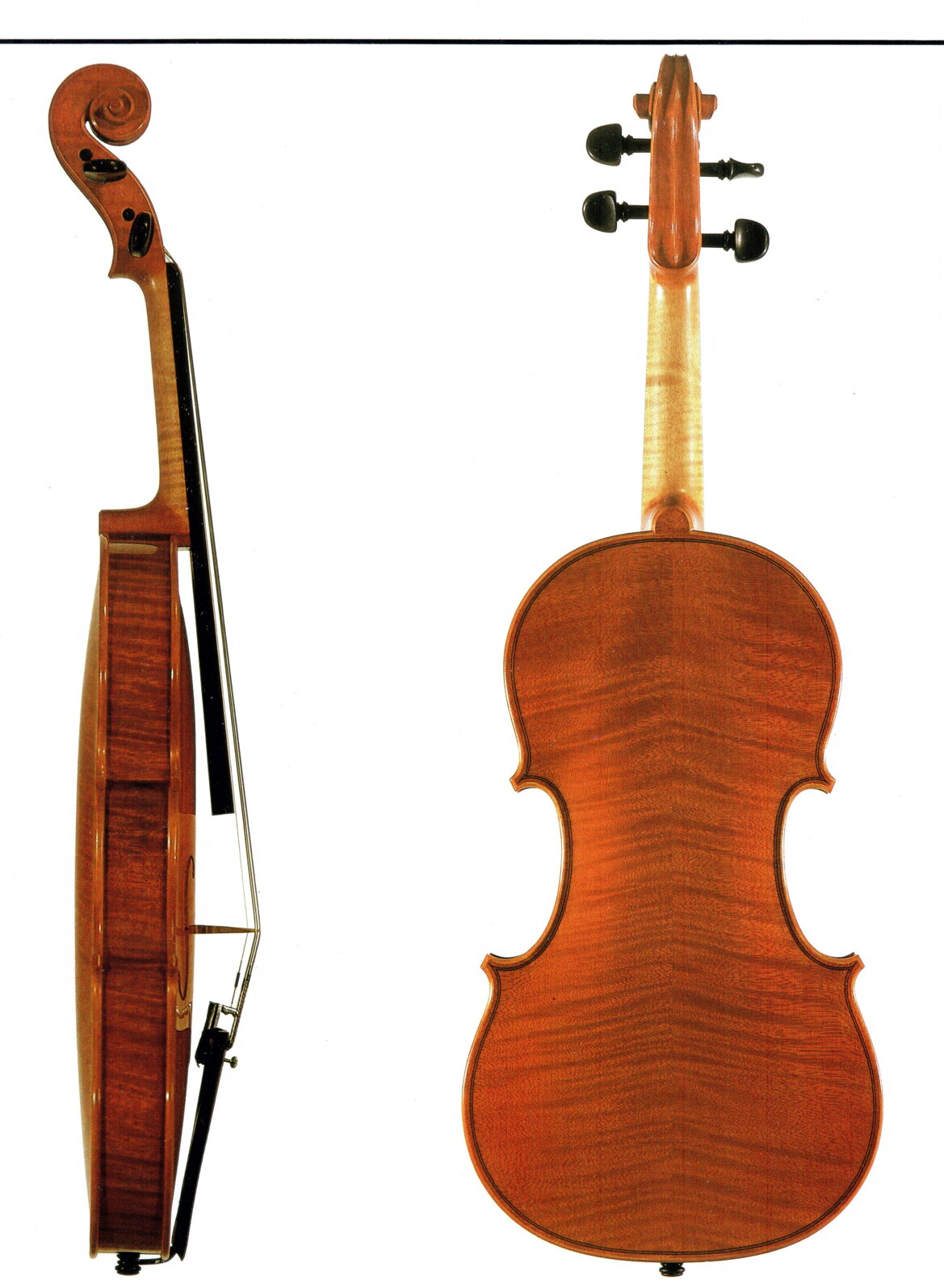
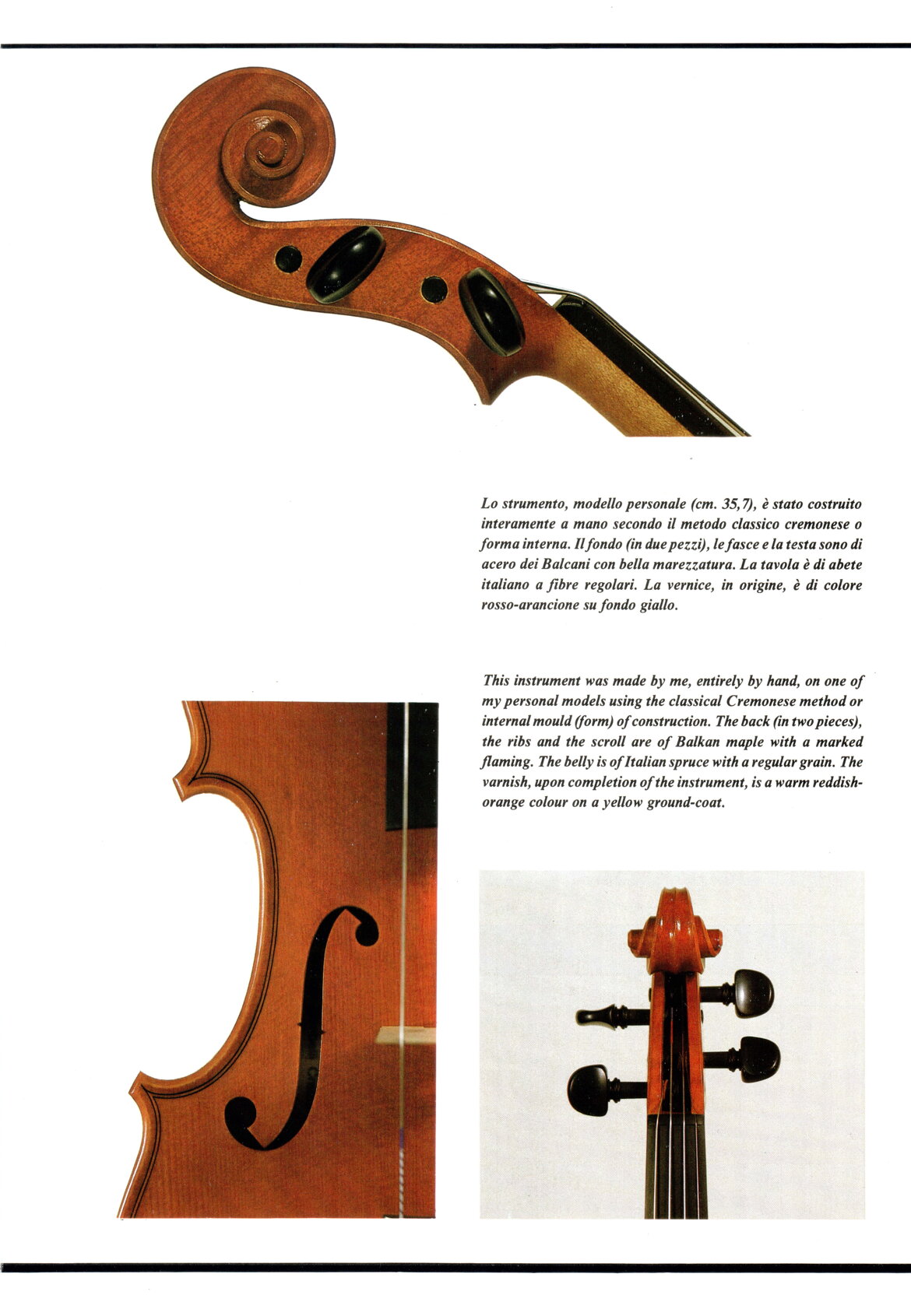
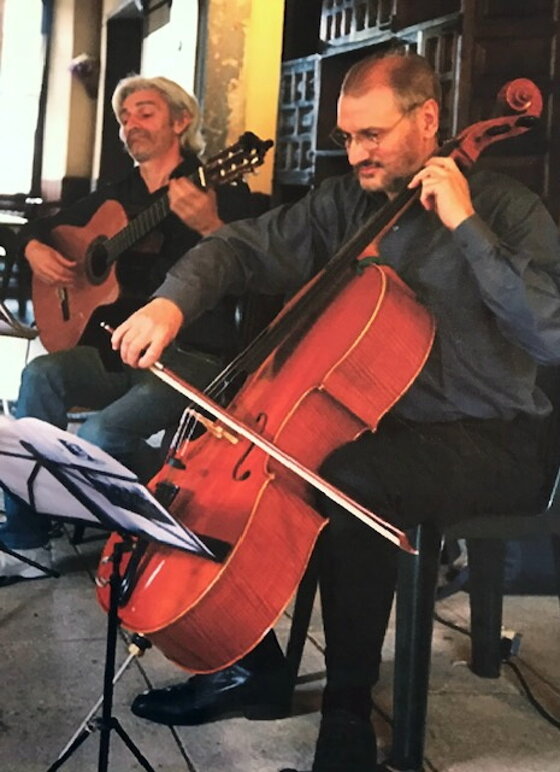
Ermanno Gallini with the Wanna Zambelli cello, 1982
Cellist Ermanno Gallini in concert with the Antonio Stradivari "Piatti" cello, model 1720, built for him entirely by hand according to the classical Cremonese method by master luthier Wanna Zambelliin 1982.
The back is a single piece of radially cut Balkan maple, with a beautiful deep curl that slopes from left to right.
The ribs and scroll are made of maple similar to the back. The belly, made of Italian spruce, has a medium grain.
The original varnish is red-orange on a yellow background. Upon inspection, the instrument's tone was found to be of excellent quality.
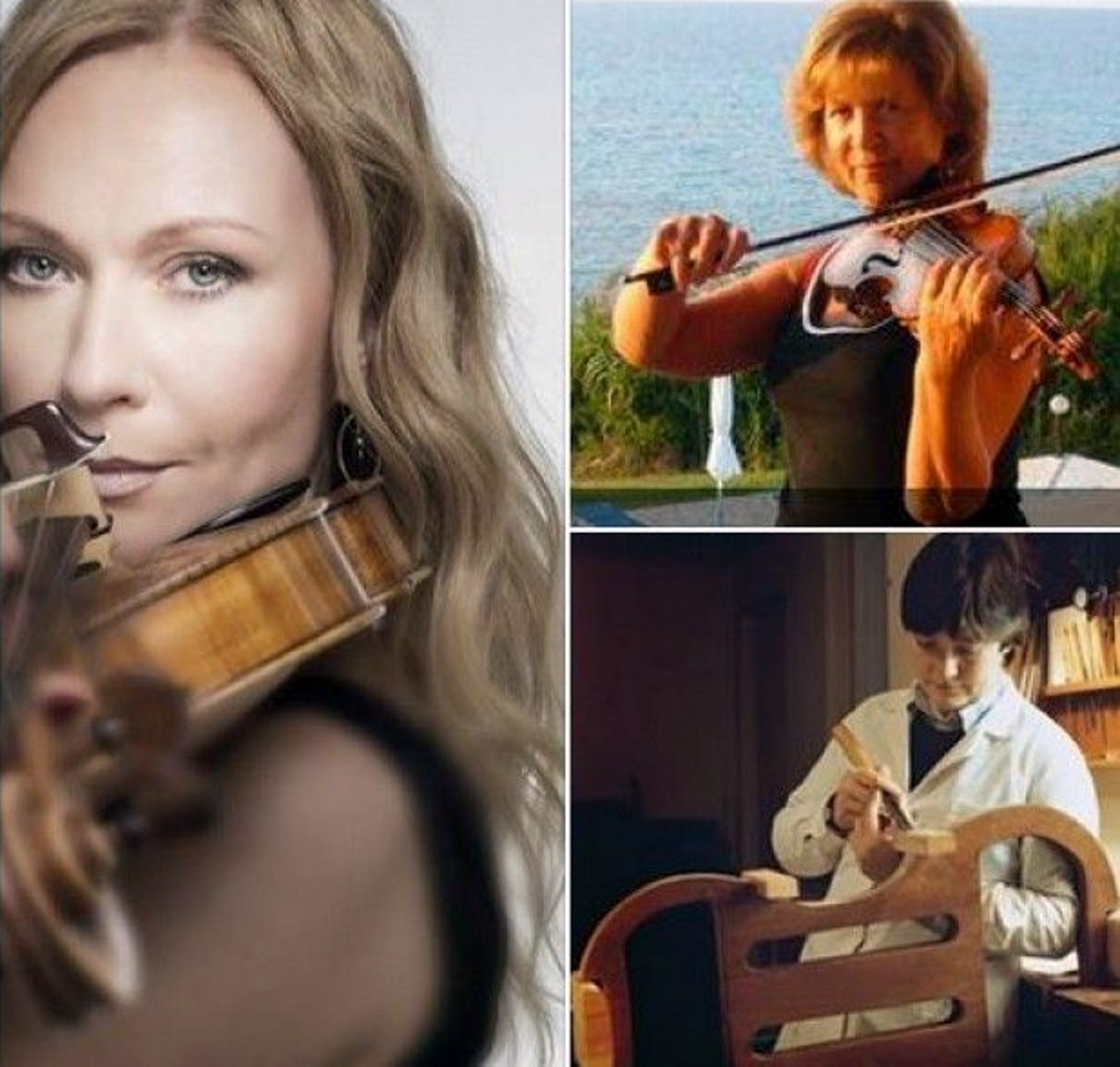
The ANLAI (National Association of Italian Artistic Violin Making) awarded the 2015 ANLAI Prizes, presented on May 9th in the Salone dei Quadri of the City of Cremona, to four highly significant female figures. In addition to renowned violist Anna Serova (pictured left), honorary president of the 9th ANLAI National Violin Making Competition for stringed instruments, the recipients were violinist Fiorella Foti (top right), founder, with Maestro Giuliano Carmignola, of the "Camerata Strumentale Veneta" Orchestra, and Maestro Wanna Zambelli (bottom right), the "doyenne" of Cremonese violin makers, the first Italian woman to graduate in violin making, a teacher at the Cremona School of Violin Making since 1974 and a former student of master luthiers Pietro Sgarabotto, Francesco Bissolotti, and Simone Fernando Sacconi. The 2015 Anlai Prize was also awarded to cellist Silvia Chiesa (pictured below), who has won over audiences and critics alike thanks to a brilliant solo career that places her among the most highly regarded Italian performers in the world.
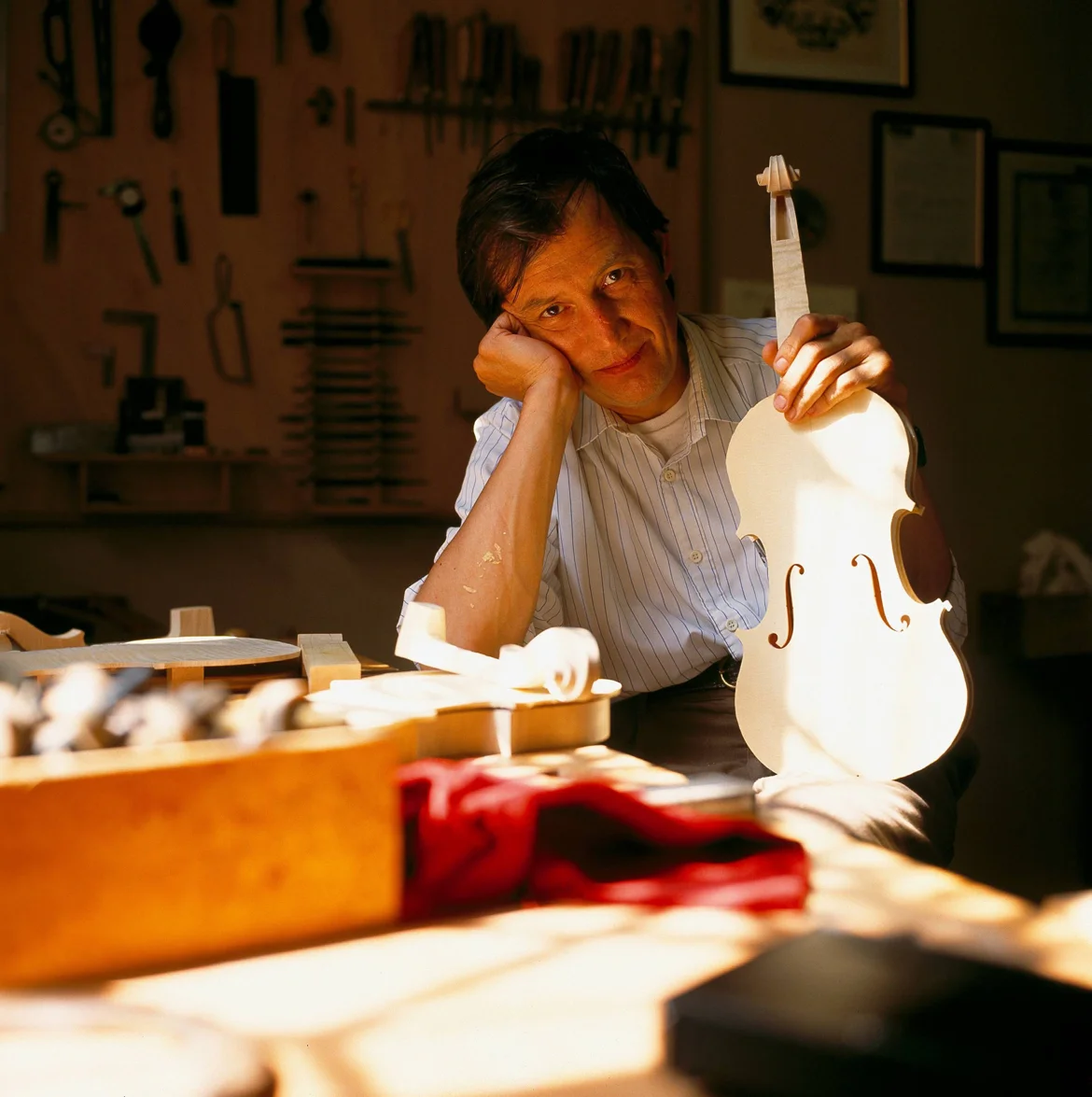
Pictured: Alexander Krylov. Born in Eisenach, Germany, in 1948, he graduated in violin from the Moscow Academy of Music. In 1973, he earned a diploma in violin making from the International School of Violin Making in Cremona (a year after Wanna Zambelli), having studied under Pietro Sgarabotto, Francesco Bissolotti, and GioBatta Morassi.
A friend of Wanna, he and her went fishing on the banks of the Oglio River, near Volongo (Cremona), Zambelli's hometown.
A winner of numerous competitions, he served on juries at violin-making competitions in the USSR, Czechoslovakia, and, in 1985, in Cremona. Until 1982, he was president of the Council of Violin Makers of the USSR Ministry of Culture. He collaborated on the catalog of the exhibition in Cremona: Stradivari and Cremonese Violin Makers in the USSR (1988). He trained about fifteen students in Russia.
In 1985, he moved permanently to Cremona, where he died in 1999.
His son, Sergei Krylov, is now an acclaimed violinist and internationally renowned conductor.
Conclusion: The Enduring Legacy of Wanna Zambelli
In conclusion, maestro Wanna Zambelli represents a multifaceted and pivotal figure in the history of Cremonese violin making. Her journey, which began with her groundbreaking graduation from the International School of Violin Making as the first Italian woman, continued with a long and influential teaching career, a deep commitment to preserving the classical method, and a significant contribution to documenting the legacy of Simone Fernando Sacconi.
Her authoritative voice is also heard in reflections on the contemporary challenges of Cremonese violin making, with proposals aimed at protecting the quality and authenticity of this centuries-old tradition. Wanna Zambelli is not only a witness, but an active protagonist in the ongoing narrative of Cremona's rich violin-making tradition, combining masterful craftsmanship with a passion for transmitting knowledge and a vision for the future of this art.
Her voice, rising in defense of the quality and authenticity of Cremonese violin making, underscores her deep connection to the region and her concern for the future of this art. Wanna Zambelli leaves a lasting legacy, not only as a skilled artisan but also as a figure who has broken barriers and inspired new generations, helping to keep the tradition of classical Cremonese violin making alive. She therefore represents a benchmark in contemporary violin making, combining fidelity to tradition with an artistic sensibility and dedication that have made her one of the most esteemed artisans in her field.
Her instruments are produced in a very limited but absolutely exclusive manner, driven by a constant pursuit of perfection. Is there a formula capable of explaining and reproducing the way of being a woman and an artisan that places Wanna Zambelli at the pinnacle of world violin making? If so, she describes it herself: the daughter of artisans, she was raised to model the creativity, professionalism, and responsibility of self-employment. Having come to violin making almost by chance, certainly not by choice, she has passed on her experience, her love of craftsmanship, and her personality to her instruments and her many students. And this allowed her to become – and remain for years – one of the rare women among the esteemed masters of her art.
Through her instruments, her teaching, and her defense of the classical Cremonese method, Zambelli continues to exert a profound influence on the art of violin making, cementing Cremona's unparalleled position as the heart of violin making worldwide.
The figure of Wanna Zambelli offers profound food for thought. Her reserved nature and her decision to abstain from competitions after a youthful victory contrast with the significant public honors she received and the veneration of her students. This apparent contradiction reveals that, in the Cremonese world, authority and prestige are not built on self-promotion, but on the quiet and consistent excellence of one's work and the generosity of her teaching. Her influence is profound precisely because it is based on substance.
In short, Wanna Zambelli not only embodies artisanal excellence and the transmission of knowledge, but is a living witness to the rebirth of Cremonese violin making, the guardian of a knowledge and expertise that has been recognized by UNESCO as an intangible heritage of humanity since 2012.